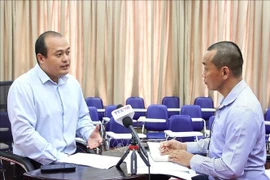
Sydney (VNA) - Emeritus Professor Carl Thayer, from the Australian Defence Force Academy at the University of New South Wales, has pointed out Vietnam's four important contributions to the Association of Southeast Asian Nations (ASEAN) over the past 30 years since the country official joined the bloc on July 28, 1995.
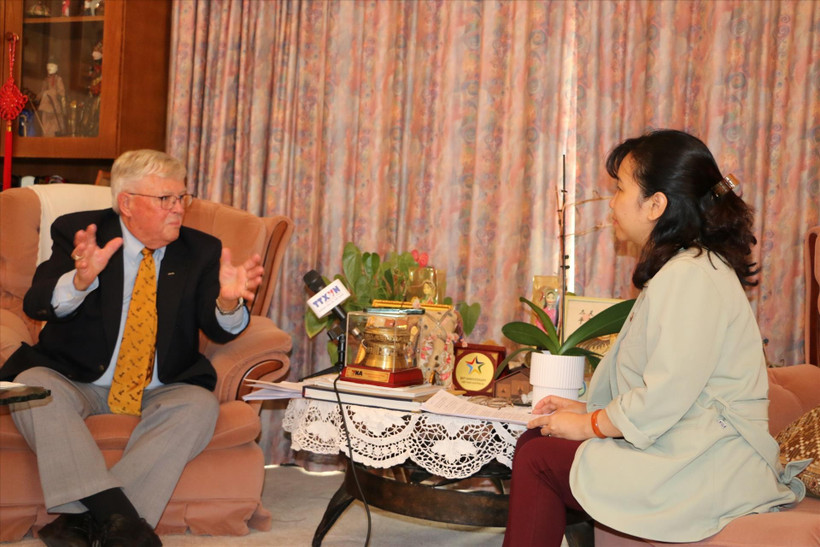
Speaking to the Vietnam News Agency (VNA)'s resident correspondents in Australia on the occasion of the 30th anniversary of Vietnam’s admission to ASEAN (July 28, 1995 – 2025), Thayer said that the first contribution is that Vietnam promoted the admission of Cambodia, Laos and Myanmar (CLM), thus meeting the original ASEAN goal of including all countries in Southeast Asia. Vietnam became a firm advocate of narrowing the development gap between the new CLMV members and ASEAN’s original members.
Second, when Vietnam assumed the role of ASEAN Chair for the first time at the 6th ASEAN Summit in 1998, it secured the endorsement of a six-year Hanoi Plan of Action to implement ASEAN Vision 2020.
Third, when Vietnam served as ASEAN Chair for the second time in 2010, it successfully expanded membership on the East Asia Summit (EAS) to include the US and the Russian Federation and hosted the first meeting of the ASEAN Defence Ministers’ Meeting Plus.
Fourth, as ASEAN Chair for the third time in 2020, Vietnam made an outstanding contribution to ASEAN’s development during the COVID-19 pandemic. Vietnam pioneered virtual meetings of ASEASN officials and Vietnam was proactive in lobbying the major powers for access to COVID vaccines.
Thayer said upon joining ASEAN, Vietnam became a member of the ASEAN Free Trade Area (AFTA) and Vietnam gained considerable experience in multilateral economic cooperation as ASEAN negotiated free trade agreements with Australia-New Zealand, China, India, Japan, the Republic of Korea (RoK), and Hong Kong. Vietnam also participated in ASEAN’s three-pillar community-building programme – Economic Community, Political-Security Community and Socio-Cultural Community. In sum, Vietnam learned and adopted best practices in multilateral economic cooperation.
However, he noted, Vietnam has to play a more proactive role to safeguard multilateralism and a rules-based global trading system as a member of ASEAN. Vietnam must give greater attention to reducing barriers to trade, creating resilient supply chains and developing new markets with members of the Regional Comprehensive Economic Partnership and the Comprehensive and Progressive Trans-Pacific Partnership. In other words, Vietnam must promote “extended multilateralism.”
For the ASEAN side, Thayer said that the bloc must double down to the ASEAN Outlook on the Indo-Pacific by enhancing its comprehensive strategic partnerships with Australia, China, India, Japan, the RoK and the US. ASEAN must convince each of its partners that they have more to gain by working with ASEAN rather than acting unilaterally.
He said that three areas should be given priority attention, including creating a stable tariff regime, reviving the East Asia Forum as a leaders’ led mechanism, and negotiating an effective Code of Conduct (COC) in the East Sea.
Vietnam can contribute by leveraging more than 30 comprehensive, strategic and comprehensive strategic partnerships to support ASEAN's centrality and the ASEAN Outlook on the Indo-Pacific.
Look to the future, Thayer said that if Vietnam succeeds in its current programme of streamlining the party-state political system, it will take a proactive role in ASEAN to achieve three key objectives as suggested by Prime Minister Pham Minh Chinh at the BRICS Summit earlier this month, including reinforcing multilateralism, improve connectivity and global governance; promoting trade liberalisation by opening market access, supply chain connectivity, technology transfer and human resource training; and harnessing safe and secure Artificial Intelligence to improve public health, education, digital infrastructure, green transition, and climate change adaptation.
As ASEAN Chair in 2029, Vietnam can use its experience in transforming Vietnam into a developing country with a modern industry and high-middle income level by 2030 to spark ASEAN’s growth and development.
Thayer noted that becoming ASEAN Chair in 2029 will provide the synergy for Vietnam to achieve the longer term goal of becoming a developed country with high income by 2045./.