Vietnam may surpass Thailand in rice export

Vietnam may surpass Thailand in rice export this year thanks to its competitive price and the removal of rice export quota, experts have said.
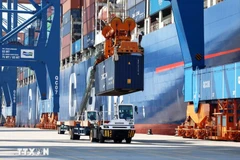
Vietnam may surpass Thailand in rice export ảnh 1Illustrative image (Photo: VNA)

Hanoi (VNA)
– Vietnam may surpass Thailand in rice exportthis year thanks to its competitive price and the removal of rice export quota,experts have said.

Statistics of the Thai Rice Exporters Association show thatThailand exported 2.57 million tonnes of rice worth 54.2 billion THB (1.71billion USD) in the first five months of this year, down 31.9 percent on volumeand 13.2 percent in value year-on-year.

Meanwhile, Vietnam shipped nearly 2.9 million tonnes of rice for1.41 billion USD in the reviewed period, up 5.1 percent in volume and 18.9percent in value, according to the Vietnam Chamber of Commerce and Industry(VCCI).

The Thai association said the country’s rice export volume thisyear is expected to stand at only 6.5 million tonnes, the lowest in the decadeand falling behind the target of 7.5 million tonnes.

The contraction is due to decreasing global demand under theimpact of the COVID-19 pandemic, a strong baht – Thailand’s currency, and loweroutput due to the prolonged drought.

Thailand currently ranks third in rice export, after India andVietnam. Its major rice buyers include the US, South Africa, Angola, China andJapan.

Experts forecast that Thailand is likely to fall from the third tothe fifth place in the list of global riceexporters in the next decade unless the country adopts long-termpolicies to increase the competitiveness of the staple.

Vietnam has succeeded in selling rice at cheaperprices than Thailand, and it has recently won contracts to export the commodityto key markets like China, Hong Kong, the Philippines, and Malaysia, the VCCIsaid.

In addition, the EU-Vietnam Free Trade Agreementis expected to help Vietnam diversify its rice markets.

Notably, apart from allocating a quota of20,000 tonnes of rice to all members of the World Trade Organisation(WTO) this year, the Republic of Korea had given a quota of 55,112tonnes of rice for Vietnam.

Those advantageous factors helped Vietnam surpassThailand to secure its second place just behind India. The country is expectedto sell 6.7 million tonnes of rice abroad this year, the VCCI said./.
VNA

See more

Toy production at a Hong Kong-invested factory (Photo: VNA)

Vietnam targets deeper market penetration in Hong Kong in 2026

Vietnam-Hong Kong trade hit 62.3 billion USD in the first 11 months of 2025, soaring 73.1% annually. Vietnamese exports to Hong Kong amounted to 36.8 billion USD, a 90.6% hike, ranking fourth among Hong Kong’s import sources, while imports from Hong Kong stood at 25.5 billion USD, up 52.9% and ranking third.

Vietnam’s start-up market enters restructuring phase

Vietnam’s start-up market enters restructuring phase

In 2026, venture capital inflows into Vietnam’s start-up ecosystem are expected to recover gradually, though in a more selective manner. VinVentures forecasts that capital will focus on start-ups that have survived the rigorous screening of 2024–2025, possess clear business models, strong commercialisation capacity, and the ability to generate real cash flows.

Workers process tra (pangasius) for export (Photo: VNA)

Vietnam–Singapore trade continues to thrive

For the year as a whole, Vietnam retained its position as Singapore’s 10th largest trading partner. Bilateral trade reached a record high of nearly 40 billion SGD, up 26.2% from the previous peak of 31.67 billion SGD recorded in 2024.

Eric Van Vaerenbergh, an energy expert and lecturer at the Brussels Engineering School (ECAM) (Photo: VNA)

Belgian expert optimistic about Vietnam’s economic outlook

Vietnam should move from a growth model based mainly on expanding capital and labour to one driven by productivity improvements. He said that this requires enhancing the quality of the workforce, particularly engineers, technicians, and managers in industrial sectors.

Workers at the VSIP Hai Phong industrial and urban complex, which specialises in producing electronic components for office equipment. (Photo: VNA)

Roadmap aims to improve business climate and boost competitiveness

By the end of 2026, Vietnam aims to rank among the world’s top 50 performers in the United Nations Sustainable Development Goals, advance at least three places in the International Property Rights Index, and climb at least one position in the Global Innovation Index.

Vietnam is strengthening its position in the technology value chain, becoming a major manufacturing hub for complete consumer electronics products. (Photo: VNA)

ESG standards offer opportunities to reposition Vietnam’s electronics firms

The 2025-2027 period will be a critical turning point, as exporters to the European market will be required to strictly comply with ESG standards, including net-zero emissions roadmaps, labour standards, corporate governance and transparency requirements. As a key export sector, the electronics industry is being directly and strongly affected by this shift.

A production line for camera modules and electronic components at the factory of MCNEX VINA Co. Ltd, a Republic of Korean-invested company in Phuc Son Industrial Park, Ninh Binh province. (Photo: VNA)

Science, technology, innovation as engines of economic growth

To ensure that science and technology truly act as a powerful growth engine, experts emphasised the need for the Government to put in place supportive mechanisms and policies that encourage enterprises to invest in research and development, while strengthening cooperation among the State, research institutions and the business sector.