Vietnam poised for new phase of rapid growth: Chinese scholars

The achievements of the past 80 years provide Vietnam with both the material foundation and spiritual strength to advance confidently under the leadership of the CPV and Party General Secretary To Lam.

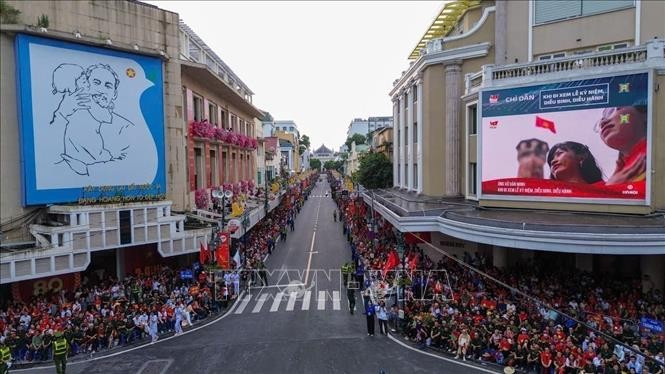
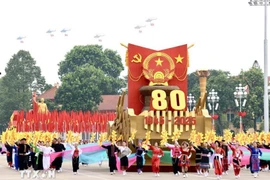
People gather at the Trang Tien intersection in Hanoi to watch the National Day parade rehearsal on August 30. (Photo: VNA)

Beijing (VNA) – Over the past eight decades, under the leadership of the Communist Party of Vietnam (CPV), Vietnam has steadfastly pursued the socialist path, achieving remarkable economic and social progress through reform and opening-up. It is now poised for a new phase of rapid growth, Chinese scholars said.

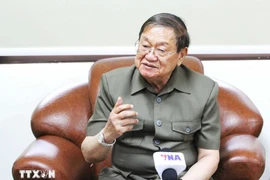
According to Professor Pan Jin’e, a Vietnam studies expert at the Academy of Marxism under the Chinese Academy of Social Sciences, Vietnam’s success demonstrates the viability of combining socialism with a market economy.
hoc-gia.jpg
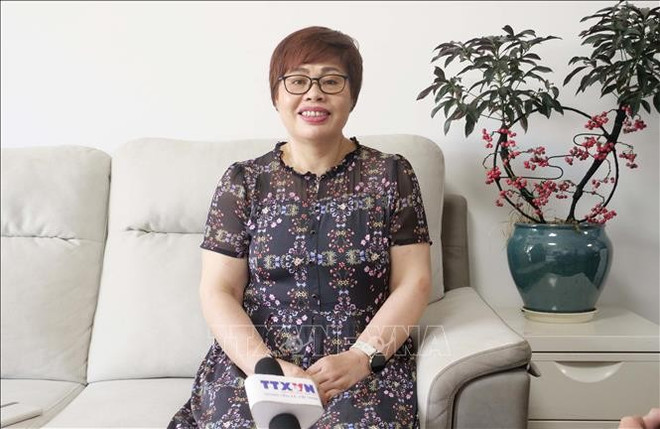
Professor Pan Jin’e, an expert in Vietnamese studies at the Academy of Marxism under the Chinese Academy of Social Sciences. (Photo: VNA)

Since initiating the Doi Moi (Renewal) process in 1986, Vietnam has gradually built a socialist-oriented market economy, moving from central planning to an open economic model.

In 2024, Vietnam’s gross domestic product (GDP) reached 476.3 billion USD, with per capita income exceeding 4,700 USD and labour productivity rising to 9,182 USD per worker. The country has also made strong progress in poverty reduction. Thanks to the National Target Programme for Sustainable Poverty Reduction, multidimensional poverty has fallen to 1.93%. The World Bank has recognised Vietnam as a “model of poverty reduction among developing countries.”

Green growth and sustainable development are also high on the agenda, with Vietnam pledging to achieve net-zero emissions by 2050.
Former head of the Department of Western Europe at the International Liaison Department of the Communist Party of China Central Committee Zhang Jianguo noted that the 1986 renewal was a turning point in Vietnam’s development. Vietnam broke free from the rigidities of central planning, embraced the market economy, maintained socialist orientation, and actively integrated internationally. As a result, the country's GDP grew from 24.66 billion USD in 1996 to 408.8 billion USD in 2022, with average annual growth of around 6%, making Vietnam one of Southeast Asia’s key growth engines.

Vietnam’s trade has expanded dramatically. In 2022, Vietnam’s total import-export turnover hit 732.5 billion USD, underlining the country’s deep integration into global markets. Living standards have improved sharply, with poverty falling from over 50% in the early reform years to single digits, alongside stronger education and health systems and a higher life expectancy.

Researcher Weiwei highlighted Vietnam’s sweeping institutional reforms in recent years, including streamlining state agencies, restructuring state-owned enterprises, and accelerating digital transformation to improve governance.

Chinese researcher Weiwei (Photo: VNA)

Chinese researcher Weiwei (Photo: VNA)

Vietnam’s active international engagement, particularly through agreements such as the Comprehensive and Progressive Agreement for Trans-Pacific Partnership (CPTPP), has boosted trade. In 2024, trade with CPTPP partners exceeded 102 billion USD, accounting for over 13% of Vietnam’s total trade.

Regarding attracting foreign investment, Vietnam has proactively outlined plans to develop high-tech fields such as semiconductors. Global technology leaders such as Samsung and Intel have expanded operations in Vietnam, fueling the development of a semiconductor ecosystem.

Looking ahead, Vietnam’s growth prospects remain strong, said Pan. In the first half of 2025, its GDP expanded by 7.52%, the highest first-half rate since 2011. she believed that Vietnam is entering a new phase of rapid growth.

Vietnam has set its sights on becoming a developed, high-income nation by 2045. To this end, the Politburo has issued four strategic resolutions described by Party General Secretary To Lam as the “four pillars for national takeoff.” These include breakthroughs in science, technology, innovation and digital transformation (Resolution 57); international integration (Resolution 59); legal and judicial reform (Resolution 66); and private-sector development (Resolution 68).

A historic administrative reform has been conducted. Following restructuring, Vietnam now has 34 provinces and centrally-run cities, down from 63, and 3,321 commune-level units, down from more than 10,000. The district-level administration was abolished nationwide. These changes aim to streamline governance, strengthen accountability, and improve services for citizens and businesses.

At the same time, Vietnam continues to wage a strong anti-corruption campaign, reinforcing political integrity and stability as a foundation for development.

“Vietnam is likely to sustain growth at rates well above the regional average,” said researcher Weiwei. “It is on track to become an upper-middle-income country by 2030 and a high-income developed nation by 2045.”

Professor Pan Jin’e added that the achievements of the past 80 years provide Vietnam with both the material foundation and spiritual strength to advance confidently under the leadership of the CPV and Party General Secretary To Lam. This, she said, will help realise President Ho Chi Minh’s vision of Vietnam standing shoulder to shoulder with the great powers of the world./.
VNA

See more

Prime Minister Pham Minh Chinh addresses the third National Forum on Digital Economy and Digital Society in Hanoi on December 20. (Photo: VNA)

Digital economy as driver, digital society as foundation of growth: PM

The forum, themed “Developing an inclusive and comprehensive digital economy and digital society to achieve double-digit GDP growth in the 2026–2030 period,” brought together leaders of ministries and localities, technology enterprises, research institutions, experts and representatives of international organisations in Vietnam.

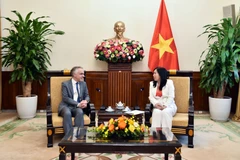
Deputy Minister of Foreign Affairs Le Thi Thu Hang (R) and Benoit Guidée, Director of the Asia–Oceania Department at the French Ministry for Europe and Foreign Affairs meet in Hanooi on December 19. (Photo: VNA)

Deputy FM meets French official

Deputy Minister of Foreign Affairs Le Thi Thu Hang stressed that Vietnam attaches great importance to its relationship with France, the first European Union country with which Vietnam has established a Comprehensive Strategic Partnership, noting that the two sides enjoy a solid foundation and significant potential for further cooperation.

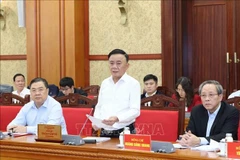
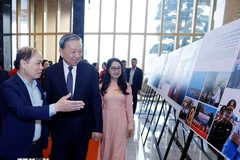
Politburo member and permanent member of the Party Central Committee’s Secretariat Tran Cam Tu speaks at the event in Hanoi on December 19 (Photo: VNA)

Senior Party official reviews preparations for 14th National Party Congress

Politburo member and permanent member of the Party Central Committee’s Secretariat Tran Cam Tu expressed his belief that relevant agencies will continue to make efforts to basically complete organisation- and service-related preparations by December 31, ensuring readiness for the final rehearsals ahead of the opening of the 14th National Party Congress.

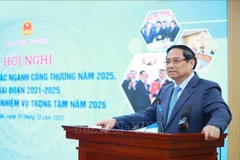
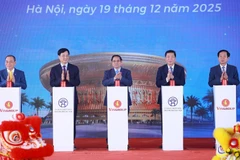
Prime Minister Pham Minh Chinh addressing the conference of the the Ministry of Industry and Trade on December 19 (Photo: VNA)

PM urges industry, trade sector to pioneer in six key areas

Prime Minister Pham Minh Chinh stressed that to make a substantive contribution to national development, the industry and trade sector must also achieve double-digit growth, generate new jobs, strengthen traditional growth drivers such as export and consumption, and accelerate emerging engines of growth, including the green, digital, circular, knowledge-based and sharing economies.

State President Luong Cuong (middle) presents congratulatory flowers to the two promoted officers (Photo: VNA)

Two military officers promoted to rank of Senior Lieutenant General

Lieutenant General Do Xuan Tung, Vice Director of the General Department of Politics of the Vietnam People’s Army (VPA), and Lieutenant General Do Van Banh, Political Commissar of the National Defence Academy were promoted to the rank of Senior Lieutenant General at a ceremony in Hanoi on December 19.

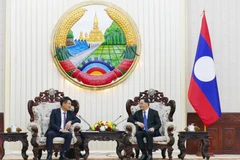
Lao Prime Minister Sonexay Siphandone (R) hosts a reception for Prosecutor General of the Supreme People’s Procuracy of Vietnam Nguyen Huy Tien. (Photo: VNA)

Vietnam–Laos step up cooperation in procuracy sector

They highly valued the effective and substantive cooperation results achieved by the Supreme People’s Procuracies of Vietnam and Laos in recent years, and called on both sides to continue enhancing coordination, stepping up exchanges of delegations at all levels, sharing professional and technical experience, and maintaining and expanding training and capacity-building programmes for officials.

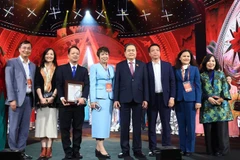
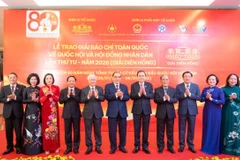
NA Chairman Tran Thanh Man and other leaders, former leaders at the 4th Dien Hong Awards honouring journalistic works on the NA and People’s Councils in Hanoi on December 18, 2025. (Photo: daibieunhandan.vn)

NA Chairman urges journalists to reflect legislature's strategic vision

The NA leader expressed his confidence that in 2026, journalists will continue to uphold their responsibility, report objectively and from multiple perspectives, accompany the NA in conveying its activities promptly and comprehensively, and identify shortcomings in law-making and legal enforcement to help people-elected agencies operate more effectively and efficiently.

Prime Minister Pham Minh Chinh (R) receives Lao Minister of Foreign Affairs Thongsavanh Phomvihane in Hanoi on December 18, 2025. (Photo: VNA)

Prime Minister calls for stronger Vietnam–Laos economic connectivity

Receiving Lao Minister of Foreign Affairs Thongsavanh Phomvihane in Hanoi on December 18, Prime Minister Pham Minh Chinh proposed that the two sides further strengthen economic connectivity, coordinate closely and share development experience for the tangible benefit of the two peoples.