Vietnam ranks among top performers in WB’s Business Ready 2025 report

The Southeast Asian nation secured its position in the first quintile – representing the top 20% globally – in the operational efficiency pillar, which measures how easily businesses can comply with regulations and use public services.

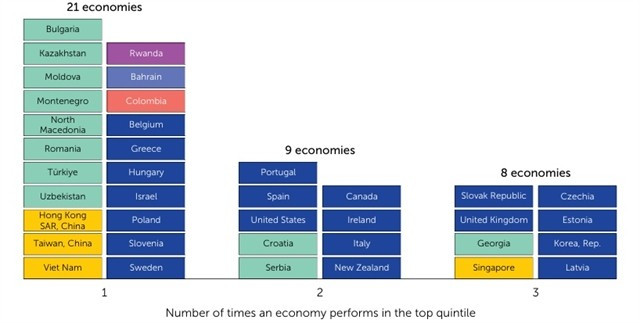
Vietnam is listed among the 21 economies that have performed in the top quintile at least once. (Photo: B-Ready 2025)

Hanoi (VNS/VNA) – Vietnam achieved a top-tier global ranking in operational efficiency, placing 16th among 101 economies with a score of 70.44 points in the World Bank's Business Ready 2025 report released on December 30, though challenges remain in other assessment areas.

The Southeast Asian nation secured its position in the first quintile – representing the top 20% globally – in the operational efficiency pillar, which measures how easily businesses can comply with regulations and use public services.

Vietnam joined 29 economies achieving top-quintile performance in one to three business areas.

According to the report, the country demonstrated exceptional strength in several areas, particularly utility services, where it scored 90.03 points – among the highest globally – and financial services at 80.32 points. Vietnam also performed well in business entry (76.62), labour (69.63), and international trade (62.48).

However, the nation scored in the third quintile for both regulatory framework (67.03 points) and public services (53.93 points), indicating substantial room for improvement in these areas.

Significant weaknesses emerged in business insolvency, where Vietnam scored only 35.66 points, and market competition at 47.61 points. These scores reveal critical gaps requiring targeted reforms to strengthen the business environment.

Globally, consistent strong performance remains rare. Only eight economies – including Singapore and Georgia as well as the UK and five other European nations – achieved top-quintile rankings across all three pillars. Singapore led the world in operational efficiency with 79.25 points, while OECD high-income economies demonstrated the most consistent excellence across assessment areas.

Within Southeast Asia, performance varies significantly. Singapore ranked first globally and Malaysia placed in the second quintile with 67.99 points in operational efficiency, while Cambodia scored 56.17 points in the third quintile. The region demonstrates both high performers and economies requiring substantial reforms.

The World Bank noted that economies with a young workforce, including Vietnam, generally score lower across all assessment pillars compared to those with mature populations. The report emphasised that such economies face particular challenges in creating business environments conducive to job creation for expanding working-age populations.

The B-Ready assessment, which replaces the previous Doing Business report, evaluates economies across three pillars: regulatory framework, public services and operational efficiency. These pillars encompass 10 topics covering the complete business life cycle from establishment through operation to closure or reorganisation.

Data collection involved 5,000 local experts and surveys of 58,000 firms across participating economies. The methodology balances analysis of formal regulations with actual business practices to provide comprehensive assessments.

The project will expand from 101 economies in 2025 to more than 160 by 2026, with assessed economies currently averaging 60% business readiness globally./.

VNA
See more

Illustrative image (Photo: VNA)

Australia announces import conditions for Vietnamese pomelos

Australia’s formal publication provides an important legal basis, marking the completion of the review, assessment and agreement on technical requirements for fresh Vietnamese pomelos. This represents a significant step forward in market access, creating favourable conditions for relevant agencies, localities and businesses to prepare for export activities in the coming time.

Containers of fresh Vietnamese durian for export are subject to a full-chain traceability system. (Photo: VNA)

First “green lane” durian shipment exported to China

​Under the “green lane” process, quality control begins at the cultivation stage, including soil sampling and monitoring, and continues through harvesting and processing, with traceability labels attached to trees and applied to fruit at the time of picking. It also allows plant quarantine procedures and the issuance of certificates of origin (C/O) directly in the localities where the orchards are located.

Delegates at the Vietnam Expo 2026 (Photo: VNA)

Vietnam pushes for deeper auto supply chain ties with RoK

The RoK stood as Vietnam’s largest foreign investor with more than 95.2 billion USD in registered capital as of February 2026, or about 18% of all foreign cash flowing in, with thousands of active projects. In January-February alone, the RoK led the pack with nearly 2 billion USD in pledges, grabbing a whopping 32.7% of total registered capital and showing no signs of slowing down.

More than 600 tourism firms, 15 countries and territories, and 34 provinces and cities are promoting destinations and introducing tourism products at the fair (Photo: VNA)

Digital transformation key to elevating Vietnam’s tourism: official

Speaking at the opening of the Vietnam International Travel Mart (VITM) 2026 in Hanoi on April 10, Deputy Minister of Culture, Sports and Tourism Ho An Phong noted that despite challenges in 2025, Vietnam largely fulfilled its socio-economic development goals. Tourism remained a bright spot, recording 21.5 million foreign arrivals and 135.5 million domestic visitors, with total revenue exceeding 1 quadrillion VND (37.9 billion USD).

A drone sprays fertiliser over rice fields. (Photo: VNA)

Low-altitude economy emerges as new growth driver for Vietnam

The UAV technology is particularly effective in addressing challenges faced by ground infrastructure, especially in densely populated urban areas and remote regions. Smart aerial devices also enable real-time data collection, improving governance, decision-making and digital transformation across industries.

Passengers at Cat Bi Airport in Hai Phong city (Photo: VNA)

Aviation sector ensures fuel supply for April 30–May 1 peak

Aviation fuel suppliers are actively negotiating and diversifying supply sources both domestically and internationally, while strengthening coordination, storage and distribution capacity to meet immediate demand. These efforts aim to support airlines in optimising operations and maintaining stable flight schedules.

A session at the Vietnam–Australia Green Transition Forum 2026. (Photo: VNA)

Green transition offers opportunities for stronger Vietnam–Australia cooperation

Under the theme "Accelerating decarbonisation in agriculture and manufacturing – Unlocking trade and investment opportunities", the forum gathered nearly 200 researchers, experts and businesses involved in policy development, investment, research and innovation. Participants exchanged insights and explored ways to translate the cooperation potential between Vietnam and Australia into practical business opportunities.