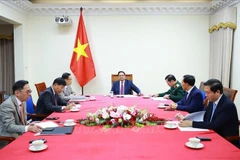
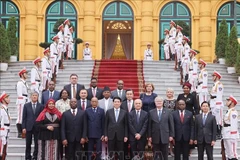
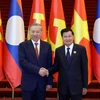
Vietnamese Party, State and parliamentary leaders on Sept. 15 received the visiting Lao Prime Minister Bouasone Bouphavanh.
At his reception, Party General Secretary Nong Duc Manh said Vietnamalways attached importance to developing relations with Laos for thebenefits of the people and for peace, stability, cooperation anddevelopment in the region and the world.
He affirmed that theVietnam-Laos traditional friendship, special solidarity andcomprehensive cooperation was an invaluable property of the two nationswhich needed to be maintained, promoted and transferred to futuregenerations. He thanked Laos for its past glorious support toVietnam .
The Vietnamese Party leader highly valued the resultsof talks between the high-level delegations of the two governments andexpressed his pleasure at the development of the comprehensivecooperation between the two countries.
General Secretary Manhexpressed his hope that the two Governments would continue to coordinateto effectively implement agreements, improve the quality of personneltraining, and raise two-way trade turnover. He also urged theimplementation of investment projects and the project on upgrading andplanting border markers between the two countries.
For his part,PM Bouasone Bouphavanh briefed the host about the implementation of theresolutions of the 8 th Congress of the Lao People’s RevolutionaryParty (LPRP) and recent resolutions of the LPRP Central Committee. Heexpressed thanks for Vietnam ’s great assistance to Laos andaffirmed that the Lao Party, State and people would try their best toconstantly develop the relations between the two countries.
Meetingthe Lao government leader, Vietnamese State President Nguyen Minh Trietpraised agreements on cooperation between the two governments as wellas economic cooperation achievements between the two countries.
Heexpressed his joy at new developments of some economic joint venturesbetween Vietnamese and Lao enterprises and his belief that the finepolitical and diplomatic ties between the two nations would bringfavourable conditions for a breakthrough in bilateral economiccooperation and trade in the future.
PM Bouasone Bouphavanhbriefed President Triet about the results of the talks between the twogovernmental delegations, as well as achievements in economiccooperation between the two countries. He also informed President Trietabout the implementation of agreements between the two Party politicalbureaus and agreements reached during the recent visit to Laos byPresident Triet.
He affirmed that the Lao people and nationalways kept in mind the great assistance from Vietnam during theirpast struggle for national independence and the present nationalconstruction.
Host and guest also exchanged views on theprospects of economic cooperation between Vietnamese and Lao businesses,and the dissemination of information about the special ties enjoyed byVietnam and Laos to the people, especially young people.
Laterthe same day, the Lao PM was received by Chairman of the NationalAssembly Nguyen Phu Trong, who expressed his pleasure at the close andeffective cooperation relations between the two parliaments.
ChairmanTrong pledged that the National Assembly of Vietnam would activelyimplement signed cooperation agreements between the two legislativebodies and oversee the implementation of cooperation agreements betweenthe two governments./.
At his reception, Party General Secretary Nong Duc Manh said Vietnamalways attached importance to developing relations with Laos for thebenefits of the people and for peace, stability, cooperation anddevelopment in the region and the world.
He affirmed that theVietnam-Laos traditional friendship, special solidarity andcomprehensive cooperation was an invaluable property of the two nationswhich needed to be maintained, promoted and transferred to futuregenerations. He thanked Laos for its past glorious support toVietnam .
The Vietnamese Party leader highly valued the resultsof talks between the high-level delegations of the two governments andexpressed his pleasure at the development of the comprehensivecooperation between the two countries.
General Secretary Manhexpressed his hope that the two Governments would continue to coordinateto effectively implement agreements, improve the quality of personneltraining, and raise two-way trade turnover. He also urged theimplementation of investment projects and the project on upgrading andplanting border markers between the two countries.
For his part,PM Bouasone Bouphavanh briefed the host about the implementation of theresolutions of the 8 th Congress of the Lao People’s RevolutionaryParty (LPRP) and recent resolutions of the LPRP Central Committee. Heexpressed thanks for Vietnam ’s great assistance to Laos andaffirmed that the Lao Party, State and people would try their best toconstantly develop the relations between the two countries.
Meetingthe Lao government leader, Vietnamese State President Nguyen Minh Trietpraised agreements on cooperation between the two governments as wellas economic cooperation achievements between the two countries.
Heexpressed his joy at new developments of some economic joint venturesbetween Vietnamese and Lao enterprises and his belief that the finepolitical and diplomatic ties between the two nations would bringfavourable conditions for a breakthrough in bilateral economiccooperation and trade in the future.
PM Bouasone Bouphavanhbriefed President Triet about the results of the talks between the twogovernmental delegations, as well as achievements in economiccooperation between the two countries. He also informed President Trietabout the implementation of agreements between the two Party politicalbureaus and agreements reached during the recent visit to Laos byPresident Triet.
He affirmed that the Lao people and nationalways kept in mind the great assistance from Vietnam during theirpast struggle for national independence and the present nationalconstruction.
Host and guest also exchanged views on theprospects of economic cooperation between Vietnamese and Lao businesses,and the dissemination of information about the special ties enjoyed byVietnam and Laos to the people, especially young people.
Laterthe same day, the Lao PM was received by Chairman of the NationalAssembly Nguyen Phu Trong, who expressed his pleasure at the close andeffective cooperation relations between the two parliaments.
ChairmanTrong pledged that the National Assembly of Vietnam would activelyimplement signed cooperation agreements between the two legislativebodies and oversee the implementation of cooperation agreements betweenthe two governments./.