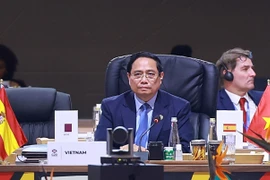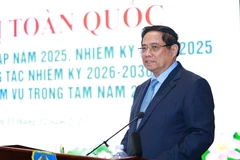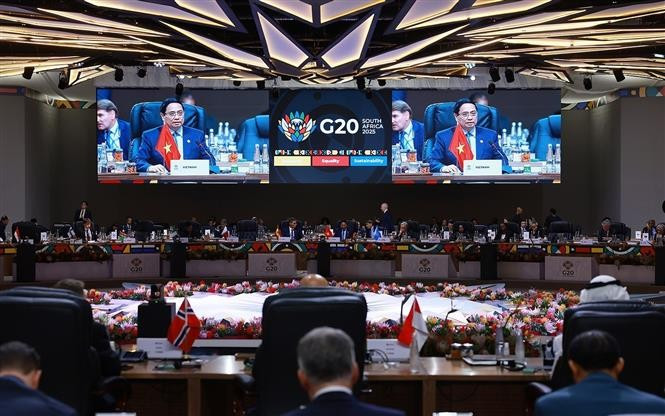
Johannesburg (VNA) - Vietnamese Prime Minister Pham Minh Chinh put forth three strategic priorities to contribute to a future of fairness, equality, and justice for nations and people worldwide while addressing the G20 Summit’s third session under the theme: “A Fair and a Just Future for All - Critical Minerals; Decent Work; Artificial Intelligence,” held in South Africa on November 23.
First, PM Chinh stressed the need to build partnerships on critical minerals that are fair, equitable, stable, and transparent, based on “harmonious benefits and shared risks”; and promote cooperation to form and diversify sustainable mineral supply chains, develop deep-processing and high-tech industries, recycling, and quality, sustainable employment that meets environmental, social, and governance standards.
The second priority is to achieve breakthroughs in training high-quality human resources linked to the development of modern, efficient, and sustainable labour markets. He called on the G20 to prioritise support and facilitate the participation of developing countries in educational cooperation initiatives; reduce barriers and promote collaboration; connect regional and global labour markets; and develop strategies, policies, programmes, and projects for training high-quality human resources, thus creating employment for youth and equipping workers with the skills needed for rapid and sustainable development.
Third, the Vietnamese PM suggested building and developing an AI ecosystem for humanity, not to replace humans. He also proposed the G20 take the lead in establishing fair, transparent, inclusive, safe, and human-centred AI governance standards; and support developing countries in building digital infrastructure, databases, and technology ecosystems for AI governance and application, ensuring safe, inclusive, and sustainable development.
PM Chinh affirmed that Vietnam is ready to closely cooperate with the G20 and the international community to implement these strategic priorities through concrete and practical programmes and projects, thereby contributing to prosperity for nations and people worldwide.

The PM also welcomed South Africa’s selection of the theme “Critical Minerals; Decent Work; Artificial Intelligence,” noting that it accurately reflects the three major global transformations today: green transition, digital transformation, and demographic – labour transition. He emphasised that the boom in science and technology, especially AI, is reshaping production methods and the international division of labour, generating enormous demand for energy and strategic minerals. This presents an opportunity for countries to make breakthroughs, but also carries risks such as supply chain disruptions and governance gaps, requiring collective global efforts, with the G20 playing a leading role.
The Vietnamese leader’s remarks were welcomed and highly appreciated by participating delegates.
At the event, participating leaders agreed to implement the G20 Critical Minerals Framework to strengthen international cooperation and ensure sustainable, transparent, safe, and stable strategic mineral supply chains.
They also emphasised that sustainable and high-quality employment is a central objective of economic growth and should play a key role in industrial policy. The leaders committed to promoting policies that create decent work, expand learning and vocational training opportunities for youth, especially those with limited access to development opportunities, and set a target to reduce by an additional 5% the proportion of young people aged 15–29 who are out of school, unemployed, or not in training by 2030.
Regarding AI governance, they agreed to focus on protecting human rights, ensuring transparency, fairness, accountability, ethics, and safeguarding privacy, data, and data governance. They also appreciated the role of the United Nations, along with other relevant forums, in promoting international cooperation on AI. The summit welcomed the AI for Africa Initiative aimed at strengthening cooperation between the G20 and the African Union (AU).
The summit adopted the Leaders’ Declaration and handed over the G20 Presidency from South Africa to the US. The participation of the high-level Vietnamese delegation, led by PM Chinh, made a positive contribution to the overall success of the summit, while highlighting the image of a dynamic Vietnam that is proactively and actively contributing to peace, cooperation, and development in the region and the world./.