Vietnam’s aquatic exports surge toward 10 bln USD amid trade hurdles

Vietnam’s aquatic exports are on pace to reach 10 billion USD in 2025, but rising trade and technical barriers, particularly in the US, are prompting exporters to pivot toward diversification and value-added processing to maintain momentum.

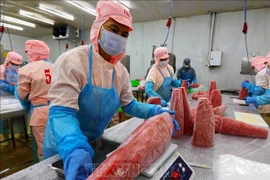
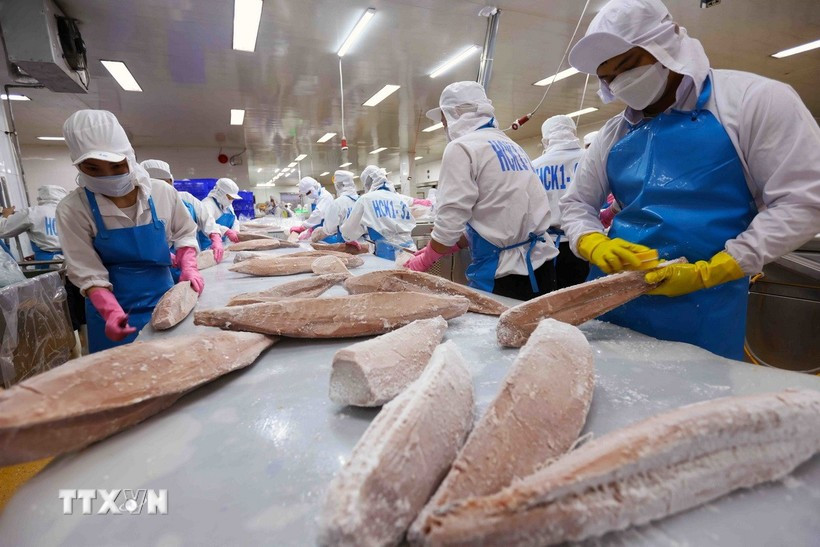
Processing ocean tuna for export (Photo: VNA)

HCM City (VNA) - Vietnam’s aquatic exports are on pace to reach 10 billion USD in 2025, but rising trade and technical barriers, particularly in the US, are prompting exporters to pivot toward diversification and value-added processing to maintain momentum.

Customs data showed Vietnam’s aquatic exports reeled in 1.12 billion USD in August, up 13.8% from last year, shrugging off choppy global markets. From January to August, exports soared 16.7% to 7.34 billion USD. Shrimp led the charge, with lobster hauls booming, tra fish making a comeback, and mollusks like squid, octopus, and bivalves raking in big gains. Tuna, though, took a hit from supply and demand disruptions.

Top buyers included CPTPP countries, China (including Hong Kong), and the US, where tra fish exports climbed 3.7% to 234 million USD in the first eight months. The EU and the Republic of Korea (RoK) were also steady customers.

Le Hang, Deputy Secretary-General of the Vietnam Association of Seafood Exporters and Producers (VASEP), projected a boom in September and October, but warned of a slowdown from late November, signaling tougher times ahead.

She highlighted mounting challenges, including tariff shifts and market barriers. In the US, a 20% retaliatory tariff undercuts Vietnam’s competitiveness against rivals like Thailand, Indonesia, and Ecuador. The shrimp sector faces further pressure from potentially steep anti-dumping duties in the upcoming 19th administrative review (POR19).

Worse, the US Marine Mammal Protection Act (MMPA) equivalency assessments denied certification for 12 Vietnamese fisheries, including key currency earners like tuna, mackerel, squid, octopus, and some crustaceans. Starting on January 1, 2026, these products will be barred from the US, threatening over 500 million USD in annual export revenue.

To counter these headwinds, Vietnamese exporters are casting their nets wider, targeting Asia, the Middle East, and South America while doubling down on value-added processing to stay competitive. Tra fish exports to China are softening, but CPTPP, ASEAN, and South American markets are growing briskly. Japan, Canada, and Mexico are hooked on tariff perks and crave safe, convenient products, making them prime long-term targets.

Nearby markets like Thailand, the Philippines, Malaysia, and Singapore are also gobbling up tra fish, thanks to low shipping costs and similar tastes. ASEAN markets are increasingly seen as a stable alternative to far-off, regulation-heavy markets.

While frozen fillets still rule, deeply processed tra fish products are growing fastest, showing exporters are adapting to consumers’ hunger for convenience. Shrimp exports are holding strong, particularly in high-value EU markets. Eurostat projected EU shrimp imports could reach 400,000 tonnes in 2025, a multi-year high, giving Vietnam a shot at bigger profits.

Industry experts said it is time to stop competing on price and focus on quality, transparency, and sustainability. Certifications like ASC, organic, and carbon-smart are becoming must-haves for retail shelves, and standardising antibiotic controls is also critical.

Focusing on fast-growing EU markets like Germany, Belgium, France, and Denmark, where premium products are in demand, could optimise resources. Expanding value-added, deeply processed shrimp products will also help Vietnam fend off rivals like Ecuador and India, they said.

To keep the industry thriving, VASEP is pushing for coordinated aquaculture zoning, tighter quality controls, and a swift fix to the EU’s “yellow card” on illegal unreported, and unregulated (IUU) fishing. It is also seeking solutions to break through US tariff and technical walls, determined to safeguard Vietnam’s seafood export boom./.
VNA

See more

The value chain map of the electronics and electrical industry provides in-depth analysis, selection, and systematisation of information from 742 companies operating in seven key electronics and electrical sectors. (Photo: VNA)

Vietnam electronics, electrical value chain map unveiled

This marks the first time that the entire supply chain of one of Vietnam’s most prominent industries has been systematised, visualised, and officially published in a structured manner, aiming to promote trade, attract investment, and support sustainable industrial development.

A Vietjet aircraft at Con Dao airport (Photo: VNA)

Vietjet doubles flights to Con Dao

Vietjet has announced its plan to double the number of flights between Hanoi, Ho Chi Minh City and Con Dao to meet the increasing travel demand of residents and visitors to Con Dao during the year-end and New Year period.

Phu Quoc becomes Vietnam’s first destination to feature an urban LRT system (Photo: Sun Group)

Sun Group to launch series of landmark projects across Vietnam

By simultaneously launching a series of large-scale and strategically important projects, Sun Group continues to reaffirm its position as one of Vietnam’s leading tourism developers, while standing as a clear example of the role played by the private sector in national construction and development.

Over 250 enterprises join the Vietnam International Gifts and Housewares Expo 2025 (Photo: VNA)

Int’l gifts, housewares expo draws over 250 enterprises

Vietnam International Gifts and Housewares Expo 2025 (IGHE 2025) features a comprehensive range of household goods, gifts and decorative products, positioning itself as a must-see destination for buyers from Vietnam and overseas.

Individuals should proactively monitor their credit data to detect signs of identity theft in a timely manner. (Photo: baodautu.vn)

Early warning: A crucial defence against identity theft, credit fraud

ID365 aims to help users monitor and control any changes related to their personal identification information. It serves as an "early warning" system, empowering individuals to proactively safeguard their identities and assets, while also strengthening the defences of the entire financial and banking system against increasingly sophisticated fraud risks.

Workers sew export garments at Maxport Vietnam Co.Ltd (Photo: VNA)

Garment industry diversifies markets to weather global volatility

The sector is striving to generate 46 billion USD in export revenue this year. Although the figure falls short of the 48 billion USD target, it still represents a 5.6% year-on-year increase, helping Vietnam maintain its position among the world’s top three textile and garment producers.

Illustrative image (Photo: VinSpeed)

Vingroup’s VinSpeed inks high-speed rail deal with Siemens Mobility

Under the pact, Siemens Mobility, a supplier of high-speed rail technologies and solutions, will design, supply and integrate trainsets and key railway subsystems, including signaling, communications and power supply. It will also cooperate in maintenance for supplied equipment and transfer technology to support VinSpeed’s rail projects.

Reference exchange rate rises (Photo: VNA)

Reference exchange rate going up

The State Bank of Vietnam set the daily reference exchange rate at 25,151 VND/USD on December 18, up 5 VND from the previous day.

Vice Chairman of the People’s Committee of Quang Ninh province Nguyen Van Cong chairs the meeting regarding sustainable marine aquaculture development for 2026 (Photo: baoquangninh.vn)

Quang Ninh eyes sustainable marine aquaculture development

Speaking at a December 17 meeting regarding sustainable marine aquaculture development for 2026, Vice Chairman of the People’s Committee of Quang Ninh province Nguyen Van Cong urged the provincial Department of Agriculture and Environment to urgently finalise the draft plan, which will serve as a basis for focusing on the development of marine aquaculture in the coming period; and take the lead in coordinating with localities to review and adjust the planning of marine aquaculture areas, with an emphasis on encouraging the efficient use of marine areas suitable for aquaculture, in line with environmental impact assessments.

Mirela Janice Eidt, head of the Office of Brazilian Ministry of Agriculture and Livestock (MAPA), speaks at the event (Photo: Vietnamese Embassy in Brazil)

Vietnam, Brazil enhance smart agriculture ties

Amid escalating global pressures, including climate change, resource scarcity and tougher standards on food safety, traceability and low-carbon production, smart agriculture and sustainable value chains are no longer optional but inevitable. With both Vietnam and Brazil prioritising this development path, they see strong potential for deeper long-term strategic collaboration.