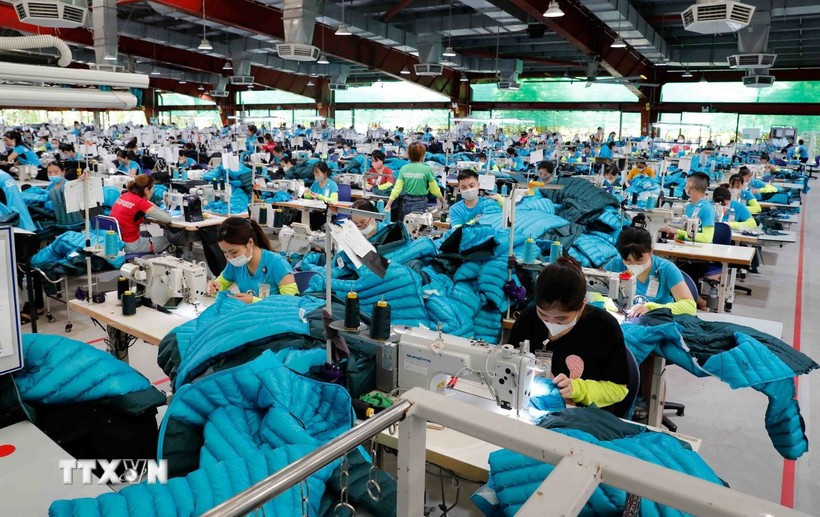
Hanoi (VNA) – Despite global market volatility, Vietnam’s textile and garment sector has maintained growth momentum, accessed new destinations, and is preparing for a phase of deeper restructuring.
The sector is striving to generate 46 billion USD in export revenue this year. Although the figure falls short of the 48 billion USD target, it still represents a 5.6% year-on-year increase, helping Vietnam maintain its position among the world’s top three textile and garment producers. The outcome is seen as an important stepping stone for continued restructuring and adaptation to increasingly stringent standards in key export markets.
Vu Duc Giang, Chairman of the Vietnam Textile and Apparel Association (VITAS), attributed the 2 billion USD shortfall to market fluctuations and international policy shifts. The escalating US – China trade tensions, higher tariffs on many textile and garment products, and the complicated geopolitical situation have directly affected global orders and consumer demand.
On the demand side, consumers have continued to rein in spending, forcing businesses to accept smaller orders, shorter delivery schedules, and tighter production timelines. As a result, profit margins have been significantly squeezed. Companies have had to manage fragmented orders, adjust production plans, and increase investment to meet green standards and traceability requirements in order to retain international clients, Giang said.
Cao Huu Hieu, General Director of the Vietnam National Textile and Garment Group (Vinatex), pointed out that the industry’s biggest challenge remains its heavy reliance on imported inputs. The dependence on imported cotton (100%) and fibres (90–95%), along with dyes and chemicals, leaves the sector exposed should the US raise tariffs on products with a high proportion of third-country origin.
Diversifying markets
VITAS said the Middle East and Africa are emerging as new markets as traditional destinations face increasing uncertainty. The Middle East alone generated around 1 billion USD in export revenue in 2024 and 700 million USD in the first seven months of 2025, reflecting Vietnamese firms’ ability to maintain the mass-market segment while gradually shifting towards higher value-added ones that requires products with greater technological and design content.
Alongside market diversification, many Vietnamese textile and garment companies are expanding their reach overseas. Nearly 30 enterprises now operate in Indonesia, Myanmar, Bangladesh, Egypt, South Asia, Africa, and Latin America, forming multinational production networks to enhance competitiveness and resilience.
Giang said the “multi-site production” model helps companies spread political and trade risks, optimise labour and logistics costs, and strengthen credibility with international buyers. Labour costs in countries such as Indonesia and Egypt are significantly lower than in Vietnam while preferential trade arrangements there offer additional tariff advantages.
Tran Nhu Tung, Chairman of Thanh Cong Textile Garment Investment Trading Joint Stock Company, said his firm is gradually reducing its dependence on the US market while boosting shipments to the EU and markets in the Comprehensive and Progressive Agreement for Trans-Pacific Partnership (CPTPP) and the Regional Comprehensive Economic Partnership (RCEP) to capitalise on preferential tariffs and secure orders with high technical requirements.
Looking ahead, intensifying competition and supply-chain risks are expected to drive deeper restructuring across Vietnam’s textile and garment industry, from upstream investment in raw materials and technology to brand-building to ensure sustainable presence in major markets./.