Aquatic exports stay flexible amid rising challenges

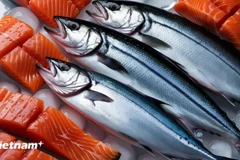
Vietnam’s total seafood exports for 2025 are forecast at 9–9.2 billion USD, slightly below the 10 billion USD target, with shrimp at 3.6–3.8 billion USD, pangasius 1.8 billion USD, tuna 850–900 million USD, and other seafood products close to 3 billion USD.

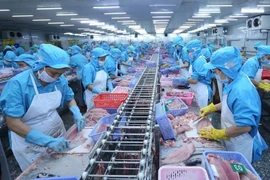
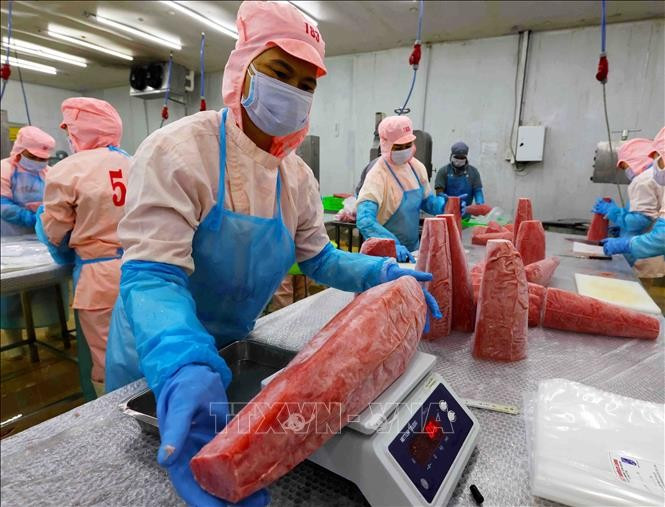
Workers process tuna for export at Ba Hai JSC factory in Phu Yen province. (Photo: VNA)

HCM City (VNA) - Vietnam’s aquatic exports showed strong growth in the first seven months of 2025 despite global disruptions and increasing tariff pressures thanks to businesses’ efforts to adopt flexible strategies to maintain competitiveness in key markets.

Strong growth before tariff deadlines

According to the Vietnam Association of Seafood Exporters and Producers (VASEP), seafood exports fetched 971 million USD in July, up 6.1% year-on-year. This raised the figure in the first seven months to 6.22 billion USD, marking a robust 17.2% increase. Shrimp took the lead with 2.49 billion USD, while pangasius brought home 1.22 billion USD, a rise of 11.1%. Tuna exports declined by 2.8% in the seven months, with a sharper 19% drop in July.

Le Hang, VASEP’s Communications Director, attributed seven-month export growth largely to shipments rushed before the US imposed reciprocal tariffs starting August. Exports to the US rose 10.4% year-on-year for seven months but fell nearly 20% in July. The US tariff on Vietnamese seafood is currently 20%, less than India’s 25% but higher than other competitors like the Philippines and Indonesia. Additional anti-dumping duties on frozen shrimp could raise the total tariff burden above 53%, she said.

In contrast, shipments to China surged by 31.7% in July and 42.6% over seven months, fuelled by demand for shrimp and squid. Vietnamese exporters are pivoting to high-growth markets and leveraging trade agreements like the Regional Comprehensive Economic Partnership (RCEP) and the Comprehensive and Progressive Trans-Pacific Partnership (CPTPP) for preferential tariffs. Japan, the EU, the Republic of Korea, and ASEAN markets also posted gains due to competitive pricing and stable supply.

Navigating tariffs, seizing opportunities

VASEP advisor Truong Dinh Hoe noted that US tariffs mainly affect frozen shrimp, while value-added processed shrimp remains tariff-free. Firms are encouraged to expand in processed shrimp and explore Asian, European, and CPTPP markets like Japan, where demand is strong.

Vietnam retains a leading position in pangasius exports to the US, bolstered by a recent zero anti-dumping duty ruling for major exporters. Nonetheless, new duties and stockpiling in China urge diversification toward ASEAN, South America, and the Middle East.

Despite expected hurdles in late 2025, markets such as China, ASEAN, and Japan show recovery signs, and the EU is easing technical barriers. These trends favour growth in high-value processed seafood, supported by trade agreements like EU-Vietnam Free Trade Agreement (EVFTA), CPTPP, and UK-Vietnam Free Trade Agreement (UKVFTA).

Vietnam’s total seafood exports for 2025 are forecast at 9–9.2 billion USD, slightly below the 10 billion USD target, with shrimp at 3.6–3.8 billion USD, pangasius 1.8 billion USD, tuna 850–900 million USD, and other seafood products close to 3 billion USD. Success depends on securing raw materials, quality improvements, technology investment, and market diversification.

To Thi Tuong Lan, Deputy Secretary General of VASEP, highlighted efforts to expand into CPTPP, ASEAN, and Asian niche markets, as well as promising regions like South America and the Middle East. To support this, VASEP will host Vietfish 2025 from August 20–22 in Ho Chi Minh City. The event features nearly 530 booths from 280 enterprises and 17 national pavilions from major seafood economies, providing a key platform for trade, innovation, and cooperation./.

VNA
See more

Officials visit a booth at the festival. (Photo: VNA)

Vietnam OCOP Festival 2025 opens in Hanoi

The festival functions as a space to bring together regional OCOP excellence, a forum connecting OCOP stakeholders with distributors, investors, experts and consumers, and a platform to spread pride in indigenous culture, local knowledge, and the aspiration for legitimate prosperity.

Prime Minister Pham Minh Chinh (third from right) and officials launch the Ministry of Construction’s new information technology systems at the conference on December 21. (Photo: VNA)

Modern, comprehensive infrastructure – a need for fast, sustainable development: PM

The Party and State continue to define infrastructure development as one of the three strategic breakthroughs, with priority given to building comprehensive and modern infrastructure, particularly transport facilities, technological infrastructure, and green – digital transition infrastructure, to help realise the national target of double-digit growth, the PM said.

Prime Minister Pham Minh Chinh addresses he third meeting of the National Steering Committee implementing the Politburo’s Resolution 68 in Hanoi on December 20. (Photo: VNA)

PM pushes trust, breakthroughs to accelerate private sector growth

Prime Minister Pham Minh Chinh noted that since the rollout of Resolution 68, alongside supporting resolutions from the National Assembly (NA) and Government, there has been a marked change in understanding the private sector’s critical position and role in Vietnam’s socialist-oriented market economy.

PM Pham Minh Chinh chairs the meeting (Photo: VNA)

Private sector thrives eight months after Resolution 68’s launch: PM

The private sector has shown marked progress eight months after the launch of Resolution 68, registering about 18,000 new enterprises monthly and pushing the nationwide total to nearly 1.1 million, Prime Minister Pham Minh Chinh told the third meeting of the National Steering Committee in Hanoi on December 20.

Phin Ho Tra – a national five-star OCOP product. (Illustrative photo: VNA)

Hanoi to host Vietnam OCOP Festival 2025

The festival is seen a practical activity celebrating the achievements made by the capital and the country in 2025, affirming OCOP’s role in rural economic development, contributing to realising Vietnam’s aspiration for strong economic growth in the context of deep integration.

The expanded Hoa Binh Hydropower Plant (Photo baochinhphu.vn)

EVN launches major power projects

Among the flagship projects inaugurated was the expanded Hoa Binh Hydropower Plant with a total installed capacity of 480MW per year and average annual output of about 488 million kWh.

An ultra-intensive shrimp farming model linked with environmental protection in Ca Mau province. (Photo: VNA)

Fisheries take the lead in the Mekong Delta’s green transition

Across the Mekong Delta, leading aquaculture producers, processors and exporters, along with suppliers of inputs, are transitioning to circular, high-tech and clean production models that cut greenhouse gas emissions and comply with international certification standards.

A perspective view of the Red River Landscape Boulevard project in Hanoi (Photo: VNA)

Works starts on Hanoi’s Red River Landscape Boulevard Axis project

The project is among the 234 key works and projects being launched, inaugurated or technically opened simultaneously across 34 cities and provinces nationwide to mark the 14th National Party Congress. Its launch contributes to implementing the country’s strategic development orientations while concretising Hanoi’s development goals in the new period.