HCM City (VNA) - Vietnam’s aquatic product exports in the early months of 2025 have continued to show steady growth, although performance has varied across product segments and markets, amid mounting challenges posed by reciprocal tariff measures of the US.
According to the Vietnam Association of Seafood Exporters and Producers (VASEP), aquatic product export turnover in April reached 850.5 million USD, up 10% year-on-year. This brought the cumulative export value in the first four months of the year to 3.3 billion USD, a 21% increase compared to the same period in 2024.
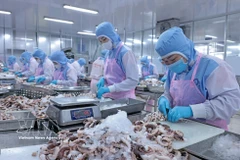
Shrimp remained the leading export product, generating 1.27 billion USD in revenue in the first four months, a robust 30% increase. The growth was driven by strong consumer demand in major markets such as China, the EU, and Japan, along with a gradual recovery in shrimp prices due to global supply-demand rebalancing.
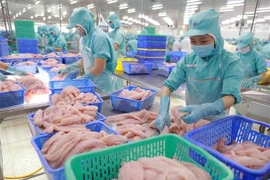
Pangasius (tra fish) followed as a strategic export item, earning 632.7 million USD in the four-month period, up 9%. However, in April alone, pangasius exports showed signs of slowing, reaching 167.7 million USD, on par with the same period last year. This stagnation is attributed to tariff pressure from the US and increased competition from other white fish such as tilapia.
Tuna exports in April experienced a sharp 12% decline to 76 million USD. Total exports in the four months stood at over 302 million USD, up just 1% year-on-year. Businesses pointed to a shortage of raw materials, especially due to minimum size regulations for skipjack tuna, as a major bottleneck, hampering harvesting, processing, and export volumes.
In contrast, products such as tilapia and red tilapia posted a breakthrough growth rate of 138%, albeit from a modest base of 19 million USD. Other categories also recorded impressive gains such as mollusks, crabs, and swimming crabs, buoyed by strong demand from China and ASEAN countries.
China (including Hong Kong) led all export markets, with total revenue reaching nearly 710 million USD in the first four months, up 56%. April alone saw 182.3 million USD, a 29% rise, driven primarily by demand for shrimp, crabs, and mollusks catering to the premium segment.
The EU and the Republic of Korea remained key growth markets, with respective exports reaching 351.5 million USD and 264.1 million USD. These gains were largely supported by preferential tariffs under the EU-Vietnam Free Trade Agreement (EVFTA).
Meanwhile, aquatic product exports to the US faced significant headwinds. April revenue declined by 15% to 120.5 million USD. However, cumulative exports in the January–April period still rose 7% to 498.4 million USD. The sharp April decline underscores the disruptive impact of the US's reciprocal tariffs on Vietnam’s seafood.
The US's tariff measures are exerting immense pressure on Vietnam’s seafood industry, according to VASEP Deputy Secretary General Le Hang.
Key products such as pangasius and shrimp, which are heavily dependent on the US market, are particularly affected. Higher tariffs raise product costs, prompting American importers to consider alternative suppliers such as India and Ecuador. Additionally, technical barriers, such as stricter food safety inspections and traceability requirements, are further eroding Vietnam’s competitive edge, she elaborated.
Despite these challenges, Vietnam is leveraging its broad network of free trade agreements, including the Comprehensive and Progressive Agreement for Trans-Pacific Partnership (CPTPP) and the EVFTA, to mitigate negative impacts by expanding into the EU, Japanese, and ASEAN markets. Many Vietnamese enterprises are also shifting strategies, focusing on high-value-added products and market diversification to reduce reliance on the US.
Experts predict a significant export shift in the coming two months as Vietnamese businesses accelerate shipments to the US before new tariff measures take effect on July 9. During this period, companies are expected to ramp up exports of key products like shrimp and pangasius to maximise opportunities under the current tariff regime. Exports to the US market in May and June could rise by 10–15% compared to April 2025, driven by last-minute contracts and competitive pricing strategies.
Conversely, exports to markets such as China and ASEAN are likely to level off, with anticipated growth of just 3–5%, due to intensifying competition from Chinese seafood products that are being diverted from the US market. This will reduce the appeal of Vietnamese products, particularly in lower-price segments. Exports to the EU and Japan are expected to maintain stable growth of 8–10%, bolstered by trade agreements, though not enough to offset declines in major markets like the US and China.
Vietnamese enterprises are actively exploring lower-risk markets such as Brazil, Mexico, and the Middle East, while enhancing deep processing capabilities to gain a competitive edge in high-value segments. Brazil, in particular, is emerging as a promising market. However, businesses must prioritise product quality and sustainability standards to overcome technical trade barriers./.