Hanoi (VNA) – Vietnam’s coconut export revenue in 2025 is forecast to reach as much as 1.15 billion USD, securing the country’s position among the world’s top five coconut exporters.
With vast market potential ahead, the coconut industry is poised for a breakthrough if it focuses on building sustainable value chains, modernising production, and standardising raw material areas.
According to Cao Ba Dang Khoa, General Secretary of the Vietnam Coconut Association, the exports of the sector’s four key product groups brought in over 520 million USD in H1, an increase of more than 20% compared with the same period last year. These core product groups include fresh coconuts, frozen coconut milk, crude coconut oil, food and cosmetic products made from coconut, handicrafts, and agricultural by-products. This performance is particularly positive as exports typically show the strongest growth in the latter half of the year.
Achieving such momentum early on signals favourable prospects for the industry throughout 2025. In addition to export growth, the value of coconuts in Vietnam has also seen a remarkable leap. In 2023, coconuts at farm-gate prices fetched around 5,000 VND (0.19 USD) each, but by the third quarter of 2025, this has risen to 15,000 VND. Nonetheless, this still trails behind international market levels.
To fully harness the sector’s market potential, Vietnam’s coconut industry must pivot towards sustainable development. Eco-friendly cultivation methods, climate resilience, and emissions reduction will be vital in the coming phase.
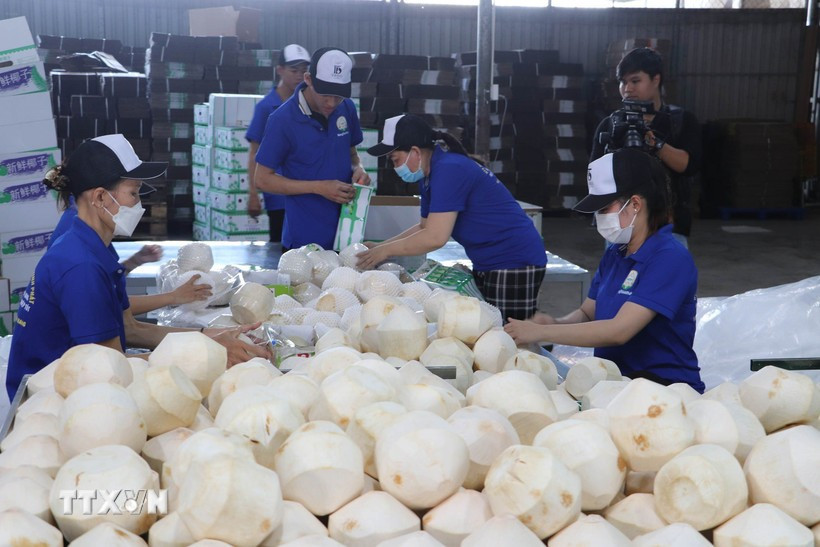
Khoa emphasised the urgent need to establish a stronger legal framework, including banning toxic plant protection chemicals, while also enhancing training for farmers and workers. On the business side, greater automation in processing and the application of artificial intelligence in production management are required to boost transparency and ensure food safety.
A key matter lies in product traceability and the creation of digital maps of coconut-growing regions, he added.
Tran Minh Hai, Vice Rector of the Institute for Public Policy and Rural Development, said that the cooperative model is the key to enhancing export capacity. Large-scale coconut-growing zones are increasingly shifting to the Southeast and Central Highlands, with areas spanning between 30 and 50 hectares. These zones are beginning to receive official planting area codes, enabling a stable supply for exports.
A notable step forward came when China’s General Administration of Customs (GACC) approved six additional planting areas and packaging facility codes for An Giang province. This move further opens the door for fresh Vietnamese coconuts to penetrate deeper into the vast Chinese market, which currently accounts for 30-35% of Vietnam’s coconut export turnover./.