HCM City (VNS/VNA) – Passion fruit, banana, pineapple, and coconut are emerging as Vietnam’s next billion-dollar export items, offering strong potential to diversify the country’s fruit and vegetable sector, experts affirmed at a recent forum held in HCM City.
Organised by the Ministry of Agriculture and Environment, the forum titled “Solutions to Enhance Competitiveness and Promote the Export of High-Potential Fruits” gathered hundreds of delegates both in-person and online. The event focused on unlocking the export potential of passion fruit, banana, pineapple, and coconut.
According to the ministry, Vietnam currently cultivates more than 50 fruit varieties across over 1.3 million hectares of farmland. However, only durian has surpassed the 1 billion USD export milestone, reaching 2.3 billion USD in 2023 and 3.3 billion USD in 2024.
Dragon fruit, which once crossed that threshold, fell to just 534 million USD last year.
Deputy Minister Tran Thanh Nam noted that passion fruit, banana, pineapple, and coconut are expected to become the country’s next strategic export items. These fruits not only have substantial production capacity but also align with global consumption trends and increasingly strict import requirements.
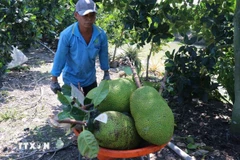
Together, these four fruit crops cover over 420,000 hectares and yield more than 6.3 million tonnes annually. Vietnamese bananas alone are grown on 161,000 hectares, generating nearly 380 million USD in exports in 2024 and placing Vietnam among the world's top nine banana exporters. The fruit is now available in key markets such as China, Japan, the Republic of Korea, Australia, the EU, and the US.
Pineapples are cultivated on over 52,000 hectares, coconuts on nearly 202,000 hectares, and passion fruit on over 12,000 hectares. All of which are expanding in both scale and deep-processing capacity, he said.
Despite these advantages, Nam warned that the sector still faces major obstacles: lack of high-quality, disease-resistant varieties; underdeveloped raw material zones; fragmented supply chains; low processing capacity; lack of national branding; and market volatility.
Without proactive restructuring, he said, Vietnam risks falling behind regional competitors.
Dang Phuc Nguyen, General Secretary of the Vietnam Fruit and Vegetable Association, highlighted the global potential of pineapples. He noted that the global market is expected to grow at a compound annual rate of 6.3%, underscoring vast export opportunities.
Nguyen said Vietnamese pineapples are highly competitive, with products like DOVECO’s concentrated juice exported to more than 50 countries at premium prices.
In some cases, Vietnamese products have even outperformed those from the US and Europe, strengthening Vietnam’s global reputation.
“To reach billion-dollar export status, the pineapple industry needs a clear and systematic strategy,” Nguyen said. “This includes expanding raw material areas, improving varieties, investing in irrigation, and applying advanced technologies to enhance yield and quality. Government support is also critical.”
Ngo Quoc Tuan, Deputy Director of the Post-Import Plant Quarantine Centre II, reaffirmed the strong export potential of these four fruits but warned of increasingly strict phytosanitary and traceability requirements from import markets.
He urged producers to shift their focus from volume to quality, emphasising the need to adopt advanced technologies, build traceability systems, and strengthen value chains.
Nguyen Nhu Cuong, Deputy Director of the ministry’s Department of Science and Technology, added that Vietnam must diversify export markets, enhance post-harvest technologies such as irradiation and hot steam treatment, and strictly manage planting area codes to meet global standards and build buyer confidence.
In the coconut sector, Nguyen Thi Kim Thanh, Chairwoman of the Vietnam Coconut Association, said to ensure sustainable development, the coconut industry needs a stable supply of raw materials in both quality and quantity.
She stressed the need for close coordination between the ministry, research institutes, and universities to develop solutions that enhance productivity and modernise production.
“Coconut can be processed in combination with other fruits such as banana and pineapple to diversify product offerings and increase the value of Vietnamese fruit exports,” she noted.
Deputy Minister Nam concluded that boosting the competitiveness of Vietnam’s fruit industry requires a comprehensive restructuring of the value chain, moving toward a greener and more modern agriculture.
Key priorities include planning and developing raw material zones, linking with processing and distribution businesses, applying cost-saving technologies, modernising logistics and processing, building national brands, and expanding formal export channels.
He stressed that accelerating market access negotiations for passion fruit, banana, pineapple, and coconut will be essential to reducing overreliance on traditional markets and diversifying export destinations./.
VNA