Growing e-commerce market sees tougher fight against counterfeits

The local e-commerce market has surpassed 30 billion USD this year, recording growth of 25% and accounting for two-thirds of the value of the digital economy. However, this rapid growth has also brought about serious consequences, particularly the widespread proliferation of counterfeit and imitation goods and trade fraud.

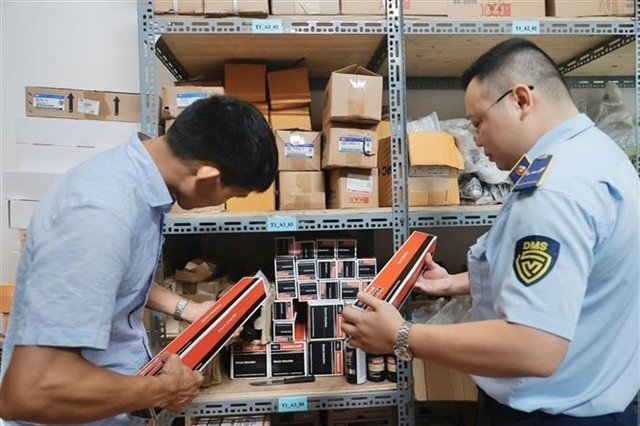
Hanoi's market surveillance team 2 inspects a shop in Hong Ha ward on July 14. (Photo: VNA)

Hanoi (VNA) – Amid the rapid expansion of e-commerce and social networks, trade fraud and the sale of counterfeit and imitation goods have become increasingly sophisticated, posing major challenges to market surveillance and regulation.

Booming digital market

The local e-commerce market has surpassed 30 billion USD this year, recording growth of 25% and accounting for two-thirds of the value of the digital economy, according to the Vietnam E-commerce and Digital Economy Agency under the Ministry of Industry and Trade.

This surge has been driven by widespread internet access, smartphone penetration, and the development of online shopping platforms and social networks. At the same time, consumers are shifting their purchasing habits from in-store shopping to online channels due to convenience, competitive pricing and a wider range of choices. This trend has not only boosted production and distribution, but has also created jobs for hundreds of thousands of workers in the logistics and technology sectors.

However, the rapid growth of e-commerce has also brought about serious consequences, particularly the widespread proliferation of counterfeit and imitation goods and trade fraud. In 2025, market surveillance forces have nationwide detected and handled more than 23,400 cases involving counterfeit goods, most of which occurred on e-commerce platforms and social media. The infringing products range from cosmetics, clothin,g and footwear to electronic devices, and even health supplements and medicines.

In early November, the Hanoi market surveillance authority uncovered and dealt with a warehouse in Phu Xuyen commune containing 2,000 counterfeit handbags bearing the trademarks of many well-known and protected brands such as Hermes, Gucci and YSL. According to the warehouse owner’s statement, the wholesale purchase price of each bag was only between 50,000 VND (1.9 USD) and 60,000 VND (whereas genuine products would cost from tens to hundreds of millions of VND), but they were later advertised and sold on e-commerce platforms and social networks via anonymous accounts at prices of several hundred thousand dong per item.

Creating healthy, safe digital business environment

It can be seen that the greatest challenge now in preventing counterfeit goods in the e-commerce environment stems from legal regulations that have yet to keep pace with market developments.

Currently, on e-commerce platforms and social networks, seller identities and product quality are difficult to verify, creating loopholes for counterfeit goods to enter the market. This lack of transparency undermines consumer confidence and causes economic losses estimated at trillions of VND each year.

In addition, existing penalties are not sufficiently deterrent; fines are low compared with the enormous profits from counterfeit production, prompting many offenders to repeat violations even after being penalised multiple times.

Tran Huu Linh, head of the Agency for Domestic Market Surveillance and Development under the Ministry of Industry and Trade, said that management methods for the e-commerce market need to be renewed. In particular, greater application of information technology and data analysis is required to monitor the market and provide early warnings of potential risks. Automated monitoring systems using artificial intelligence to detect counterfeit products based on images, reviews and transaction data should be deployed more widely.

Renewing management approaches and strengthening control over the digital space are seen as key to enabling market surveillance forces to effectively protect consumers and create a safe and healthy digital business environment./.

VNA
See more

A nuclear reactor at the DaLat Nuclear Research Institute (Photo: VNA)

New decree sets roadmap for nuclear infrastructure and workforce development

The decree also covers simulation systems and databases for radiation safety, nuclear safety and nuclear security; specialised computational software for safety assessment; monitoring and command-and-control systems for responding to radiation and nuclear incidents; as well as design documentation, technical manuals, prototype products and other related facilities and equipment.

The interest rate policy has been adjusted in line with market movements to ensure system liquidity and reduce capital costs. (Photo: VNA)

Banking sector anchors macroeconomic stability, setting stage for new growth cycle

Throughout 2025, the State Bank of Vietnam (SBV) has reaffirmed its role as the central regulatory authority in managing monetary policy, stabilising the financial market, and maintaining macroeconomic balance. Closely monitoring international and domestic economic trends, the SBV steered the monetary policy proactively while closely coordinating with the fiscal policy to achieve the dual objective of controlling inflation and supporting growth.

Professor Reena Marwah from the University of Delhi, and Secretary-General of the Association of Asia Scholars. (Photo: VNA)

Vietnam – A rising star in Asia: Indian professor

Vietnam’s projected GDP growth of around 8% in 2025 shows that its economy is on an impressive growth trajectory, driven by multiple reinforcing engines, said Professor Reena Marwah from the University of Delhi, and Secretary-General of the Association of Asia Scholars (AAS).

Harvesting jackfruit (Photo: VNA)

China to allow import of Vietnamese fresh jackfruits from June 1, 2026

To ensure smooth customs clearance, all orchards and packing facilities participating in exports must be registered and approved by competent authorities of both countries. The list of approved entities granted export codes will be published and regularly updated on the GACC website.

The fruit and vegetable sector is also set to hit a record, with exports projected at around 8.5 billion USD in 2025. (Photo: VNA)

Agro-forestry-fishery exports poised to hit record high in 2025

Agro-forestry-aquatic exports totalled 64.01 billion USD in the first 11 months of 2025. If performance in the final month matches that of recent months, the figure could approach 70 billion USD, far exceeding the 65-billion-USD target set for the year.

A view of Dinh Vu port in Hai Phong city. (Photo: VNA)

Circular on domestic maritime transport permits for foreign vessels issued

Under the circular, which will take effect from February 1 next year, the Minister of Construction will grant the permits for cases such as transporting oversized or overweight cargo or other types of goods using specialised vessels; clearing congested cargo, passengers, and luggage at ports when Vietnamese ships are unable to handle them; and conducting disaster relief, disease control, or emergency humanitarian aid.

At a tax office in Hanoi (Photo: VNA)

Decree regulates corporate income tax incentives

A CIT rate of 15% applies to enterprises with a total revenue in the preceding year of not more than 3 billion VND (114,000 USD), while a CIT rate of 17% applies to enterprises with a total revenue in the preceding year of over 3 billion VND but not more than 50 billion VND.