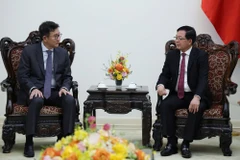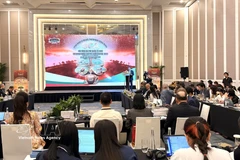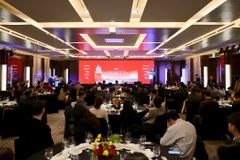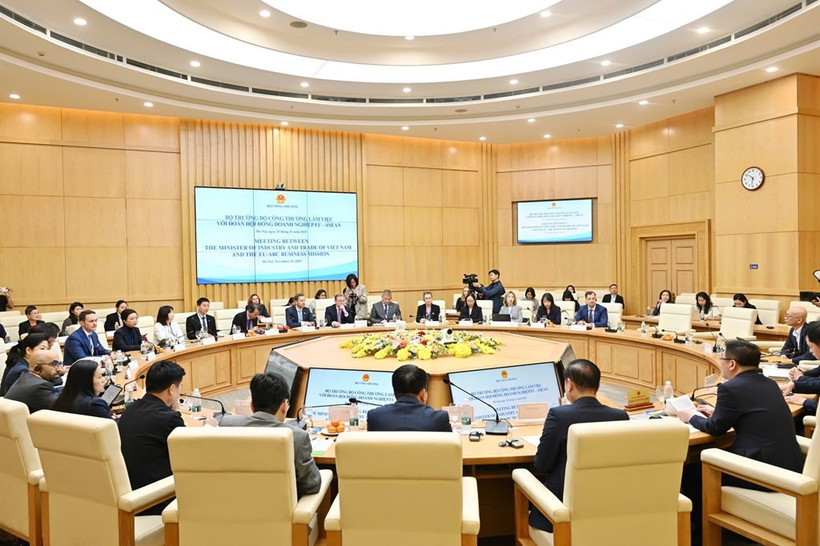
Hanoi (VNA) – Minister of Industry and Trade Nguyen Hong Dien and leaders of relevant departments and agencies on November 25 held a working session with a delegation from the EU-ASEAN Business Council (EU-ABC), the primary voice for European firms within the ASEAN region.
Speaking at the meeting, Dien lauded the strong cooperation between Vietnam and the EU in particular, and between the EU and ASEAN in general. He stressed that Vietnam-EU relations have developed comprehensively across all areas, especially since the EU-Vietnam Free Trade Agreement (EVFTA) came into force.
The EU is now Vietnam’s fourth-largest trading partner and third-largest export market. Notably, European investment in the ASEAN member state has grown strongly in high-tech industries, renewable energy, logistics, the circular economy, and processing – manufacturing.
Amid regional and global economic volatility, Vietnam and European businesses should work more closely, with stronger trust, to build new and sustainable supply chains, he said, considering this a considerable oppportunity that Vietnam wishes to share with partners in Europe, which has green finance sources, advanced technology, outstanding governance experience, and the strongest commitment to sustainability, so as to advance more substantive and extensive cooperation.
The Vietnamese Government and the Ministry of Industry and Trade (MoIT) welcome and encourage European enterprises to continue expanding long-term investment and business operations in Vietnam, the minister stated.
During the discussion, the two sides exchanged views on cooperation directions for the coming period, focusing on maintaining the momentum of bilateral trade growth. They agreed to expand high-quality investment projects; strengthen supply-chain linkages; promote cooperation in areas related to sustainable development, green transition, and digital transformation; and further improve mechanisms and policies to facilitate both sides' business operations.
Representing the EU-ABC, Chairman Jens Rubbert said the council wishes to continue accompanying Vietnam and considers the country a key partner in ASEAN. He emphasised that the EVFTA has been and continues to be a driving force for bilateral trade.
Since the EVFTA took effect, Vietnam’s exports to the EU have grown by an annual average of 12–15%, demonstrating significant cooperation potential. The council expressed the hope to further expand business and investment activities in Vietnam.
During the meeting, representatives of the EU-ABC and EuroCham Vietnam commended the Vietnamese Government’s efforts in improving the business environment and implementing integration commitments, as well as the MoIT’s leading role in industrial, trade, and energy cooperation.
They affirmed that the European business community view Vietnam as an important destination in their development strategy in the region and hope to enhance policy dialogue with Vietnamese authorities.
Concluding the session, the two sides agreed to maintain regular communication and dialogue channels at both leadership and technical levels to promptly share information, address bottlenecks, and promote practical, effective, and sustainable cooperation, investment, and trade opportunities./.
VNA