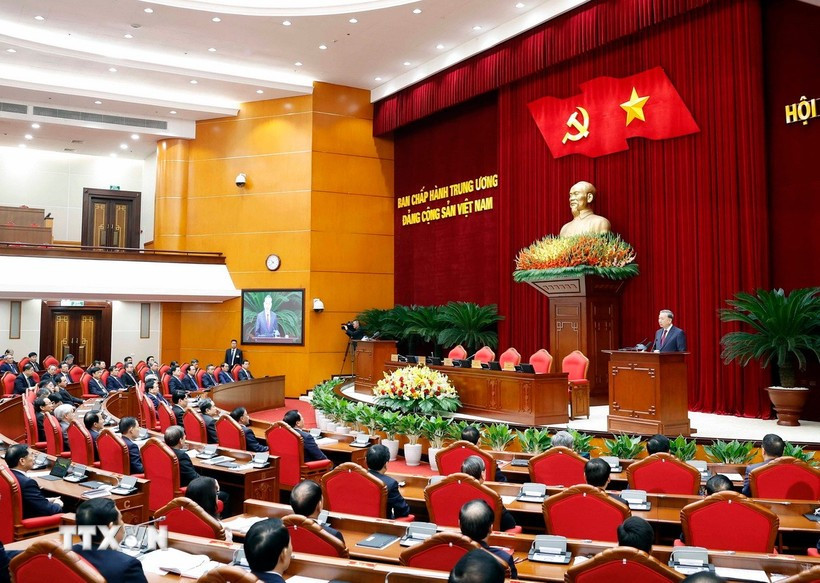
Hanoi (VNA) - At the 13th Party Central Committee’s 14th plenum, Party General Secretary To Lam outlined five key "advantages" in selecting personnel for the Politburo and the Secretariat of the 14th term. These are not only criteria for choosing leaders but also shape the nation's leadership profile.
They serve as a measure of stature, intellect, and political mettle, laying the foundation for the new term and driving the country’s development towards 2045.
As the country is entering a new phase, where the aspirations for development have been clearly defined in the Party’s resolutions, choosing individuals to take on historic responsibilities is of decisive importance.
The first requirement is to have a national strategic vision and the ability to maintain the country's autonomy. This vision not only entails foresight but also sharpness and the courage to choose a development path which is independent, self-reliant, not dependent on, and not caught up in external currents.
In a world marked by volatility and fiercer strategic competition between major powers, leaders must be able to see opportunities within challenges, identify risks early, and protect the nation's interests.
Nearly 40 years of renewal have demonstrated that many of Vietnam's great successes are closely tied to individuals with far-reaching visions, such as those behind the orientation toward international economic integration, the development of the private economy, and the current push for green transition and digital transformation.
A strategic vision is the factor that distinguishes policymakers from national leaders.
The second requirement is leadership and command ability on a national scale. A leader must not only excel in one industry or field but should possess the capacity to comprehensively manage, mobilise resources, and unite strengths. In today’s digital age, leaders cannot rely solely on administrative experience; they need organisational and executional skills, setting clear, specific goals, establishing individual responsibilities, measuring progress with data, and ensuring decisions are carried out with a high level of public service discipline.
Third, a national leader must also have political credibility and integrity at an exemplary level for others to follow. Credibility does not stem from the position held but from character, role modeling, dedication, and tangible results.
In the history of the Vietnamese revolution, the political credibility of the leaders has always been an invaluable source of spiritual strength, gathering the trust of the people. In the current context, where society increasingly demands transparency, integrity, and effectiveness, leaders must demonstrate political mettle and ethical integrity, set themselves as examples, and place the nation's and people’s interests above all else. Political credibility is also a measure of trust and the foundation of the people's faith in the Party.
The fourth "advantage" is that high-level personnel must have the ability to turn resolutions into tangible results, and measurable outcomes. This reflects the Party's special emphasis on the quality, effectiveness, and contributions of officials, prioritising those with projects, initiatives, or plans that yield clear, impactful results. They must also possess the capability to handle crises such as natural disasters, epidemics, financial instability, or non-traditional security threats. These leaders should be decisive but also willing to listen to feedback, engage with the people, and serve their needs. Only then can they truly reflect the spirit of "actions speak louder than words" and "bringing resolutions into life."
A resolution, if not materialised with specific figures or reflected in the quality of people's lives, remains just a promise. Therefore, the ability to turn intent into real outcomes is the factor reflecting the competence of a strategic official.
Finally, the requirement for those deserving to join the Politburo and the Secretariat is to have enough endurance, both mentally and physically, to withstand the pressures of their work during the 14th term and beyond.
This may seem like a simple demand, but it holds profound significance!
In the context of increasingly heavy workloads and the rapid pace of political, economic, and social changes, a leader needs not only intelligence but also endurance to maintain alertness, resilience, a spirit of commitment, and the determination to drive reforms and overcome challenges. A leader who is healthy, resolute, and capable of working persistently embodies the image of a dynamic, modern, and effective Party. From spirit to physical strength, political endurance guarantees stability and the capacity for long-term leadership.
Therefore, the five "advantages" outlined by General Secretary Lam are not just requirements for a specific personnel term, but a long-term direction to form a leadership team with intelligence, ethics, capability, and high combat strength. This is also a preparatory step for the journey toward 2030 – the Party’s 100th founding anniversary - and beyond, towards the vision of 2045, when Vietnam aims to become a high-income, developed country. A strong Party can only be built on the foundation of strong individuals, both in terms of character and capability./.
VNA