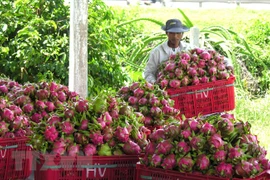
A farmer in Tra Vinh province is harvesting dragon fruits. (Photo: VNA)
 Hanoi (VNS/VNA) - Vietnam’sfruit sector should focus on gaining trust from domestic consumers beforefocusing on exports, said Deputy Director of the Plant Cultivation Departmentunder the Ministry of Agriculture and Rural Development (MARD) Nguyen Nhu Cuong.
He said high quality fruitproducts that are well consumed domestically will lay a credible foundation forthe exports in the future.
The domestic market is the mosteffective place for the country’s tropical fresh fruit industry to seekconsumers. As the country’s economy is developing and people’s incomesincrease, domestic consumers are also more conscientious than before, requiringfood, including fruit, to meet strict standards of food safety and hygiene.
If the fruit sector wants toconquer domestic customers, it needs to adjust and produce high qualityproducts capable of meeting export standards to serve the domestic market.
Nguyen Dinh Tung, General Directorof Vina T&T Import Export Service Trading Co Ltd (Vina T&T Group), saidthat many foreign customers visited Vietnam buthad few chances to enjoy delicious fruits in the domestic market.
“This is a big problem for theentire Vietnamese fruit sector. There is no reason for domestic consumers tohave no chance to enjoy the delicious and high quality fruits produced by thecountry’s farmers,” said Tung.
Tung said his group had plannedto set up a system of tropical fruit shops that meet export standards for thedomestic consumers. In this way, consumers will be treated more equitably thanbefore.
“Domestic consumers are willingto spend more to have safe products, and want to be treated the same asinternational customers,” said Tung.
Vietnam now has more than 70 differentkinds of fruits consumed in the domestic market such as grapefruit, watermelon,durian, coconut, lime, lychee and plum. More than half of these types arecurrently exported to fastidious markets such as the US, Australia,Europe, theRepublic of Korea and Japan,in addition to the MiddleEast and India.
As free trade agreements between Vietnam and other countries have comeinto effect, it’s time for Vietnamese fruits to compete with imported fruitsfrom many countries around the world. According to statistics from the GeneralDepartment of Vietnam Customs, Vietnamese consumers spend more than 1.2 billionUSD consuming imported fruits.
Nguyen Lam Vien, Chairman and GeneralDirector of Vinamit Joint Stock Company, said that his company provided thedomestic market with processed fruit products that have quality equivalent toexports.
“Our products are processed inaccordance with the US Department of Agriculture (USDA) organic standards andEuropean safety standards. All the fruit sources are granted internationalorganic certificates,” said Vien.
“Vinamit does not discriminatebetween products for the domestic market and exported ones, customerseverywhere are equally respected,” he added.
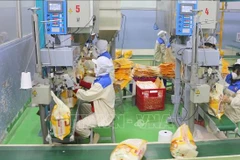
At present, Vinamit has eightprocessing lines for fruits such as frozen fruit, dried fruit, vacuum driedfruit, chocolate coated fruit, cold dried fruit and fruit candies. Theseproducts are mainly Vietnamese fruits such as dragon fruit, banana, jackfruit,durian, watermelon, avocado and strawberry.
Economist Pham Chi Lan said thatin a production chain, businesses are not only buying and selling but are alsoa bridge to develop quality brands in the market.
“High quality products which arestrongly consumed in the domestic market will create prestigious momentum whenthey are exported,” said Lan.
“In order to meet the standardsof rigorous markets such as the US,Europe, theRepublic of Korea and Japan,the domestic market itself must be a tough market to verify the quality of theproducts,” she said.
Hoang Trung, Director of thePlant Protection Department of MARD, said that to supply quality products tothe domestic market and for export, Vietnam must address problems includingquarantine and safety for fruits, and especially needs to eliminate pesticideresidue.
Vietnam has currently more than300,000ha of orchard where VietGap standards are applied to meet the domesticcustomers’ demands.
Trung said his department hadissued nearly 6,000 plantation codes for dragon fruit, mango, longan, rambutanand litchi. It was in coordination with local authorities to issue additionalcodes for the orchard growing areas for export.
“MARD has been working withenterprises to complete construction on seven agricultural product processingfactories, which will be operational this year,” said Trung.
The most important way tomaintain the domestic market is ensuring that fruit growers and fruitprocessing enterprises make high quality products, building up confidence andenticing domestic consumers to choose Vietnamese fruits over many kinds ofimported ones.-VNS/VNA
VNA