CIS: Opportunity for game developers in Vietnam

The CIS region, which includes Eastern Europe and Central Asia, has potential for gaming developers from Vietnam as this market displays user behaviour patterns that are highly favourable for mobile gaming growth, particularly around major holiday periods.

An image of a Vietnamese game. CIS region has potential for gaming developers from Viet Nam. (Photo: Courtesy of cellphones.com.vn_

HCM City (VNS/VNA) - The CIS region, which includes Eastern Europe and Central Asia, has potential for gaming developers from Vietnam as this market displays user behaviour patterns that are highly favourable for mobile gaming growth, particularly around major holiday periods.

Data from advertising company Yango Adds reveal that there is a remarkably stable annual trend in which during the eight to ten days of public holidays that mark the New Year period, gaming activity across these markets surges at every stage of the user journey.

Accordingly, searches for gaming content climb sharply as soon as the holiday begins, often reaching some of the highest levels recorded throughout the entire year.

This heightened interest quickly translates into action: install volumes rise simultaneously, with clear peaks between January 2 and January 9, a period when users have more leisure time, increased device usage, and a greater appetite for discovering new forms of entertainment.

“What makes this pattern especially valuable for developers is its predictability. The same surge appears consistently across both the 2023 - 2024 and 2024 - 2025 holiday cycles, making January one of the most reliable growth windows for gaming apps in CIS,” said Thu Nguyen, business development manager, Yango Ads Vietnam.

Beyond seasonal behaviour, Thu explained, these markets naturally align with the strengths of Vietnamese studios. “Audiences in the region respond well to polished, lightweight, mobile-first titles, the very genres where Vietnam has consistently excelled.”

She said puzzle, match-3, casual, simulation, and hybrid-casual games all demonstrate strong user engagement across the region.

“Combined with a digitally active population, widespread smartphone penetration, and a sustained appetite for visually driven, accessible gameplay, CIS emerges as a market offering not just scale but also cultural and behavioural compatibility. Unlike saturated Tier-1 regions, it provides room to grow without facing overwhelming bidding pressure or creative fatigue,” she added.

Vietnam’s gaming industry is entering a defining moment.

According to xsolla.com, a gaming company, local Vietnamese studios have already proven their ability to create globally appealing titles, from polished casual hits to inventive puzzle games enjoyed across continents.

As the industry matures, however, the challenge is no longer simply building a great game; it is finding markets where creativity can translate into efficient and scalable growth.

To capture opportunity, experts advise Vietnamese studios to consider three strategic shifts in how they approach expansion into these holiday-driven markets.

According to Thu, timing must be treated as a core element of growth.

Maintaining an always-on presence ensures steady visibility, but the real acceleration happens when campaigns intensify during the New Year holiday surge.

In addition, by acquiring users efficiently during the holiday period and monetising through in-app purchases and advertising, studios can reinvest earnings into further UA, reinforcing momentum each subsequent season. This approach reduces reliance on continual influxes of new capital and is particularly effective for rapidly evolving mobile genres.

With the right adtech partners and automated optimisation tools, Vietnamese developers can test, learn, and scale without establishing local legal entities or navigating complicated administrative processes. AI-driven systems can optimise budgets in real time, improve creative performance, and ensure that studios make the most of high-conversion periods like the New Year holidays, they said.

“Vietnam's game developers have already shown that they can build global hits. The next stage of growth will depend on choosing markets where timing, culture, and user behaviour create natural pathways to scale. Eastern Europe and Central Asia stand out as one of those rare regions, offering predictable seasonal peaks, lower competition than traditional Tier-1 markets, high-intent players, and the most cost-efficient UA window of the year,” said Thu.

Rather than fighting for increasingly expensive users in oversaturated environments, Vietnamese studios can unlock sustainable, long-term growth by looking toward this region. Here, the New Year holiday season does more than mark the beginning of another calendar year; it opens a powerful, data-backed gateway to the next chapter of Vietnam’s global gaming success, she said./.

VNA
See more

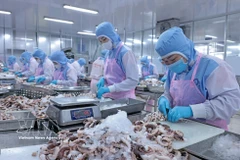
Processing octopus for export to the Japanese market at Huy Nam Company in An Giang (Photo: VNA)

Squid, octopus exports pick up early in 2026

In terms of product structure, squid has emerged as the main growth driver. Export turnover of squid exceeded 64 million USD, rising nearly 30%, while octopus exports brought in more than 47 million USD, up over 16%. The development indicates that demand for squid products is recovering faster in the short term.

The world’s longest over-sea cable car to Hon Thom Island in the Phu Quoc special zone, An Giang province. (Photo: VNA)

An Giang steps up tourism development ahead of APEC 2027

Tourism in the province has recorded strong growth, affirming its position as one of the region’s leading destinations. Phu Quoc Island continues to attract the majority of international travellers, receiving more than 817,660 visitors, accounting for over 98.5% of total foreign arrivals to the province.

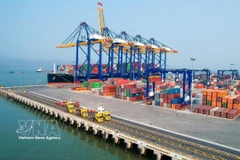
Import-export activities at Lach Huyen international port in Hai Phong (Photo: VNA)

Reducing risks, removing logistics bottlenecks amid Middle East volatility

According to Truong Xuan Trung, Trade Counsellor of Vietnam in the UAE, the Middle East serves not only as a consumption market but also as a key global transhipment hub, meaning instability in the region creates ripple effects across intercontinental transport networks. Shipping route adjustments and airspace restrictions have lengthened transit times, increased costs and disrupted delivery schedules, with some Vietnamese shipments forced to reroute or seek alternative markets.

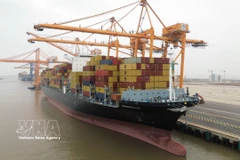
Cargo is handled at container terminals No. 3 and No. 4 of Hai Phong International Gateway Port. (Photo: VNA)

Businesses seek “survival momentum” amid global geopolitical turbulence

This is an urgent move as the challenges of 2026 differ markedly from previous ones, shaped by overlapping external shocks ranging from geopolitical tensions disrupting supply chains to surging logistics and raw material costs, exchange-rate pressures, and increasingly complex tariff barriers in global markets.

At the 2025 trade connectivity week for mechanical, electrical and digital industries. (Photo: VNA)

Ho Chi Minh City gives boost to supporting industry firms

Supporting industry firms in Ho Chi Minh City are scrambling to embed themselves more deeply into both global and domestic supply chains, backed by a suite of local incentives that are speeding up their tech upgrades and market access.

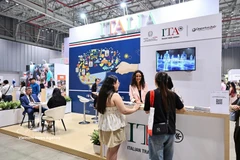
Italy's national pavilion at the ongoing Food & Hospitality Vietnam 2026 exhibition at Ho Chi Minh City's Saigon Exhibition and Convention Centre (SECC) draws visitors for hands-on experiences. (Photo: IVNA)

Italian food firms eye opportunities in Vietnam

Italy’s exports of food and beverages to Vietnam reached 105.1 million EUR in 2025, up 4% year-on-year, positioning the country among the leading EU suppliers to the Vietnamese market.

An overview of the working session (Photo: baoquangninh.vn)

Quang Ninh promotes all-round cooperation with Guangxi Zhuang Autonomous Region

Quang Ninh encourages Guangxi enterprises to invest in high-tech marine aquaculture and expand aquatic product exports in China. At the same time, the province aims to develop livestock farming in line with international standards and attract investment in deep-processing plants for agricultural products such as cinnamon, star anise and tea, linked with traceability systems at border gates.

Illustrative image (Source: VNA)

Vietnam becomes fastest growing market for Norwegian salmon in Southeast Asia

The Norwegian Seafood Council (NSC) reported at the “Norwegian seafood industry in Vietnam market 2026” event held in Ho Chi Minh City on March 25 that fresh Norwegian salmon exports to Vietnam jumped 16% in volume in the first two months of 2026 compared with a year earlier, while frozen salmon shipments surged about 37%.

At a petrol station (Photo: VNA)

Energy giants work hard to roll out E10 RON95 sale ahead of schedule

Petrolimex and PVOIL, are in a strong position to accelerate the transition toward cleaner fuels. These companies have been actively preparing infrastructure, upgrading blending systems, and coordinating supply chains to ensure the availability of E10 RON95 across their nationwide retail systems.

Deputy Prime Minister Nguyen Chi Dung visits Bosch Industrial in Stuttgart, Germany. (Photo: VNA)

Vietnam, Germany boost innovation, startup ecosystem connectivity

Deputy PM Nguyen Chi Dung highly valued CfE’s reputation and pioneering role in building Germany’s innovation-driven startup ecosystem, and called for stronger cooperation with NIC to support Vietnamese universities, research institutes and organisations in training and scientific research.