Hanoi (VNA) – Experts at the World Bank (WB) said that amid regional volatility, Vietnam has emerged as a bright spot of stability, buoyed by a strong recovery in manufacturing and domestic consumption.
In its October 2025 edition of the East Asia and Pacific Economic Update, the World Bank notes that Vietnam is likely to top the region with growth of around 6.6 % in 2025, the highest rate among developing economies in the region.
Meanwhile Mongolia and the Philippines are forecast to grow by roughly 5.9 % and 5.3 % respectively, while China, Cambodia, and Indonesia are all projected at around 4.8 %. In contrast, Pacific island nations are estimated at roughly 2.7 % growth, and Thailand at approximately 2%.
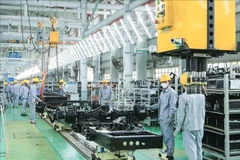
According to the WB experts, Vietnam stands out in a volatile regional environment thanks to its strong manufacturing and domestic consumption rebound. The bank applauds Vietnam’s policy governance for maintaining macro-economic stability, controlling inflation, and supporting enterprise recovery in the post-pandemic period.
The WB’s Chief Economist for East Asia & Pacific, Aaditya Mattoo, highlights that approximately 80 % of new jobs in Vietnam are generated by dynamic young enterprises, a positive signal of the vitality of the private sector. He also points out, however, that the share of young firms among all enterprises has declined in recent years, indicating structural and business-environment challenges.
Mattoo also emphasises that Vietnam has made significant progress in specialising its industry and services sectors, especially in higher value-added fields.
He said that institutional reform and labour productivity improvement will be decisive in whether Vietnam fully seizes the opportunities arising from global supply chain shifts.

For the regional outlook, the report forecasts growth of about 4.8 % in 2025 for the East Asia & Pacific region, slightly down from 5.0 % in 2024. The region’s previous model of inclusive growth is now facing new headwinds. Recent job growth has been concentrated in lower-productivity service roles, often in the informal sector, with limited potential for advancement.
Moreover, youth face difficulty in finding employment, and women’s labour-force participation remains comparatively low. Although around 25 million people are expected to escape from poverty in 2025–26, in most regional countries the number of people vulnerable to poverty still exceeds the size of the middle class.
Carlos Felipe Jaramillo, Vice-President for East Asia & Pacific at the WB, acknowledged that there exists a paradox in the region: economic growth is reasonably strong, yet it is not generating sufficient quality employment. More decisive reforms to remove barriers to market entry and competition will unlock private capital and allow dynamic and efficient firms to flourish, thereby creating more jobs.
The report also highlights short-term signals of a growth slowdown in the region. Retail sales are rising, but consumer confidence has yet to return to pre-COVID-19 levels. Industrial production is strong, but business confidence is declining. Exports accelerated ahead of the recent tariff increases, yet new export orders are weakening.
Growth in 2026 is forecast to ease to around 4.3 %. Results will be affected by rising trade restrictions, high global uncertainty, slower global growth, and domestic policy choices — in particular where countries rely heavily on fiscal stimulus rather than structural reform.
Mattoo stressed that the region’s growth model, trade-oriented and labour-intensive, lifted millions out of poverty. But now it confronts a twin challenge: trade protectionism and automation of work. Business-environment reforms and improved education can create a virtuous cycle of opportunity and capability, leading to higher growth and better jobs./.