Women’s football: Vietnam to battle Australia for Olympics berth

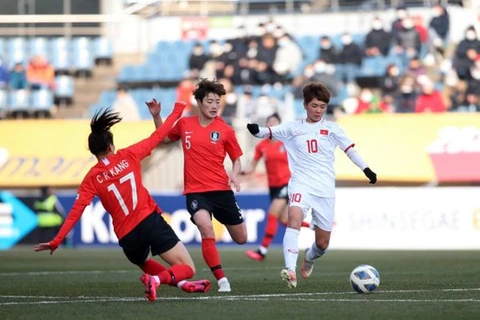
Vietnam’s women’s football team will play powerhouse Australia in a two-leg playoff next month, with a berth in the Tokyo Olympic Games in the summer on the line.
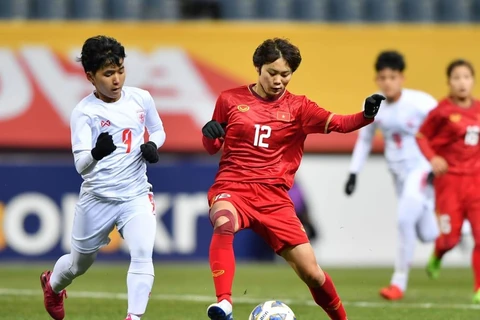
Women’s football: Vietnam to battle Australia for Olympics berth ảnh 1Mai Duc Chung’s players celebrate their 1-0 win over Myanmar in Group A of the AFC Women’s Olympic Qualifiers at the Jeju World Cup Stadium on February 6 (Photo: the-afc.com)


Hanoi (VNS/VNA) –Vietnam’s women’s football team will play powerhouse Australia in a two-legplayoff next month, with a berth in the Tokyo Olympic Games in the summeron the line.

Vietnam finished second in the third qualification round’s GroupB, while Australia finished top of their group after a 1-1 draw versus China onFebruary 13, setting up the clash with Vietnam.

Securing an aggregate win and the nation's first-everOlympic spot will be a tough task for coach Mai Duc Chung and his players.

Vietnam’s women’s football team is ranked 32nd  in the world and sixth in Asia, and has nevercompeted in any World Cup or Olympics.

Meanwhile, the Australian team stands seventh in the world and istop in the continental rankings. The team has taken part in seven out ofeight World Cups and advanced to the quarter-finals three times in 2007, 2011and 2015.

Australia has also entered three Olympics and made thelast-eight round twice. 

In head-to-head meetings between two teams in the past 10 years,Vietnam lost all seven matches, scoring two goals and conceding 37. In theirlatest meeting at the 2018 Asian Cup, Australia won 8-0. 

Chung said he knows the scale of the challenge ahead of him.

“It is good for us to reach this playoff. The next rival will bevery strong, even stronger than the Republic of Korea (who defeated Vietnam 3-0in the third qualifier),” said Chung.

Midfielder Nguyen Thi Tuyet Dung also said Australia is thetoughest rival for Vietnam in her 10-year career.

“We may not be worse than some teams but Australia is different.They are better in terms of physique and technique,”said Dung who was in thesenior Vietnamese team that lost 4-2 to U20 Australia in the AFF Cupsemi-finals in 2018.

“I think the best way is to limit our mistakes and cover ourweak points so we can make something of the matches. Of course, we will notgive up early but compete for national pride.”

The 70-year-old coach Chung said he will seek several friendlymatches to prepare his team.

The COVID-19 outbreak would make it difficult to get aninternational team to come to Vietnam, so he said he wants his players to playlocal men’s teams instead.

"If there is no international friendly, I would like tosharpen my players’ skills with several men’s team who are tall and big andgood at high balls similar to the Australians,” said Chung.

The players will have a few days rest before returning totraining next week in Hanoi.

They will visit Australia on March 6 for the first leg andhost the Australian team five days later at Quang Ninh province’s Cam Pha Stadium./.
VNA

See more

Viet Youth Readiness Hub debuts at the event (Photo: VNA)

Vietnamese Canadian youth hub launched to fight mother tongue erosion

The Viet Youth Readiness Hub is seen as a dedicated platform to connect, support, and empower Vietnamese-Canadian youth. It aims to emerge as a central force to host social events, advance heritage education, foster exchange and integration among young Vietnamese in Canada.

At the event “Vietnamese Language in the heart of Kyushu, Japan” (Photo: VNA)

Vietnamese in Japan revive mother tongue among young generations

While the number of Vietnamese-origin children in Japan is surging, opportunities to actually speak Vietnamese in daily life are vanishing fast. Many children can understand the language but default to Japanese in response, gradually relegating their mother tongue to a secondary role, sometimes even treating it as a “second foreign language” inside their own houses.

A tribute to Hung Kings in Ho Chi Minh City (Photo: VNA)

Hung Kings’ Commemoration Day 2026 to spread sacred values, foster national unity

Following the merger of Phu Tho, Vinh Phuc, and Hoa Binh provinces into the new Phu Tho province last year, the Hung Kings Temple Festival has taken on heightened significance. It now serves not only as a tribute to the ancestral homeland but also a unified cultural platform that extends sacred ancestral values to Vietnamese communities at home and abroad.

A traditional art performance at Bach Ma temple in Hanoi (Photo: VNA)

Traditional arts hold untapped economic power

Traditional arts embody deep aesthetic values, worldviews, and national identity, shaping the country’s distinctive “aesthetic identity” and foundational cultural tastes

A performance at the opening ceremony of the Hung Kings Temple Festival and the 2026 Ancestral Land Culture and Tourism Week on late April 17 (Photo: VNA)

Hung Kings Temple Festival, associated tourism week kick off

The annual festival serves as a major national cultural event, offering an opportunity for people across Vietnam and overseas Vietnamese communities to pay tribute to their ancestors, express gratitude, and strengthen the great national solidarity.

A ritual at Hue Nam Temple Festival (Photo: VNA)

Hue Nam Temple Festival: From imperial relic to distinctive cultural celebration in Hue

Historically known as Ngoc Tran Son Tu, the temple was renamed Hue Nam during the reign of King Dong Khanh in the late 19th century, symbolising royal gratitude to the Mother Goddess. It is also the only temple in Hue that harmoniously combines royal ceremonial elements with folk religious practices, creating a distinctive blend of court ritual and popular belief.

Participants in the 20th Cong hien (Devotion) Awards presentation ceremony in Hanoi on April 15 (Photo: VNA)

Devotion Awards mark two decades of honouring excellence in music, sports

Nguyen Thien Thuat, Editor-in-Chief of the The Thao & Van Hoa newspaper and Head of the organising board of the awards, said, noting that their achievements reflect the spirit of the Politburo’s Resolution No. 80, which emphasises preserving national cultural values while selectively absorbing the essence of world culture.

Artisans and students take part in cultural activities and exchanges in the Xoan singing performance space at Hung Lo ancient communal house in Phu Tho province (Photo: VNA)

Ancestral legends revived through contemporary performance

Beyond cultural value, well-organised festival programmes linked with tourism and media can contribute to the development of cultural industries and enhance Vietnam’s cultural soft power, positioning heritage-based events as distinctive national cultural brands in the international arena.