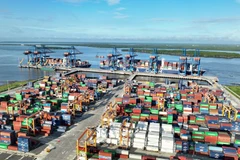
Hanoi (VNA) - Vietnam's agricultural, forestry, and fisheries sector recorded robust growth in the first seven months of 2025, with exports reaching 39.68 billion USD and a trade surplus surpassing 11.5 billion USD, up 14.7% and 15.9%, respectively, according to the Ministry of Agriculture and Environment.
July alone produced exports worth 6.01 billion USD, a year-on-year increase of 13.4%.
Broken down by sector, farm produce contributed 21.49 billion USD, up 17%, while livestock products brought in 339.2 million USD, up 22.1%. Fisheries exports reached 6.06 billion USD, up 13.8%, and forestry products posted 10.38 billion USD, up 8.6%. Input materials for production earned 1.4 billion USD, up 30.2%, and salt contributed 6.4 million USD, more than doubling last year’s figure.
By region, Asia was the largest export destination with a 42.6% share, followed by the Americas (23.3%), and Europe (15.1%). Africa and Oceania accounted for 3.1% and 1.3%, respectively. Shipments to Asia rose by 3.3%, the Americas by 14.7%, Europe by 43.1%, Africa by 88.9%, and Oceania by 4.4%.
Among individual markets, the US leads with its 21% share, followed by China at 18.4% and Japan at 7.2%. Exports to the US increased by 12.1%, while shipments to China grew by 3.6%. Japan demonstrated strong appetite for Vietnamese products, with imports rising 23.6%.
On the import side, Vietnam also saw increases across most regions, with imports from Asia rising by 19.6%, Americas 11.2%, Europe 17.9%, and Africa 13.4%.

Surpluses were recorded in three major categories of forestry, fisheries, and farm produce. Forestry products achieved a surplus of 8.39 billion USD (up 4.9%), fisheries 4.18 billion USD (up 7.5%), and farm produce 4.28 billion USD (up 33.4%).
Meanwhile, some categories remained in deficit. Inputs for production ran a 3.1 billion USD trade deficit, narrowing by 6.9%. Livestock products recorded a 2.21 billion USD deficit, widening by 22.9%. Salt imports left a 15.9 million USD deficit, down 9.2%.

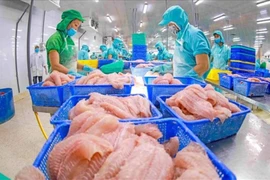
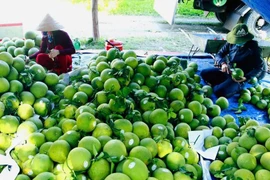
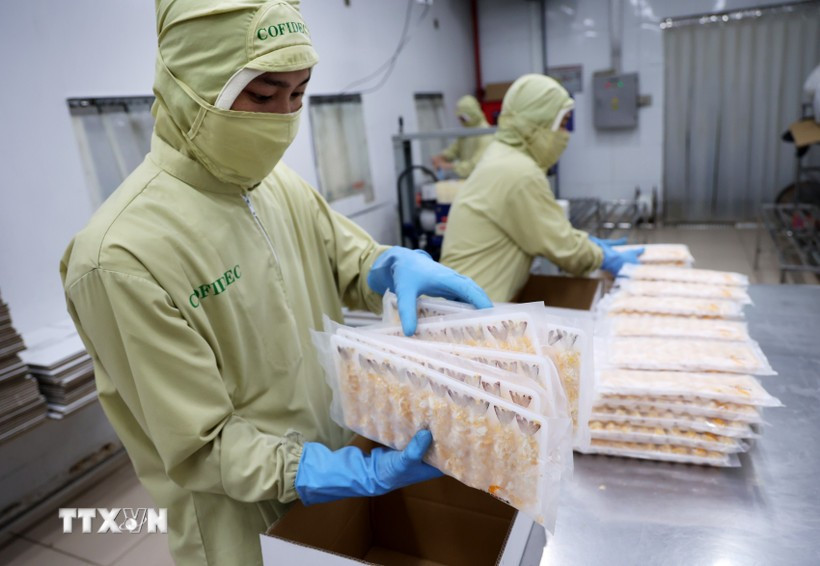
Six major commodities achieved surpluses of over 1 billion USD each. Wood and wood products topped the list at 7.7 billion USD, up 4.1%. Coffee followed with 5.78 billion USD, marking a sharp 66% surge. Fruit and vegetable exports recorded a 2.47 billion USD surplus, down 7.1%. Shrimp posted 2.08 billion USD, up 16.3%; rice stood at 1.81 billion USD, down 30%, and tra fish brought in 1.11 billion USD, up 8.3%.
Five product categories with largest trade deficit during the seven-month span were animal feed and raw materials (1.89 billion USD), cotton (1.88 billion USD), crop-based products (1.72 billion USD), corn (1.29 billion USD), and meat and by-products (917.7 million USD).
In the third quarter of this year, the Ministry of Agriculture and Environment eyes 14-15 billion USD in exports, while in the final quarter, it plans to accelerate shipments, capitalising on rising year-end demand, festivals, and the Lunar New Year to achieve a turnover of at least 16 billion USD./.