Australian writer shares impressions of Hanoi’s “Five City Gates” tourist train

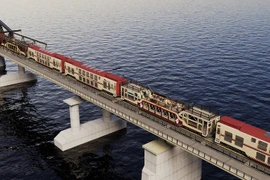
Dubbed a “moving cultural space”, the 40-minute journey departs from Hanoi Railway Station, runs along Train Street and through busy intersections crowded with cars and motorbikes, crosses the Red River via historic Long Bien Bridge, and arrives at Tu Son Station in neighbouring Bac Ninh province.

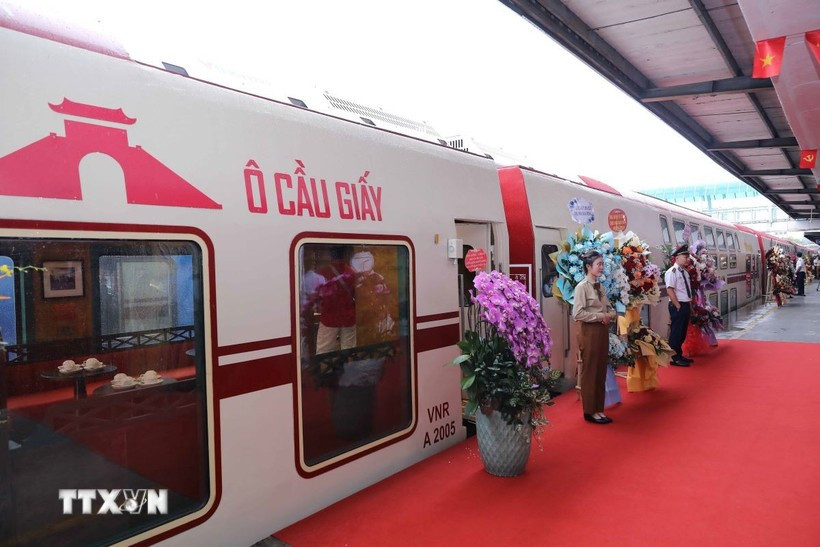
Named after five historic gates of the Red River Delta region – Cau Den, Quan Chuong, Cau Giay, Cho Dua and Dong Mac, the train’s luxuriously appointed carriages are designed in a nostalgic Indochine style. (Photo: VNA)

Sydney (VNA) – Australian newspaper The Age on February 25 published an article by travel writer Julie Miller highlighting a new and safer way to experience Hanoi’s famed Train Street – aboard the “Hanoi Five City Gates” tourist train.

Dubbed a “moving cultural space”, the 40-minute journey departs from Hanoi Railway Station, runs along Train Street and through busy intersections crowded with cars and motorbikes, crosses the Red River via historic Long Bien Bridge, and arrives at Tu Son Station in neighbouring Bac Ninh province. From there, passengers continue by bus to Do Temple, one of Vietnam’s most important cultural relics dedicated to the eight kings of the Ly Dynasty.

Named after five historic gates of the Red River Delta region – Cau Den, Quan Chuong, Cau Giay, Cho Dua and Dong Mac, the train’s luxuriously appointed carriages are designed in a nostalgic Indochine style.

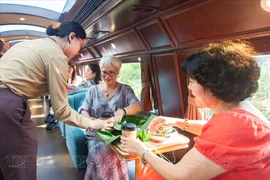
Miller recounts antique decorative items, heritage photographs and varied seating arrangements, including bench seats facing panoramic windows. In her carriage, an old rickshaw plumped with cushions and brightly coloured conical hats hanging from the ceiling added to the retro ambience.

While the upper deck features a glass-domed roof, she notes that the lower level offers the best views of Train Street, where passengers find themselves face-to-face with tourists waving and taking photos as the train whooshes past. The experience, she writes, is both thrilling and amusing, while offering a vivid sense of how closely daily life unfolds alongside the railway tracks.

On board, guests are served a sticky rice snack and cups of jasmine-scented lotus tea, accompanied by intimate performances of traditional Vietnamese music. Train staff dressed in traditional attire pose for photographs with passengers, many of whom embrace the occasion by wearing colourful Ao Dai.

Beyond the train itself, Miller says scenes along the route struck her. Lines of schoolchildren waving enthusiastically at foreign visitors, worshippers offering incense at the Do Temple, and Quan Ho folk singers performing aboard dragon boats on a nearby lake were memorable highlights of the journey./.

VNA

See more

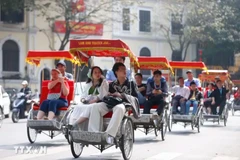
International tourists take a cyclo tour around Hoan Kiem Lake in Hanoi. (Photo: VNA)

Hanoi prepares new tourism products

A highlight is the continued preparation of dossiers seeking national tourism site recognition for three areas, namely Ba Vi National Park tourism area, Huong Son landscape complex, and the Hoan Kiem Lake and Old Quarter vicinity.

Spectacular fireworks over Kiss Bridge in Phu Quoc Special Zone of An Giang province. (Photo: VNA)

Tourism development strategy to be shaped for new era

As Vietnam enters a new phase of development, tourism is poised for a breakthrough that can reaffirm its role as a key engine of economic growth. In this context, refining the policy framework and fostering an open, modern development environment have become essential prerequisites for accelerating momentum and unlocking the sector’s full potential.

With just a smartphone, travellers can search for and book a variety of travel services for their journey. (Photo: VNA)

Digital transformation – a lever for building a smart tourism ecosystem

In recent years, digital transformation has become a common feature in socio-economic development strategies. For tourism – a multi-sector, experience-driven industry closely tied to information – digitalisation is no longer a trend but an inevitable requirement to enhance competitiveness and ensure sustainable development.

International tourists at Phu Quoc International Airport in An Giang province. (Photo: VNA)

Advertising technology bolsters tourism

Success in 2026 will depend on how effectively Vietnam continues to remove friction from the traveler’s journey – addressing critical areas like payment gateway interoperability and digital service seamlessness – to ensure that global intent is fully converted into high-value impact on the ground.

International visitors experience the traditional new year calligraphy activity (Photo: VNA)

Tet tourism season sees strong nationwide growth

The holiday from February 14–22 saw tourism activities flourish not only in major cities but also across many localities nationwide. Average room occupancy at accommodation facilities reached up to 60%, with several destinations posting notably high rates, including Phu Quoc at around 95%, Sa Pa at 90–95%, and Da Lat and Phan Thiet at 80–90%.

Visitors explore a calligraphy writing space in Thuan Hoa ward, Hue city, during the Lunar New Year 2026. (Photo: VNA)

Tourism flourishes during Tet, welcoming 14 million visitors

During the nine-day Lunar New Year (Tet) holiday, Vietnam's tourism sector served an estimated 14 million visitors, up 12% year-on-year, according to the Vietnam National Authority of Tourism (VNAT) under the Ministry of Culture, Sports and Tourism.

Hanoi is estimated to welcome about 1.34 million travellers during the nine-day Lunar New Year (Tet) holiday from February 14–22. (Photo: VNA)

Hanoi serves 1.34 million tourists during Tet holiday

This strong growth underscores Hanoi’s robust tourism appeal from the start of the new year. The structure of international source markets continued to expand, with key markets, including China, the Republic of Korea (RoK), India, France, the UK, the US, Germany and the Philippines.

A corner of Con Dao Island (Photo: VNA)

Con Dao emerges as bright spot on global tourism map

Prestigious fashion magazine Vogue has officially listed Con Dao Island, part of the great Ho Chi Minh City metropolitan area, among the world’s most ideal honeymoon destinations for 2026, underscoring the strong potential of the island district in capturing the high-end resort market.

Coffee shops overlooking lush green terraced fields and set close to nature in Ta Van, Lao Cai province, are popular with visitors. (Photo: VNA)

Lao Cai draws tourists on first days of Lunar New Year

Total tourism revenue across the province is estimated at 700 billion VND (26.95 million USD), with overall room occupancy rates reaching 70% – 80%. Sa Pa continued to affirm its appeal, generating an estimated 459 billion VND in revenue and recording occupancy rates of between 90% - 95%.