Beneath Vietnam’s forest, a cave system ranks among Southeast Asia’s longest

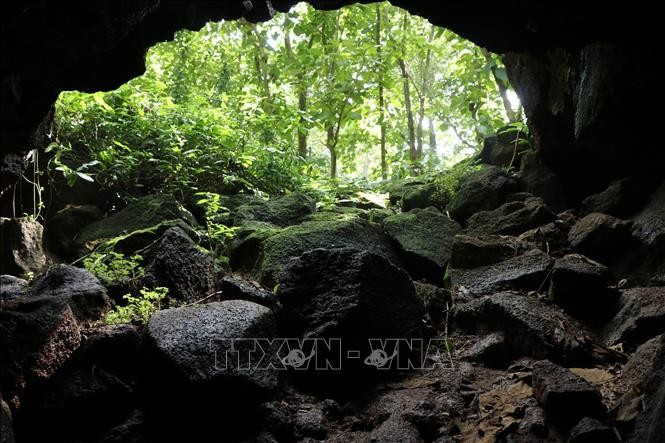
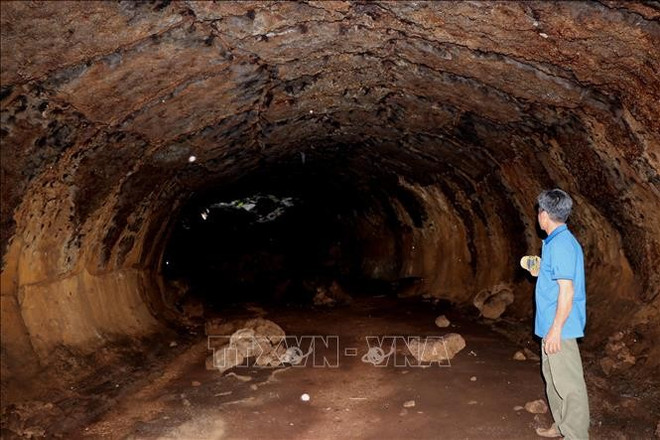
The cave system is in an arched formation, with colourful rock layers in predominantly brown hues forming the ceiling near the entrance. Some passages feature low ceilings that barely touch visitors’ heads.

The entrance of the volcanic cave systems in Dong Nai (Photo: VNA)

Dong Nai (VNA) – Deep in the teak forest in Phu Hoa commune, the southern province of Dong Nai, lies one of Southeast Asia’s longest volcanic cave systems that has remained untapped despite its extraordinary significance.

The discovery was made by explorers from the German Speleological Federation and experts from Vietnam’s Institute of Tropical Biology, who surveyed a cave network in the Phu Hoa commune, which was formerly part of Tan Phu and Dinh Quan districts. Their findings revealed that Doi (bat) Cave stretches up to 534 metres, including collapsed sections, with its longest continuous passage measuring 426 metres. At its widest point, the cave reaches four metres high and ten metres wide.

The La Nga Agricultural Seed Station manages the teak forest sheltering the cave. Planted in 1958 on 165 hectares, the forest was originally intended to supply wood for gunstocks and reforestation projects. Locals later named the site Bat Cave, owing to the thousands of bats inhabiting its dark chambers.

The cave system is in an arched formation, with colourful rock layers in predominantly brown hues forming the ceiling near the entrance. Some passages feature low ceilings that barely touch visitors’ heads.

Ho Huu Duc from the La Nga agricultural seed station said that the cave was once a shelter for Vietnamese soldiers during the resistance war against the US. After national reunification, settlers discovered several cave entrances, but few dared to go deep inside due to the narrow passages and lack of oxygen.
vocalnic-cave-dong-nai-vna.jpg
Inside the cave system (Photo: VNA)


Apart from large bats, the cave system hosts spiders, centipedes, scorpions, and crickets, among others. Local authorities and conservation groups have urged residents not to enter the caves to hunt bats, stressing the importance of protecting biodiversity.

Several cave specialist teams have conducted site visits and proposed collaborative tourism development projects focused on cave exploration. However, local authorities and relevant agencies have yet to reach a consensus on comprehensive planning for the exploitation and conservation of this remarkable volcanic cave system./.
VNA

See more

Nho Que River - a masterpiece of nature in the Dong Van Karst Plateau in Tuyen Quang province (Photo: VNA)

Vietnam solidifies standing in global tourism landscape

Vietnam has once again been honoured as the World’s Leading Heritage Destination in 2025 by the World Travel Awards (WTA), marking its sixth recognition after the wins in 2019, 2020, 2022, 2023, and 2024 and reaffirming its foothold in the global tourism industry.

A double-decker sightseeing bus in Ho Chi Minh City. (Photo: VNA)

HCM City elevates destination appeal, enhances tourism workforce quality

As Ho Chi Minh City’s tourism sector continues to sustain growth momentum, it is shifting strongly from post-merger recovery to development acceleration, with a focus on restructuring destination spaces to offer diverse tourism models and attract more domestic and international visitors.

Visitors tour Ngo Mon (Noon Gate) at the Hue Imperial Citadel. (Photo: VNA)

Visit Vietnam Year – Hue 2025: renewing heritage, shaping distinct brand

Visit Vietnam Year – Hue 2025 has left a series of strong imprints, reflecting a marked transformation in Hue’s tourism in terms of scale, quality and brand positioning. More than a programme of events, it has become a powerful driver, helping position Hue as a competitive cultural and heritage tourism centre in the region.

A view of the talkshow within the conference in Hue on December 12 to review and discuss strategic orientations for the 2023-2025 roadmap to reduce plastic waste in the local tourism sector. (Photo: VNA)

Hue accelerates shift toward green, low-plastic tourism models

Over the past three years, Hue tourism authorities have strengthened communication and advocacy for plastic waste reduction through 10 training sessions with 690 participants, “Coffee Talk” events, professional Zalo groups, and direct engagement with businesses. As a result, 102 enterprises and business households have signed commitments to reduce plastics, and 12 hotels have pioneered plastic-reduction practices.

The inaugural flight from New Delhi lands at Phu Quoc International Airport (Photo: Sun Group)

Phu Quoc welcomes new direct flights from India

Phu Quoc International Airport welcomed over 180 Indian travellers on a new direct flight from New Delhi on December 10, marking the start of a month-long flight series that will link the two destinations and bring a fresh wave of visitors to Vietnam’s pristine island.

Visitors pose for a photo at Ben Thanh Market in HCM City (Photo: VNA)

HCM City speeds up digital tourism to draw more travellers

Following its goal of building a friendly destination, the Ho Chi Minh City Department of Tourism is rolling out a range of local stimulus programmes, with a focus on bringing the city’s signature attractions closer to domestic and international visitors through digital platforms.

Foreign visitors are touched to receive meaningful gifts from their Vietnamese friends (Photo: VietnamPlus)

Vietnam welcomes more than 19 million international visitors in 11 months

A UN Tourism report highlighted Vietnam’s performance as one of the most notable recoveries worldwide. While tourism across the Asia–Pacific has rebounded to only around 90% of pre-COVID levels, Vietnam is among a select group of destinations, alongside Japan, recording rapid and sustained growth, it said.