Cashless payment festival launched in HCM City

As of 2024, Vietnam had recorded over 204.5 million bank accounts held by individual customers and 154.1 million bank cards in circulation. Nearly 87% of Vietnamese adults now have bank accounts.

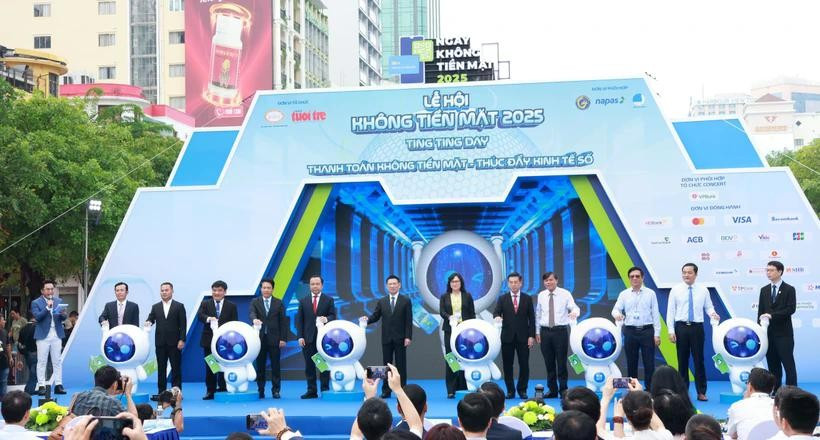
The “Ting Ting Day” Festival opens on June 14 in HCM City (Photo: VNA)

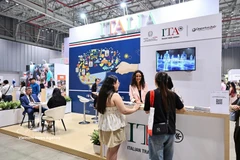
HCM City, (VNA) - The “Ting Ting Day” Festival opened on June 14 on Nguyen Hue pedestrian street in District 1 as part of the 2025 HCM City Cashless Day programme, aimed at promoting cashless payments and the development of the digital economy.

The event is co-organised by the State Bank of Vietnam, Tuoi tre (Youth) newspaper, the HCM City Department of Industry and Trade, and the National Payment Corporation of Vietnam.

As a key highlight of the 2025 HCM City Cashless Day, the festival offers thousands of visitors the chance to experience modern cashless payment methods — including cards and e-wallets — while purchasing food, drinks, beauty products, and a wide variety of other goods from participating businesses.

Visitors also enjoy special promotions and giveaways, take photos with eye-catching decorations, and play mini-games themed around cashless payment.

A modern take on the traditional market is simulated at the festival, where vendors promote their products via livestream and customers can purchase food items simply by scanning QR codes.

In addition, attendees can explore an exhibition showcasing the evolution of cashless payments in HCM City and discover the latest in financial technology from leading Vietnamese banks, e-wallet providers, and payment intermediaries.

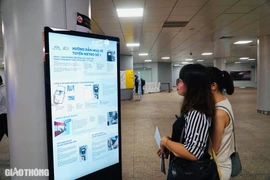
Several visitors tried using their bank cards to pay for a metro ride simply by tapping the cards on a scanner — a quick and seamless experience.
As part of the 2025 Cashless Day and the Vietnam Grand Sale, a 2025 Shopping Season will be held in HCM City in two phases: from June 15 to September 15, and from November 15 until the end of the year.

More than 10,000 businesses across various sectors will offer a wide range of promotional deals to attract customers — particularly targeting workers in industrial parks and export processing zones, as well as shoppers at major malls and city-wide events.

As of 2024, Vietnam had recorded over 204.5 million bank accounts held by individual customers and 154.1 million bank cards in circulation. Nearly 87% of Vietnamese adults now have bank accounts./.
VNA

See more

Certificates of membership in the Vietnam International Financial Centre in Da Nang are awarded at the conference on January 9. (Photo: VNA)

Da Nang continues targeted investment promotion approaches

According to Chairman of the Da Nang People’s Committee Pham Duc An, the city prioritises building sustainable economic ecosystems and focuses on key breakthrough sectors with strong spillover effects, including high technology and digital transformation, logistics, urban infrastructure, finance, processing and manufacturing industries, high-tech agriculture, and the pharmaceutical and medicinal herb industry.

In 2025, Hyundai sales reached 53,229 vehicles across the Vietnamese market. (Illustrative photo: Yonhap/VNA)

Hyundai sales in Vietnam rise almost 23% in December

In 2025, sales reached 53,229 vehicles across the market, a result considered a testament to the efforts by TC Group, Hyundai Thanh Cong, and the entire Hyundai dealership network nationwide amidst a volatile market.

Hydroponic vegetable cultivation model at the High-Tech Agricultural Park (Photo daibieunhandan.vn)

HCM City accelerates shift toward ecological urban agriculture

​The city’s agricultural sector is undergoing a strong transformation, restructuring toward higher value-added and sustainable development. In recent years, the sector has maintained steady growth, with agricultural, forestry and fisheries output rising by an estimated 2.5% annually.

Illustrative photo (Photo: VNA)

Dong Nai to launch major projects ahead of 14th National Party Congress

The launch of work on these projects represents an important political event for the province as they demonstrate the strong commitment of the entire political system to developing a comprehensive and modern infrastructure network, enhancing inter-regional connectivity, and addressing social welfare needs.

Illustrative image (Photo: VNA)

Lam Dong ready for nationwide economic census 2026

The entire process needs to reassure respondents that statistical activities operate independently, information is protected under the Statistics Law, and all data collection is completely separate from tax management.

Officials cut the ribbon to inaugurate the IFC Da Nang. (Photo: VNA)

Vietnam launches International Financial Centre in Da Nang

The Government has clearly defined the development orientation of the International Financial Centre in Da Nang as a modern international financial hub closely linked with the innovation ecosystem, digital technology, and sustainable finance.

Officers of the Thanh Hai Border Guard Station (Phu Thuy ward, Lam Dong province) patrol and monitor fishing vessels entering and leaving the port. (Photo: VNA)

Lam Dong steps up oversight to curb IUU fishing

As of early January 2026, the province had 8,210 registered fishing vessels, with more than 90% holding valid fishing licences, according to the department. A total of 8,115 vessels, or 98.76%, have been updated in the National Population Database, while 1,773 out of 1,941 vessels measuring 15 metres or longer have been granted food safety certificates, accounting for 91.34%.

Prime Minister Pham Minh Chinh speaks at the national conference on accelerating public investment for 2025 and 2026 (Photo: VNA)

People’s legitimate rights, interests must never be overlooked in public investment: PM

The Prime Minister underlined that public investment has consistently been identified as a key political task, with public investment disbursement results serving as one of the criteria for evaluating officials under Party regulations. Through state spending, public investment directly boosts aggregate demand and serves as an effective tool for regulating and stabilising the macroeconomy while safeguarding major economic balances.