Central, Central Highlands localities set ambitious visions for development

Localities in the Central and Central Highlands region all identified science – technology development, innovation, and digital transformation as a top breakthrough and the key driver for socio-economic development.

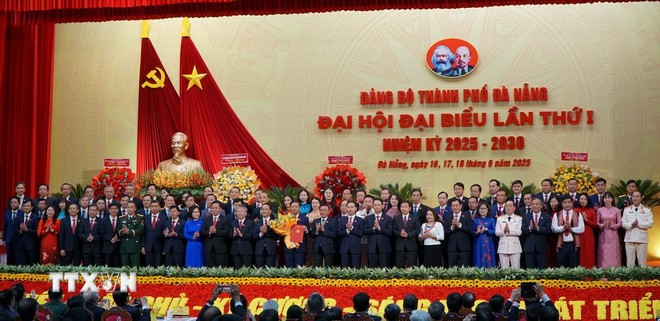
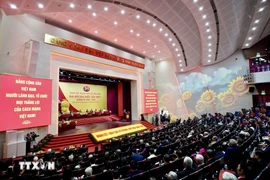
A view of the first Congress of the Party Organisation of Da Nang city for the 2025 - 2030 (Photo: VNA)

Da Nang (VNA) – Political reports presented at the Congresses of the Party Organisations of localities in the central and Central Highlands region have highlighted a broader vision and strong ambition for annual economic growth of at least 10%, and the determination to develop major and well-connected infrastructure projects to unlock new development opportunities and promote breakthroughs.

Strategic infrastructure breakthroughs

Currently, most provinces and cities in the central and Central Highlands region are expanding development space, placing special emphasis on investing in strategic infrastructure, particularly transport, to enhance connectivity and drive socio-economic development in the coming time.

As the core hub of the central and Central Highlands region, Da Nang aims to become a growth pole of Vietnam by 2030, targeting an annual average GRDP growth of at least 11%. By 2045, the city is expected to become an ecological and smart urban centre, serving as a free trade hub, international financial centre, industrial and logistics hub, innovation and startup centre, as well as a livable and high-standard tourism city in Asia.
gia-lai.jpg
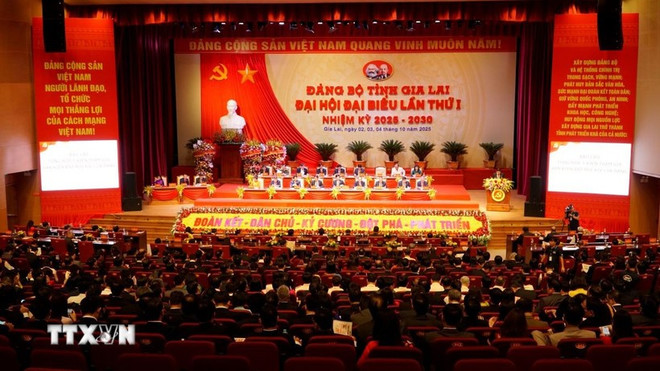
The closing ceremony of the Congress of the Party Organisation of Gia Lai province for the 2025 - 2030. (Photo: VNA)

In the next five years, Da Nang will focus on accelerating the progress of key infrastructure projects, including developing Lien Chieu port into an international gateway in the region; expanding Terminals T1 and T2 at Da Nang International Airport to a capacity of 10 million passengers per year; upgrading Chu Lai airport to international standards; developing strategic interregional East–West transport infrastructure; and others.

The city will also consider investing in the Da Nang–Thanh My–Ngoc Hoi–Bo Y expressway and other transport projects connecting Da Nang with southern Laos and northeastern Thailand, as well as several urban railway lines.

As Vietnam’s second-largest province, Gia Lai will concentrate on developing a modern, smart, and well-connected socio-economic infrastructure system to meet its growth demand, including a provincial road network; expressways and national roads linking key economic and tourism zones; a railway connecting provinces in the Central Highlands, and two new freight railway stations in Tuy Phuoc and Van Canh communes to serve cargo transportation to and from Quy Nhon port, Nhon Hoi Economic Zone, and logistics centres.

The locality will also invest in new terminals, expand aprons, and construct a second runway and taxiways in line with the plans for Phu Cat and Pleiku airports; expand or build new docks at Quy Nhon–Thi Nai–Dong Da, Nhon Hoi, and Phu My and Hoai My ports. Other projects include building Thi Nai 2 Bridge, completing the coastal road connecting to Quang Ngai province; and constructing a new provincial administrative centre in Nhon Hoi Economic Zone.

Meanwhile, Quang Ngai province, strategically located at the Indochina crossroads and serving as the gateway from the Central Highlands to the sea, will prioritise key and strategic interregional projects, especially in transportation, including completing the Quang Ngai–Kon Tum expressway, a coastal road, Mang Den and Ly Son airports, and upgrading major national highways to create a seamless transport corridor from the Central Highlands to the sea with international connectivity.

Motivations for socio-economic development

Localities in the Central and Central Highlands region all identified science – technology development, innovation, and digital transformation as a top breakthrough and the key driver for socio-economic development.

Khanh Hoa aims to become a centrally-run city by 2030, a national growth pole and modern maritime economic hub. It will speed up economic restructuring through science, technology, innovation, and digital transformation, with high-tech industry, renewable energy, logistics, digital economy, tourism, and the private sector as key growth pillars. By 2030, the province aims to rank among the top 10 in the country in developing infrastructure for scientific research, technological advancement, innovation, and digital transformation.

Meanwhile, Gia Lai plans to restructure its economy and establish a new growth model, using science, technology, innovation, and digital transformation as the main drivers to boost productivity, quality, efficiency, value-added, and competitiveness. It will focus on developing the digital, green, and circular economy and building a digital society, aiming to make the locality an increasingly attractive destination for domestic and international tech businesses and scientists, as well as a regional centre for science, technology, and innovation.

Da Nang sets to become a leading city in science, technology, innovation, startups, and digital transformation by 2030 through finalising related mechanisms and policies in line with Resolution No. 57-NQ/TW. It will pay attention to effectively implementing the regulatory sandbox for new technological solutions, prioritising areas such as blockchain, fintech, artificial intelligence, robotics and automation, and digital assets.

Da Nang will prioritise resources and international cooperation for infrastructure investment to support science, technology, innovation, and digital transformation, particularly projects such as an AI research and training lab, a small-scale semiconductor advanced packaging Lab-Fab, and a Da Nang innovation space.

In his address at the 1st Congress of the Party Organisation of Da Nang, Politburo member and Permanent Member of the Party Central Committee's Secretariat Tran Cam Tu urged Da Nang to proactively explore new growth models and drivers, build on science, technology, innovation, and digital transformation; and focus on improving the investment environment while enhancing economic productivity, quality, and competitiveness./.
VNA

See more

NA Chairman and President of the National Election Council Tran Thanh Man speaks at the event (Photo: VNA)

Nationwide conference on 2026 parliamentary, local elections wraps up

The outcomes of the upcoming National Assembly and People's Council elections will be critical to upholding democracy, reinforcing great national unity, fostering public trust, and ensuring the success of comprehensive national renewal, and the process of building and safeguarding the Socialist Republic of Vietnam as well.

Party General Secretary To Lam speaks at the conference. (Photo: VNA)

Party chief highlights key tasks to ensure successful 2026 elections

With the determination of the Party committees, authorities, and over 100 million voters across the country, Party General Secretary believed that the elections will be a success and truly become a great festival of the Vietnamese people where the will of the Party is united with the aspirations of the people.

Party General Secretary To Lam with residents of Thuong Cat ward, Hanoi. (Photo: VNA)

Party chief joins Great National Unity Festival in Hanoi's Thuong Cat ward

Party General Secretary To Lam stressed the spirit of the “Five Dares” (dare to think, dare to speak, dare to act, dare to take responsibility, dare to innovate for the common good) and the “Three Togethers” (planning together, acting together, sharing together) to strengthen national unity.

Prime Minister Pham Minh Chinh speaks at the meeting (Photo: VNA)

PM asks for fast-tracking projects ahead of APEC 2027

To host APEC 2027, An Giang province proposed and received approval for 21 infrastructure projects in the Phu Quoc special zone, with a total estimated investment of 137 trillion VND (nearly 5.2 billion USD).

General Phan Van Giang, Vietnam’s Minister of National Defence, and General Tea Seiha, Deputy Prime Minister and Minister of National Defence of Cambodia, at Border Marker 171 at Bavet International Border Gate (Cambodia). (Photo: VNA)

Vietnam, Cambodia promote border peace, friendship

The Vietnam–Cambodia Border Defence Friendship Exchange contributed to building a Vietnam–Cambodia border line of peace, friendship, stability, cooperation and development, reinforcing political trust and directly promoting the friendship and solidarity between the two nations.

General Phan Van Giang, Vietnam’s Minister of National Defence, and General Tea Seiha, Deputy Prime Minister and Minister of National Defence of Cambodia, pose for a commemorative photo at the friendship tree-planting area at Bavet International Border Gate. (Photo: VNA)

Vietnam, Cambodia hold border defence friendship exchange

The year 2025 has seen robust progress in bilateral defence cooperation, reflected through delegation exchanges, training and capacity-building activities, joint rescue and disaster response drills, and trilateral exchanges among Cambodia, Laos, and Vietnam.

The third meeting of the National Election Council is held on November 10, 2025. (Photo: VNA)

Nationwide conference to roll out preparations for NA, People's Council elections

The conference on November 15 aims to contribute to the successful organisation of the elections of deputies to the 16th National Assembly and People’s Councils at all levels for the 2026-2031 tenure in a democratic, lawful, safe and economical manner, truly making them a festival of the entire people and strengthening public trust in the Party, the State, and the country’s renewal process.

The welcoming ceremony for officers and crew of the Prairial at Tien Sa port in Da Nang on November 14 (Photo: VNA)

Da Nang welcomes French navy vessel on friendly visit

The French Navy’s frigate Prairial, commanded by Lieutenant Colonel Wallerand Faivre D'Arcier, arrived at Tien Sa Port on November 14 to begin a six-day friendly visit to the central coastal city of Da Nang.

Deputy Auditor General of Vietnam Doan Anh Tho (Photo: VNA)

Vietnam attends 8th ASEAN Supreme Audit Institutions Summit in Singapore

At the summit, the Vietnamese delegation presented ASEANSAI Strategic Plan for 2026–2029; the 2025 annual performance report of ASEANSAI’s committees and Secretariat, and the committee’s 2026–2027 work plan, which are seen as instrumental in advancing ASEANSAI’s strategic development orientations for the new term.

The meeting between the delegation from the Ho Chi Minh National Academy of Politics and the Czech Senate. (Photo: VNA)

Vietnam, Czech Republic advance newly upgraded strategic partnership

Hung emphasised that the visit aimed to concretise the newly-elevated Strategic Partnership while preparing for the upcoming visit to Vietnam by senior Czech leaders. He briefed the hosts on Vietnam’s socio-economic situation, highlighting major breakthroughs in science–technology, innovation, digital transformation and human resources development.

Vietnamese Ambassador to Kuwait Nguyen Duc Thang (Photo courtesy of the embassy)

PM’s visit to Kuwait to open new development phase for bilateral ties: Ambassador

This is the first visit by a high-level Vietnamese leader to Kuwait in 16 years, taking place at a time when the two countries are preparing to celebrate the 50th anniversary of the establishment of diplomatic relations in January 2026, Vietnamese Ambassador to Kuwait Nguyen Duc Thang said, stressing that the time is ripe for both countries to consolidate and deepen their bilateral relationship, elevating it to new heights and making practical contributions to each country’s development goals.