Conference talks realisation of Vietnam-Laos border treaties

A conference was held in Dong Hoi city, in the central province of Quang Binh, on November 13 to look into the implementation of certain documents on the Vietnam-Laos borderline, border markers, and border gates.
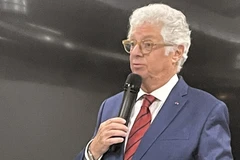
Conference talks realisation of Vietnam-Laos border treaties ảnh 1Vice Chairman of the Quang Binh provincial People’s Committee Le Minh Ngan addresses the conference in Dong Hoi city on November 13 (Photo: VNA)

Quang Binh (VNA) – A conference was held in DongHoi city, in the central province of Quang Binh, on November 13 to look intothe implementation of certain documents on the Vietnam-Laos borderline, bordermarkers, and border gates.

On March 16, 2016, the Vietnamese and LaoGovernments signed a protocol on the countries’ borderline and border markers,along with an agreement on regulations for land border and border gatemanagement. These documents took effect on September 5, 2017.

Addressing the conference, Vice Chairman of theQuang Binh provincial People’s Committee Le Minh Ngan said the treaties areimportant legal documents that fully and precisely describe the borderline andborder markers’ locations, while also specifying the responsibility andobligations in managing and protecting the shared boundary of each side. Theyhave helped to improve border management and build a Vietnam-Laos border ofpeace, stability, cooperation, and development for the sake of the two peoples.

He noted that in order to effectively realisethese documents, authorities of all levels and the general public must come tounderstand their terms, implement measures, and promote a high consensus in thematter, especially among border residents, in the management and protection ofthe borderline and border markers.

An official of the western border division ofthe foreign ministry’s National Boundary Commission informed participants on theVietnam-Laos and Vietnam-Cambodia border situation, some noteworthy issues inlocal land border management, and the realisation of the treaties.

Vietnam and Laos share a border of nearly 2,340km that runs across through 10 Vietnamese provinces: Dien Bien, Son La, ThanhHoa, Nghe An, Ha Tinh, Quang Binh, Quang Tri, Thua Thien-Hue, Quang Nam, andKon Tum. 

The line also appears in 10 Lao provinces:Phongsaly, Luang Prabang, Houaphan, Bolykhamsay, Khammoune, Savannakhet,Salavan, Xiengkhouang, Sepon, and Attapeu.

The two countries marked the completion of aproject on increasing and upgrading border markers along their boundary inMarch 2016. 

Under the project, 1,002 markers and stakes wereplanted along the joint border, compared to only 199 markers before2008. These were increased in necessary areas to further clarify theborder in reality. Meanwhile, existing markers, especially those at bordergates, were upgraded to create a system of solid and modern bordermarkers, officials said. –VNA 
VNA

See more

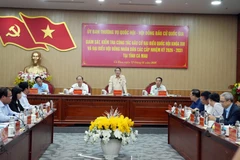
National Assembly Vice Chairman Nguyen Duc Hai speaks at the January 12 working session to inspect preparations for the elections of deputies to the 16th legislature and People’s Councils at all levels for the 2026-2031 term in the southern province of Ca Mau. (Photo: VNA)

NA Standing Committee inspects election preparations in Ca Mau

In Ca Mau, 13 candidates have been introduced for the National Assembly, 73 for the provincial People’s Council, and 1,469 for commune-level People’s Councils. The provincial election committee has designated five NA constituencies and 18 constituencies for People’s Councils at provincial and commune levels.

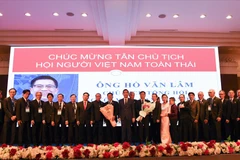
Vietnamese association in Thailand elects leadership for 2026–2028 term (Photo: VNA)

Vietnamese community in Thailand elects new executive board for 2026–2028 term

Established in July 2012 under the Thai Government approval, the Association of Vietnamese in Thailand currently has 26 local chapters and a women’s committee, and has played an active role in preserving cultural identity, supporting community development, and fostering people-to-people ties between Vietnam and Thailand.

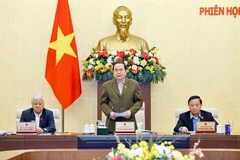
National Assembly Chairman Tran Thanh Man speaks at the event (Photo: VNA)

National Assembly Standing Committee convenes 53rd session

NA Chairman Man said the 53rd session will review and approve two resolutions on specific matters relating to the organisational structure and the contingent of prosecutors of the Supreme People’s Procuracy, as well as consider the NA’s people's aspiration report in December 2025.

Prime Minister Pham Minh Chinh meets with Uruguayan President Yamandú Orsi on the sidelines of the expanded BRICS Summit on July 7, 2025. (Photo: VNA)

Vietnam–Uruguay relations poised for further elevation: Uruguayan Ambassador

Uruguayan Ambassador to Vietnam Raúl Juan Pollak Giampietro noted that although the two countries have yet to formally establish a comprehensive partnership, the foundations of bilateral cooperation have been steadily strengthened and expanded, particularly in the fields of economy and trade, science and technology, agriculture, and people-to-people exchanges.

Assaf Talgam, a historian and a journalist of Zo HaDerekh, the official newspaper of the Communist Party of Israel. (Photo: VNA)

CPV's leadership - central factor shaping Vietnam’s enduring stability, impressive achievements: Israeli historian

Talgam said that from a comparative and historical perspective, the CPV’s leadership has been the central factor underpinning the country’s enduring political stability and impressive development trajectory. In a world marked by rapid and unpredictable changes, few political organisations have been able to maintain continuity of leadership while simultaneously adapting their governance approach as effectively as the CPV.

Prime Minister Pham Minh Chinh presents Certificates of merit from the Government’s Party Committee to individuals with outstanding achievements. (Photo: VNA)

Prime Minister outlines five specific strategies for Government’s Party Committee

PM Chinh noted that the Government’s Party Committee exercised comprehensive leadership over the Government's operations, proactively and effectively responded to emerging issues, with a particular focus on socio-economic development. As a result, 2025 witnessed high economic growth, sustained macroeconomic stability and ensured major balances.