Contactless NAPAS card payment system launched on buses

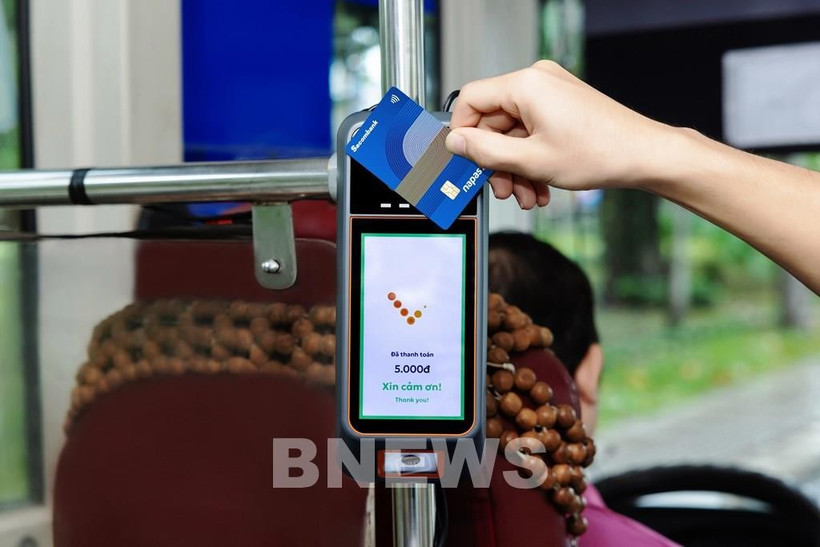
By using NAPAS cards, passengers no longer need to purchase paper tickets or load money onto separate cards, thus reducing boarding times, queues, and the use of cash.

In the coming stages, the automatic payment system is expected to be rolled out across all 138 routes, covering about 2,221 vehicles (Photo: VNA)

Hanoi (VNA) – The Vietnam National Payment Corporation (NAPAS), Saigon Thuong Tin Commercial Joint Stock Bank (Sacombank), and Ho Chi Minh City Public Transport Management Centre on September 16 officially launched the contactless NAPAS card payment method on the bus system.

This marks an important step in the modernisation of public transport and the promotion of a cashless society. As scheduled, the new payment method will be applied to over 30 bus routes, with more than 600 vehicles operated by various transportation companies. Passengers can use NAPAS domestic ATM cards issued by 28 banks to make direct payments by tapping their cards on devices installed on the buses. Additionally, some banks have launched digital card services that enable users to make payments via smartphones or smartwatches.

By using NAPAS cards, passengers no longer need to purchase paper tickets or load money onto separate cards. This cuts boarding times, minimises queues, and reduces the use of cash. This aligns with modern consumption trends and encourages people to opt for public transport over private vehicles.

Nguyen Dang Hung, Deputy General Director of NAPAS, said that there are currently more than 80 million contactless NAPAS cards in circulation. The new system in Ho Chi Minh City will allow passengers to “tap and go”, providing a quick, secure, and efficient travel experience, while expanding the use of this technology from the metro system to other forms of public transport.

Le Hoan, Deputy Director of the Ho Chi Minh City Public Transport Management Centre, emphasised that the cashless payment system is already in use on 96 routes with 1,456 vehicles, and the system will continue to expand. This will enhance the public’s experience and encourage bus usage, ultimately contributing to reduced traffic congestion and sustainable transport development. Pham Duc Duy, Deputy Director of Sacombank’s Personal Banking Division, noted that the project is a step toward expanding the digital payment ecosystem. The convenience of tapping a card will motivate people to prioritise public transport.

In the coming stages, the automatic payment system is expected to be rolled out across all 138 routes, covering about 2,221 vehicles. This is seen as a continuation of the success of the automated ticketing system on Metro Line 1, working toward a fully digitalised public transport network in Ho Chi Minh City. Earlier, in 2021, NAPAS tested the deployment of domestic card payments on Vinbus electric buses. The expansion to the city’s bus and metro systems reaffirms the commitment to creating a seamless and integrated payment ecosystem for everyday life./.

source

See more

Nguyen Huy Ngoc, Vice Chairman of the Phu Tho provincial People’s Committee, former Director of the provincial Department of Health and the provincial General Hospital (Photo: the Ministry of Public Security)

Phu Tho province's official prosecuted for bribery

According to the Ministry of Public Security, its Police Investigation Agency for Corruption, Economic and Smuggling Crimes (C03) is investigating a case involving violations of accounting regulations causing serious consequences, smuggling and receiving bribes at Viet My Medical Investment JSC and related agencies and localities.

A jobseeker applies at Hue city's employment service centre. (Photo: VNA)

Vietnam’s hiring outlook to see strong growth in Q4

In Vietnam, among 285 businesses surveyed, 52% expected to increase hiring in Q4, 16% planned to reduce hiring, while 32% intended to maintain their current workforce levels, according to the latest ManpowerGroup Employment Outlook Survey.

Gildas Tréguier, Secretary-General of the France-Vietnam Health Federation (Photo published by VNA)

‘Small bricks’ help strengthen Vietnam-France ties

Dr. Gildas Tréguier, Secretary-General of the France-Vietnam Health Federation (FSFV), said the visit comes as Vietnam is opening further to the world and entering a new stage of development, creating greater demand for experience sharing and closer cooperation with international partners, including France. After nearly 40 years of involvement in medical cooperation programmes with Vietnam, he said bilateral ties have been built not only through major events and government-level agreements, but also through the contributions of generations of people.

Cultural activities are held at the 2026 Vietnamese Language Summer Camp in Klinok village on the outskirts of Minsk, Belarus. (Photo: VNA)

Vietnamese language preserved across globe

In the new context, Politburo Resolution No. 23-NQ/TW, dated August 2, 2026, continues to place the preservation of the Vietnamese language within the strategic vision of mobilising resources from the Vietnamese community abroad and promoting Vietnamese cultural values around the world.

Overseas Vietnamese teachers participating in the 2026 training course on Vietnamese language teaching methods (Photo published VNA)

Leveraging overseas Vietnamese resources for Vietnam-France ties

As Vietnam enters a new era of prosperous and harmonious development, top leader To Lam's official visit to France will significantly contribute to the special dynamics of bilateral relations while fostering shared commitments to international peace, security, and stability.

Ambassador Nguyen Huong Tra briefs representatives of the Vietnamese communities in Belgium and Luxembourg on the country's situation. (Photo: VNA)

Overseas Vietnamese ready to contribute to national transformation

Affirming that overseas Vietnamese are an integral part of the nation and partners in its development and creation, Vietnamese Ambassador to Belgium and Head of the Vietnamese Mission to the European Union (EU) Nguyen Huong Tra pledged to listen to them openly and responsibly, and convey their recommendations to authorities at home.

The operation to remove the bomb is carried out cautiously and meticulously by military forces. (Photo: VNA)

Phu Tho: 200kg bomb safely relocated, detonated

According to a report by the Phu Tho Military Command, local residents spotted the bomb on August 31 in the Da River after the river water receded, exposing it beneath mud and soil on the riverbed. The bomb remained intact, including its fuse, and was located about 300m from a residential area.

Quang Ninh's seaport infrastructure, including the Ha Long International Cruise Port, is capable of serving large cruise ships. (Photo: VNA)

Quang Ninh 2030: Ambitious targets for a breakthrough

These objectives reflect the principle that economic development must not become detached from living standards; rather, the benefits of growth should create opportunities for all residents to share in its achievements.

A police officer guides a citizen on how to use VNeID app. (Photo: VNA)

Shift to data-driven administrative procedures needs acceleration

Under a draft decree replacing Decree 63, authorities will have to proactively pull information from databases and records for informational or technical procedures. Applicants would no longer be required to resubmit documents, and certification or information requests could not be turned into discretionary licensing through an “ask – give” mechanism.