Ho Chi Minh City charts roadmap to green public transport

HCM City is implementing a project to convert its bus fleet to electric vehicles, underscoring its commitment to environmentally friendly public transport.

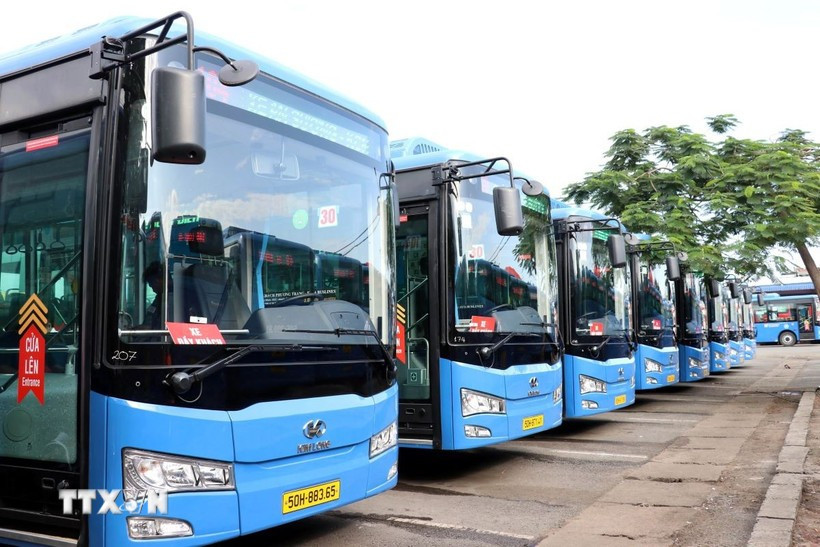
Electrical buses in Ho Chi Minh City. (Photo: VNA)

Hanoi (VNA) – As Vietnam’s economic hub, Ho Chi Minh City has been identified as a frontrunner in the national drive to “green” urban transport, with public transport placed first in the transition.

Alongside the determination to replace fossil-fuel vehicles, the city is also working to comprehensively develop infrastructure and roll out support policies for businesses, aiming to ensure a realistic and sustainable transition.

Raising electric bus share to 45.3%

HCM City is implementing a project to convert its bus fleet to electric vehicles, underscoring its commitment to environmentally friendly public transport.

Under the roadmap, from 2025, all newly invested or replaced buses must meet green standards, while from 2030 onward, 100% of buses in operation must be electric. If the plan is carried out as scheduled, the city will run around 3,200 electric and green-energy buses within the next five years.

In preparation, the municipal Department of Construction has taken early steps to replace fossil-fuel vehicles with cleaner alternatives.

In 2024–2025, the department organised open bidding for 108 subsidised bus routes. Priority was given to operators deploying new and electric buses. As a result, 627 electric buses have been put into service, accounting for 26.3% of the city’s bus fleet.

In early 2026, an additional 454 electric buses are expected to enter operation, lifting the proportion of such vehicles to 45.3%. Further tenders will be rolled out from late 2026 onwards, with the goal of fully converting the city’s bus system into a clean and green energy-powered one by 2030.

Le Hoan, Deputy Director of the Public Transport Management Centre under the Department of Construction, said international experience shows that public transport such as metro lines and buses is typically prioritised in emission-control strategies, followed by commercial transport and then private vehicles. Beyond buses, the city is also targeting the greening of ride-hailing, delivery vehicles and fleets used by state agencies.

From December 19, the centre will coordinate with transport operators to launch six electric bus routes serving Con Dao special zone, marking another step in expanding green transport solutions.

In parallel, HCM City plans to establish low-emission zones in central areas and Can Gio from 2026, as part of efforts to curb pollution and move towards net-zero emissions before 2050, in line with the Prime Minister’s direction.

Charging infrastructure gap

At present, there are only five charging stations for electric buses in the city, with 56 charging points – barely sufficient for current demand. Most have been invested by transport operators themselves, while a comprehensive public charging network has yet to take shape.

The municipal Department of Construction has proposed selecting 19 depots and parking sites to install charging facilities, creating a new revenue source through the leasing of public assets while easing infrastructure bottlenecks. Estimated annual revenue of over 22 billion VND (nearly 834,700 USD) would be channelled back into road transport infrastructure.

Looking ahead, the city estimates it will need more than 2.2 trillion VND to support the transition, including interest-rate subsidies for vehicle and charging station investments.

Deputy Director of the Department of Construction Bui Hoa An stressed that strong and practical incentive policies—covering finance, taxes and risk-sharing mechanisms—will be decisive in making green transport a reality in HCM City./.
VNA

See more

Adrien Jean (right) introduces his photos at the exhibition (Photo: VNA)

Vietnam - France friendship captured through photographs

The “Lyon – Ho Chi Minh City” exhibition showcases 14 large-format photographs by Adrien Jean, a French photographer living in Ho Chi Minh City, and Tony Noel, a French-Vietnamese photographer based in Lyon. The works are displayed along the exterior wall of the French Residence at 6 Le Duan street, making art accessible to a wide public - from passers-by to photography enthusiasts.

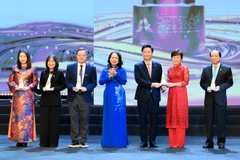
VNA General Director Vu Viet Trang (second from right) and Permanent Vice Chairman of the Vietnam Journalists Association Nguyen Duc Loi (fourth from right) present the A Prize to the winners. (Photo: VNA)

VNA Press Awards 2025 inspire professional commitment, innovation in digital era

A notable feature of this edition is the significant rise in both the number and diversity of entries across all categories. These figures reflect not only growing engagement but also a more coordinated and professional approach among editorial departments and domestic and overseas bureaus, forming a consistent and multi-dimensional flow of information.

Glenn Mathews and his wife hand over the diary of Vietnamese martyr Vo Van Cong to Minister Counsellor Nghiem Xuan Hoa, representing the Embassy of Vietnam in Australia. (Photo: VNA)

Australian veteran’s son returns diary of Vietnamese martyr

Entries in the diary show that Vo Van Cong was born in 1944 in the former Phuoc Tho commune, Nhon Trach district, Bien Hoa province, now Dong Nai province. He joined the revolutionary movement in April 1961 and was admitted to the Communist Party of Vietnam in May 1962.

A number of youth union members at the Vietnam Academy of Social Sciences visit the exhibition space showcasing books and materials on culture. (Photo: VNA)

Book week underscores role of knowledge in policymaking

The highlight is a series of activities on April 21, including a book and document exhibition on culture, the launch of a special publication titled “Special scientific information for leadership” and initiatives promoting reading culture, including a book donation programme and a book review contest.

Hanoi has over 1,100 libraries and numerous cultural and educational spaces in the community. (Photo: VNA)

Spreading value of books, building foundations of learning society

Each weekend in Hanoi, the “Reading with Children” Club brings together students to practise reading, explore language, and express ideas creatively. According to founder of the club Nguyen Thuy Anh, the club encourages children to reflect, retell stories, and connect books with personal experiences, making reading more vivid and meaningful.

Automated ticketing system is used on the urban railway Cat Linh-Ha Dong line in Hanoi. (Photo: VNA)

Digital transformation powers Hanoi metro expansion

Beyond convenience, stable fares and the elimination of fuel, parking and maintenance costs have made urban rail increasingly attractive. The growing preference for metro travel is also contributing to a greener, more modern urban lifestyle.

Delegates cut the ribbon to inaugurate the operation of electric bus route No. 43. (Photo: VNA)

Hanoi accelerates shift to green buses, targets 100% by 2030

In the 2027–2030 period, the city will accelerate the transition towards the complete phase-out of fossil fuel-powered buses. The share of electric and green energy-fueled buses is projected to reach 79–89% by 2029 and 100% by 2030.

At the second session of the Ho Chi Minh City People’s Council (Photo: VNA)

Ho Chi Minh City greenlights central square, administrative centre in Thu Thiem

The new central city square and administrative centre will create a modern, centralised political-administrative complex for Ho Chi Minh City, designed to house around 8,000 officials, civil servants, and employees. It will also handle daily traffic of 1,500- 2,000 citizens and business representatives through a unified one-stop-shop administrative service system.