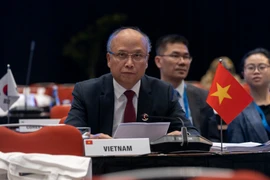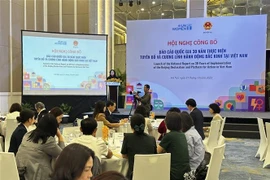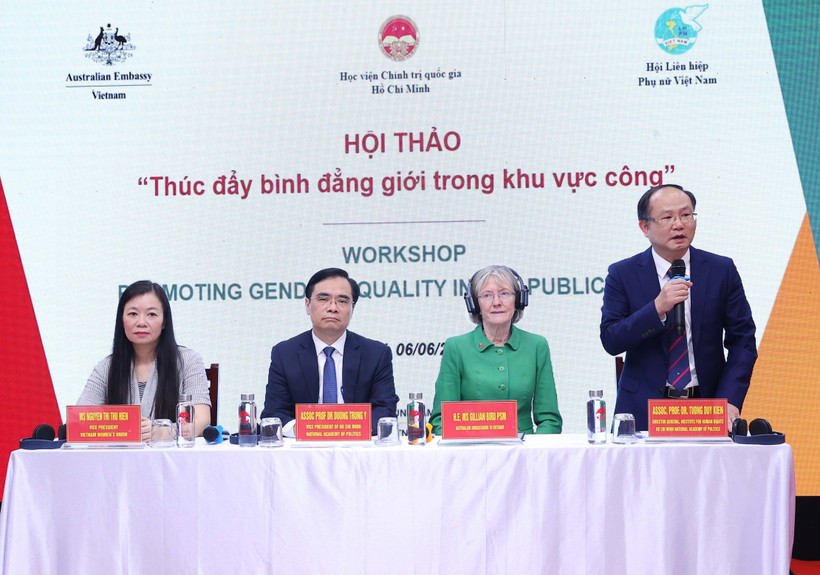
Hanoi (VNA) – A scientific workshop announcing the results of a pilot study on the Gender Equality Index for the public sector in Vietnam was held in Hanoi on December 18.
The event organised by the Ho Chi Minh National Academy of Politics (HCMA), in coordination with the Australian Embassy in Vietnam through the Vietnam–Australia Centre (VAC) aimed to introduce and discuss the findings of a study developing a specialised assessment tool to measure gender equality in the public sector, covering both central agencies and local authorities.
The index is expected to contribute to improving public governance efficiency while promoting a fair, transparent and inclusive working environment in line with Vietnam’s international commitments on gender equality and sustainable development.
In his opening remarks, Assoc. Prof. Dr. Nguyen Manh Hung, Vice Director of the HCMA and Vice Chairman of the Central Theoretical Council, stressed that gender equality in the public sector is not solely a women’s issue or one confined to a particular field. Rather, he said, it is an indicator reflecting the quality of national governance, the inclusiveness of development, and the modernity of a people-centred public administration.
He noted that the HCMA had tasked its Centre for Gender Studies and Women’s Rights with conducting the pilot research on the data collection framework for the Gender Equality Index. The research aims to make gender equality measurable, monitorable and manageable within the public sector.
Renée Deschamps, Deputy Ambassador of Australia to Vietnam, said promoting women’s participation, voice and influence in public organisations is not only the right thing to do but also a foundation for effective governance, innovation and sustainable growth. She noted that the index was developed and piloted in collaboration with Griffith University, measuring gender equality across the entire leadership pipeline, from recruitment to training, leadership development, rotation, appointment and various aspects of the working environment.
The index comprises ten core indicators along with several supplementary ones, designed to assess gender equality across the human resource development system. A notable finding from the pilot is that while women account for more than 45% of total staff in participating agencies, structural barriers continue to limit their access to senior management positions. The study also found that women make up a large proportion of frontline civil servants who ensure continuity, discipline and quality in public administration, but their representation declines sharply at higher decision-making levels, with clear “breaks” along the promotion pathway.
Initial survey results indicate that gender equality in the public sector cannot be achieved simply by increasing the number of women. Instead, it depends heavily on how institutional systems operate from planning, training, rotation, evaluation and appointment to informal norms and practices within organisations. A trend highlighted by the study is that gender gaps widen at higher levels, with a consistent absence of women in top leadership positions across surveyed agencies.
Based on the evidence, Dr. Luong Thu Hien, Director of the Centre for Gender Studies and Women’s Rights, Deputy Director of the Institute of Human Rights at the HCMA and head of the research team, recommended a shift in approach from focusing solely on the proportion of women leaders to intervening across the entire leadership pipeline. She also called for moving from headcount-based monitoring to tracking flows and bottlenecks, and from encouragement-based measures to stronger accountability mechanisms./.