Conversion to green industrial park – a climate-friendly pathway for Southeast region

As developing eco-friendly, new-generation industrial parks helps address climate change and pursue sustainable growth, the Southeast region, the country’s most dynamic economic engine, has jumped on the bandwagon to create a competitive edge in luring high-quality investments.

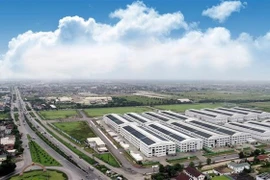
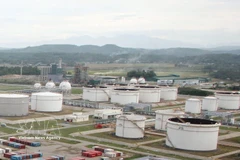
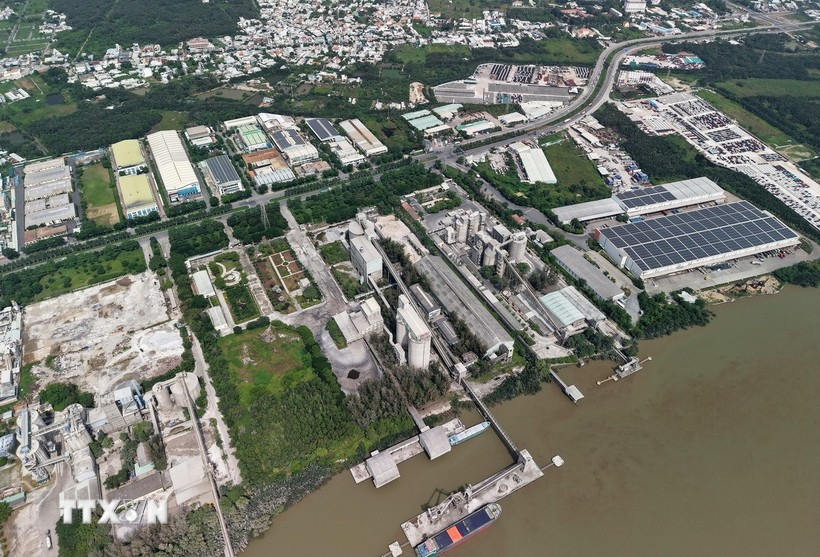
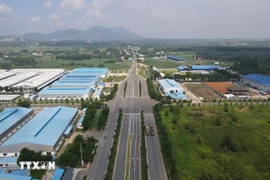
A bird's eye view of Hiep Phuoc Industrial Park (Photo: VNA)

HCM City (VNA) – As developing eco-friendly, new-generation industrial parks helps address climate change and pursue sustainable growth, the Southeast region, the country’s most dynamic economic engine, has jumped on the bandwagon to create a competitive edge in luring high-quality investments.

An inevitable trend

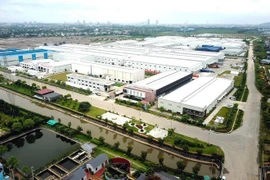
Following its merger with Binh Duong and Ba Ria – Vung Tau provinces, Ho Chi Minh City currently manages 66 export processing zones and industrial parks with steadily expanding scale and potential. Between 2025 and 2030, the city aims to attract 20 – 21 billion USD in new investment, prioritising high-tech, value-added, and environmentally friendly industries. Five key parks, namely Tan Thuan, Hiep Phuoc, Tan Binh, Cat Lai, and Binh Chieu, are being restructured towards green, high-tech, and circular operations.

Hiep Phuoc Industrial Park is set to become the city's first ecological industrial zone after joining the Global Eco-Industrial Parks Programme for 2020-2023 - a UNIDO initiative supported by the Swiss government. From meeting only 44% of the criteria in 2020, the park achieved 76% compliance by late 2023 and is projected to reach 88% soon.

Dong Nai province has also been a pioneer, chosen by the Ministry of Finance to pilot eco-industrial zones with the ambition of replicating the model nationwide. The province has set its sights on becoming a national leader in the green industry, reinforcing Vietnam’s commitment to net-zero emissions by 2050. By 2030, Dong Nai aims to rank third nationwide in economic scale, with industry and construction already accounting for over 58% of its economy.

Meanwhile, Tay Ninh province has recently broken ground on the 170-hectare Thu Thua Industrial Park worth nearly 3 trillion VND (114 million USD). The park is designed as a smart, green hub, attracting clean industries such as electronics, logistics, supporting industries, and high-tech agriculture. The project will integrate renewable energy, advanced wastewater treatment, optimised transport systems, and worker services, building a sustainable industrial ecosystem.
phu-my-resize.jpg
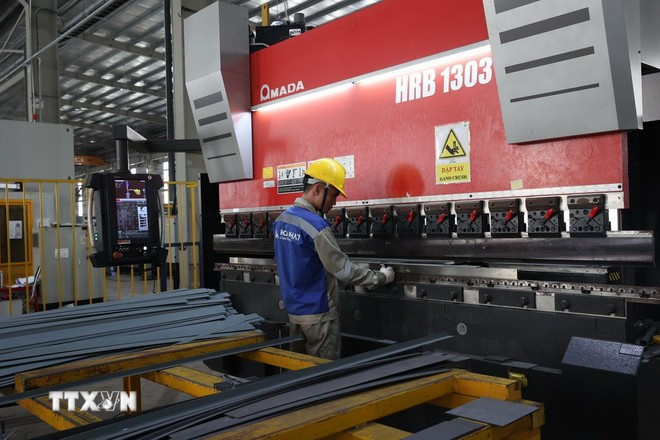
Container production at Phu My 2 Industrial Park (Photo: VNA)

Challenges and opportunities

Vietnam pledged to achieve net-zero emissions by 2050 at COP26 and is translating that goal into action through various policies. As the country’s third-largest industrial cluster, Ho Chi Minh City is well-positioned to lead the shift toward a low-carbon industry.

Experts said building net-zero industrial parks not only helps the city expand its reach to green export markets but also affirms its leading role in environmental protection and sustainable development. However, they underscored various challenges during the conversion.

The city’s key industrial zones, spanning 2,900 hectares and employing 160,000 workers, consume more than 70% the total energy used by energy-intensive firms citywide. Their energy intensity is 1.7 times the city’s average. Sectors such as steel, cement, electronics, and textiles face steep challenges, with steel production requiring costly low-emission technologies, while cement remains heavily dependent on coal.

According to the Ho Chi Minh City Export Processing and Industrial Zones Authority, green transition has been accelerated and seen as a crucial pillar in the sustainable development strategy. Beyond green infrastructure, ecological industrial parks require comprehensive changes in terms of management, operation, and cooperation between enterprises.

In Tay Ninh, authorities are enhancing the province’s Provincial Green Index (PGI), expanding environmental monitoring, and requiring impact assessments for new projects. Advanced wastewater monitoring and greenhouse gas control systems are being installed across major industrial sites.

In the coming time, the province will continue its measures to lure high-tech and environmentally friendly projects. It aims to become an important growth pole of the country, leading in green and ecological industry park development while delivering on the net-zero target./.
VNA

See more

Phin Ho Tra – a national five-star OCOP product. (Illustrative photo: VNA)

Hanoi to host Vietnam OCOP Festival 2025

The festival is seen a practical activity celebrating the achievements made by the capital and the country in 2025, affirming OCOP’s role in rural economic development, contributing to realising Vietnam’s aspiration for strong economic growth in the context of deep integration.

The expanded Hoa Binh Hydropower Plant (Photo baochinhphu.vn)

EVN launches major power projects

Among the flagship projects inaugurated was the expanded Hoa Binh Hydropower Plant with a total installed capacity of 480MW per year and average annual output of about 488 million kWh.

An ultra-intensive shrimp farming model linked with environmental protection in Ca Mau province. (Photo: VNA)

Fisheries take the lead in the Mekong Delta’s green transition

Across the Mekong Delta, leading aquaculture producers, processors and exporters, along with suppliers of inputs, are transitioning to circular, high-tech and clean production models that cut greenhouse gas emissions and comply with international certification standards.

A perspective view of the Red River Landscape Boulevard project in Hanoi (Photo: VNA)

Works starts on Hanoi’s Red River Landscape Boulevard Axis project

The project is among the 234 key works and projects being launched, inaugurated or technically opened simultaneously across 34 cities and provinces nationwide to mark the 14th National Party Congress. Its launch contributes to implementing the country’s strategic development orientations while concretising Hanoi’s development goals in the new period.

The ground-breaking ceremony of the Yen Bai 1 biomass power plant in Lao Cai province on December 19. (Photo: VNA)

Work starts on 114-million-USD biomass power plant in Lao Cai

The project, developed by Erex Yen Bai Biomass Power Co. Ltd. is located in Dong Cuong commune, Lao Cai province. It is backed by Japan’s Erex Group and falls under the Joint Crediting Mechanism, a bilateral initiative between Vietnam and Japan to reduce greenhouse gas emissions.

At the inauguration ceremony (Photo: VNA)

Vietnam Railways Corporation unveils upgraded coaches, digital tools

These moves reflect the VNR's commitment to fulfilling six priority tasks set by the Prime Minister, including leading in innovation and digital transformation, applying sci-tech in line with the Politburo’s Resolution No. 57-NQ/TW, and spearheading advances in digital, green and circular economy.

Producing MDF panels for export at Hai Duong MDF Construction and Manufacturing Co., Ltd., in Ho Chi Minh City (Photo: VNA)

HCM City targets 15 billion USD in wood exports by 2035

The merger of HCM City with Binh Duong and Ba Ria – Vung Tau is expected to give the local wood industry a strong boost into a phase of high-quality growth driven by linkages, innovation, sustainability, and deeper integration into global value chains.

Delegates cut a ribbon to inaugurate the expanded Terminal T2 at Noi Bai International Airport in Hanoi on December 19, 2025. (Photo: VNA)

Expanded Terminal T2 at Noi Bai International Airport makes debut

The project expands the terminal’s floor area to over 200,000 sq.m, increases passenger capacity from 10 million to 15 million, even up to 18 million per year, and boosts operational capacity with boarding gates rising from 17 to 30 and jet bridges from 14 to 27, meeting strong growth in international travel demand.

A section of Can Tho - Ca Mau Expressway (Photo: VNA)

Can Tho – Ca Mau travel time halves from December 19

Stretching more than 110 km with a total investment of over 27.5 trillion VND (1.04 billion USD), the project not only resolves long-standing traffic bottlenecks in the Mekong Delta, but also opens up new development opportunities for the entire region - especially Ca Mau, the last locality in the country to be directly connected to the eastern North–South expressway axis.