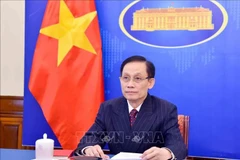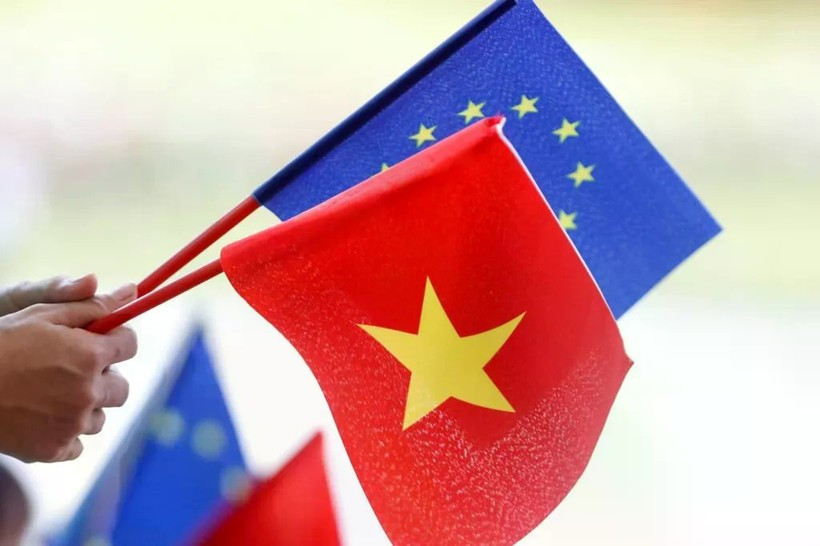
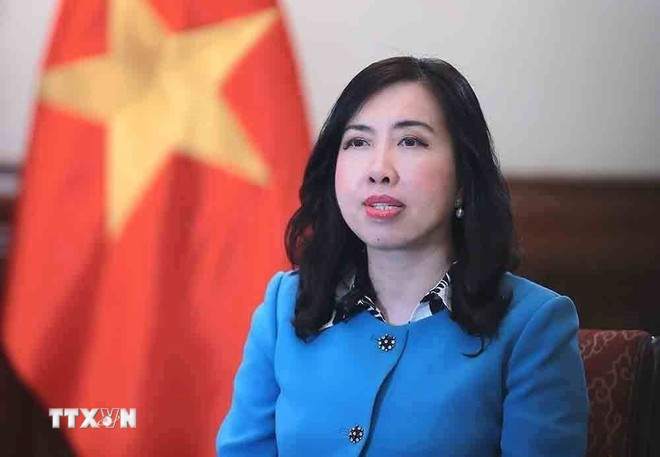
Hanoi (VNA) – Deputy Minister of Foreign Affairs Le Thi Thu Hang has authored an article on the overview and development prospects of the Vietnam-European Union (EU) relations on the occasion of the 35th anniversary of diplomatic ties (November 28).
Hang wrote that ties that began in 1990 have matured into one of the EU’s deepest engagements with any ASEAN nation. Vietnam now operates more formal cooperation frameworks with the EU than any other ASEAN member, underpinned by the 2012 Partnership and Cooperation Agreement, the landmark 2019 EU-Vietnam Free Trade Agreement (EVFTA), and a string of deals covering national defence – security, investment, and agro-forestry-fisheries.
Political and diplomatic exchanges have intensified in recent years, marked by frequent high-level delegation exchanges and close coordination at global and regional forums. Amid a rapidly changing global landscape, both sides continue to share common stance on respecting international law, safeguarding maritime security and safety, and upholding multilateralism. Their mutual liaison within the United Nations, ASEAN-EU framework, strategic dialogues, security-development cooperation, and parliamentary exchanges has built a network of mutual trust, contributing to the shared responsibility for peace, stability, and development in the Indo-Pacific region.
Trade and investment collaboration has been a standout success. Five years after EVFTA entered force, bilateral trade surged more than 10% year-on-year to 68.4 billion USD in 2024 and rose another 8.4% to 54.6 billion USD in the first nine months of 2025. The EU ranks as Vietnam’s fourth largest trade partner and sixth biggest investor, while Vietnam has overtaken all other ASEAN nations as the EU’s top trade partner in the region. The EU is also Vietnam’s third largest export market, with Vietnamese coffee, cashews, fishery products, electronics, and garments gaining strong consumer traction, the Deputy FM noted.
European companies, some present since Vietnam’s early economic opening, continue to expand. Thousands of EU-backed projects are running nationwide, drawn by political stability, an improving business climate, a skilled workforce, a strategic location, and the country’s growing reputation as a magnet for green and high-tech capital.
On the development front, she added, the EU remains a leading donor, channeling funds into judicial reform, education, forestry, environmental protection, and climate resilience. The EU-supported programmes helped Vietnam become a model of realising the Millennium Development Goals (MDGs) and have since driven progress on the Sustainable Development Goals, transforming remote and mountainous communities. Initiatives like the Just Energy Transition Partnership (JETP), climate finance packages, and circular economy projects are cementing the EU’s role as a trusted partner in Vietnam’s net-zero ambitions.
National defence-security ties are also deepening. The 2019 Framework Participation Agreement (FPA), which enables Vietnamese involvement in EU crisis-management operations, and the defence–security dialogue mechanism affirm both sides' commitment to contributing more to common efforts in keeping global peace and security. The two partners have also worked closely in addressing non-traditional security challenges, including search and rescue, the combat against transnational crime, cybercrime and human trafficking, and counterterrorism, with encouraging results.
Bilateral cooperation in other fields, including education-training, science-technology, innovation, and culture, has also been steadily strengthened and expanded. Through programmes such as Erasmus+, Horizon Europe, Team Europe and various research and education initiatives, the two sides have regularly exchanged students and lecturers, conducted academic exchanges and implemented joint research projects. In addition, cooperation in other areas such as justice, agriculture, forestry and sustainable fisheries has continued to advance, with enhanced dialogue aimed at removing obstacles and facilitating bilateral engagement.
In an increasingly volatile world, Vietnam and the EU share many commonalities – enduring values, a commitment to multilateralism, the pursuit of peace and the prevention of armed conflict and localised hostilities, in order to unlock broader developmental advantages.
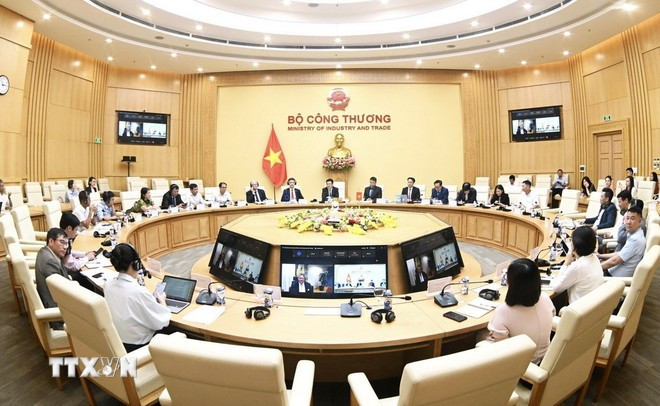
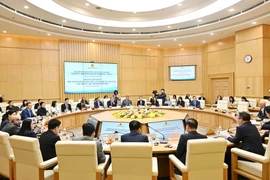
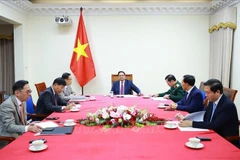
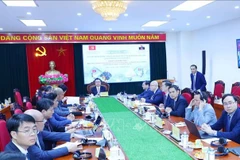
A view of the online meeting of the EVFTA Trade Committee in Hanoi on June 26, 2025. (Photo: VNA)
Their shared vision for a peaceful, secure, safe and prosperous Indo-Pacific region, together with common values regarding respect for international law, including the 1982 United Nations Convention on the Law of the Sea (UNCLOS), as well as support for free trade and sustainable development, will provide renewed momentum for Vietnam-EU cooperation at a deeper strategic level. This is particularly true in areas such as strengthening political trust, exchanging high-level delegations, boosting collaboration in maritime security and cyber security, UN peacekeeping operations, and coordination within international and regional mechanisms including the UN, the ASEAN-EU strategic partnership framework and the Inter-Parliamentary Union (IPU), Hang continued.
Against the backdrop of current global trends, Vietnam-EU cooperation faces a wide horizon of opportunities in circular economy development, renewable energy, semiconductors, satellite technology and digital transformation.
The EU is pushing ahead with efforts to diversify its supply chains and markets, while Vietnam, with its strategic location, young workforce and increasingly favourable business environment, is well-positioned to become a prime destination for EU enterprises. Once fully ratified, the EU-Vietnam Investment Protection Agreement (EVIPA) will help attract high-quality EU investment into sectors where the bloc holds strong advantages and Vietnam has significant demand, such as renewable energy, transport infrastructure, smart urban development, the circular economy, biotechnology, health care and pharmaceuticals.
Green transition and sustainable development – strengths of the EU – are expected to become prominent pillars of future cooperation, as the bloc continues to support Vietnam in its energy transition and its commitment to achieving net-zero emissions by 2050. In addition, both sides possess substantial potential for collaboration in emerging industries such as quantum technology, artificial intelligence, semiconductors, technology transfer, satellite systems and cloud computing.
In terms of cooperation in education, culture, the arts and people-to-people exchanges, Vietnam will remain a favoured destination for EU travellers thanks to the Vietnamese Government’s facilitative visa policies, while the EU will continue to serve as a hub of culture and education for Vietnamese students seeking international experience, according to the Deputy FM./.