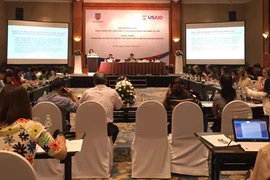
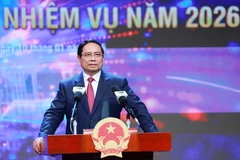
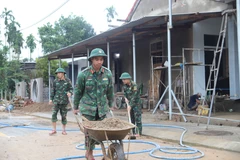
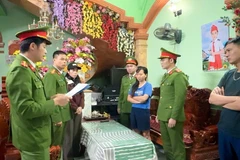
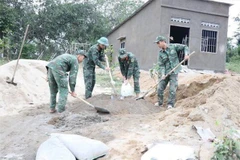
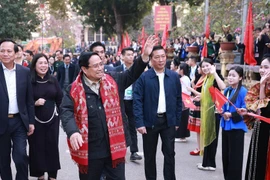
At the meeting (Photo VNA)
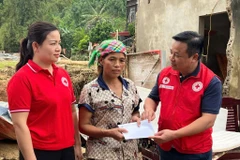
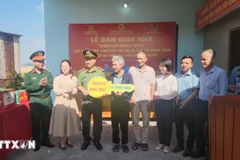
 Hanoi (VNA) – Deputy Prime Minister Vu Duc Dam has stressedthe need to get people and businesses involved in social welfare to create highsocial consensus for economic development and national defence-security.
He was speaking at a meeting in Hanoi on December 21 to review the five-yearimplementation of Resolution 15/NQ-TW adopted by the Communist Party of Vietnam(CPV)’s 11th Central Committee on social policy issues in 2012-2020.
The Deputy PM urged ministries and localities to continue reviewingpolicies of poverty reduction and social welfare.
On employment, Deputy PM Dam said it is necessary to improve employmentquality and labour productivity through encouraging new firms, thus creatingmore jobs, and developing human resources training.
He asked localities to examine the vocational training system in 2018,especially for rural workers, and improve social infrastructure at industrialparks.
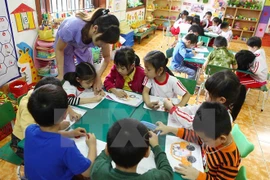
The education and training work needs the involvement of the wholesociety, focusing on supporting students in remote and underprivileged areas,as well as children from disadvantaged backgrounds, Dam said.
Regarding public health, the deputy PM required the health sector andrelated agencies to continue improving public healthcare services, reinforcingthe operation of medical facilities at grassroots level, and providing initialhealth care for people, especially welfare beneficiaries and elderly people.
The Government official told the Ministry of Science and Technology, theMinistry of Labour, Invalids and Social Welfare, and the Ministry ofInformation and Communication to develop social welfare cards – which could be usedfor payment.
According to reports at the meeting, the number of people joining socialinsurance has increased around 3.2 million over the past five years to reach13.8 million in 2017 (accounting for 25.76 percent of the labour force).
The proportion of people covered by health insurance increased to 85.59percent in 2017 from 59.1 percent in 2012.
As of the end of 2017, around 2.78 million people are receiving monthlysocial allowance.
The country has completed educational universalisation at kindergarten,primary and secondary levels. As much as 88.2 percent of rural population gotaccess to hygienic water as of October 30, 2017. -VNA
VNA