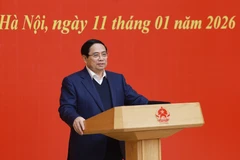
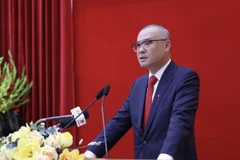
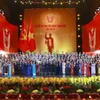
Deputy PM and FM Pham Binh Minh speaks at the conference (Source: VNA)
 Hanoi (VNA) – The diplomatic sector has efficiently servedthe national revolutionary cause and made worthy contribution to the country’sstrong rise from the ruin of war to become a symbol of peace, stability, unity andharmony, renovation and development, according to the country’s top diplomatPham Binh Minh.
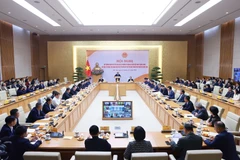
Deputy Prime Minister and Foreign Minister Pham Binh Minh has reviewedthe work and achievements of the diplomatic sector over the past years in thecontext of a world full of constant changes, and outlined the main tasks forthe sector in the time ahead in an article on the occasion of the 30th Diplomatic Conference and 19th External Affair Conference fromAugust 12-17 in Hanoi.
A world full of changes
The Deputy PM underlined that over the past two years, the internationaland regional situation is witnessing rapid, complex and unforeseeable changes,posing many challenges to the country’s strategic environment and creatingdirect impacts on the country’s security and development interests.
He noted that despite the recovery of the global economy, global financialrisks, protectionism and trade wars are having negative effects on economic developmentof the world and Vietnam.
The rise of the industrial revolution 4.0 and science-technology as animportant production force also creates unprecedented challenges for Vietnam, hesaid, adding that the risk of lagging behind is real if the country cannot capitalizeon the trend.
Meanwhile, the political–security situation in the world is full offluctuations such as policy adjustments of countries and the rise ofnationalism, which make the regional security increasingly insecure. Interest differencesamong G7, G20 and EU members affect the role of multi-lateral mechanisms.Complicated developments in the East Sea, especially large-scale reclamationand militarization activities are threatening peace, security and stability inthe region as well as the legitimate rights and interests of many countriesincluding Vietnam.
Consolidating and creating peaceful environment for development
Deputy PM and FM Minh affirmed that following the external relation guidelineof the 12th Party Congress, the diplomatic sector has persistently upheldits principles, firmly pursued targets and exercised proactiveness andflexibility in implementing assigned tasks, thus achieving many importantoutcomes, contributing to protecting national sovereignty and maintaining apeaceful and stable environment for national development, integration whileenhancing the country’s position.
The head of the diplomatic sector underlined that the sector has paidspecial attention to building institutions in the field. Over the past twoyears, the sector has submitted to the Party and the Government many proposalson foreign policies, including those dealing with international economic integrationand promotion of multilateral external relations.
Accordingly, Vietnam has actively deepening relations with neighbouringcountries, the Association of Southeast Asian Nations (ASEAN), major powers,strategic partners, comprehensive partners and traditional friendly countries.So far, Vietnam has established diplomatic relationships with 188 countries,and strategic and comprehensive partnerships with 27 partners, which includeall five permanent members of the UN Security Council. The wide network ofrelations not only helps enhance Vietnam’s status but also provides animportant foundation of and contributes directly to national defence andconstruction.
[Infographics: 30th Diplomatic Conference to focus on four key issues]
Deputy PM Minh stressed that through creating the foundation of politicaltrust, the diplomatic sector performed well its role in promoting internationaleconomic integration and expanding markets for the country. Vietnam has set upfree trade frameworks with nearly 60 countries, which in combination accountfor 59 percent of world population, 61 percent of world GDP and 68 percent ofworld trade, through 16 free trade agreements (FTAs), including new-generationones such as the Comprehensive and Progressive Agreement for Trans-PacificPartnership (CPTPP) and the EU-Vietnam Free Trade Agreement (EVFTA). Vietnam’slocalities have also inked 420 international agreements since 2016 coveringcooperation in all aspects.
At the same time, the country has optimized multilateral mechanisms toprotect national rights and interests, while engaging in joint efforts to addresscommon challenges facing the international community, the Deputy PM said.
According to Minh, the country has shifted from “actively participatingin” to “taking initiative in contributing to and bulding multilateral institutions.”As the host of the Asia-Pacific Economic Cooperation (APEC) Year in 2017,Vietnam selected the theme and priorities for the year that suited the common concernand reconciled differences, thus helping define the orientation for a newperiod of development in the region in the APEC post-2020 vision. In thecontext of strong rise of nationalism and protectionism, APEC 2017 was able to notonly maintain the impetus but also push forward linkage, connectivity and freetrade in the region.
Besides, Vietnam also demonstrated its high sense of responsibility asmember of ASEAN, the UN, the Asia-Europe Meeting (ASEM), the UN SecurityCouncil, the UN Economic and Social Council (ECOSOC), the UN Educational,Scientific and Cultural Organisation (UNESCO) and Mekong mechanisms, amongothers.
A top and regular task of the diplomatic sector is to protect nationalsovereignty and territorial integrity. Deputy PM and FM Minh said the sectorhas maintained close coordination with other ministries, agencies and localadministrations while cooperating with relevant countries to build borderlinesof peace, friendship, stability and cooperation for development.
In the East Sea issue, facing new and complicated developments withpotential unforeseeable risks, Vietnam has persistently and firmly deployedmany measures to defend national sovereignty and sovereign and jurisdictionrights over waters, continental shelf and islands in line with internationallaw, including the 1982 UN Convention on the Law of the Sea.
The Deputy PM said Vietnam, together with the ASEAN and China, ispushing negotiations on a legally-binding and effective Code of Conduct on theEast Sea. At the same time, the country is actively expanding marinecooperation with countries inside and outside the region, and holding talks to narrowdifferences and build trust.
Protecting the interests of Vietnamese citizens and Vietnamese nationalsoverseas is another task of special importance for the diplomatic sector, accordingto Minh. Since 2016, the sector has protected more than 16,000 citizens andmore than 5,000 fishermen. Guidelines and policies on support of overseasVietnamese have been carried out synchronously, helping consolidate the nationalunity bloc and optimize the resource from 4.5 million overseas Vietnamese fornational development.
Cultural diplomacy has also received attention with a view to preservingthe national cultural identity during international integration and enhancingthe nation’s position and “soft” strength. A project on honouring President HoChi Minh as a hero of national liberation and an outstanding man of culture hasbeen carried out effectively.
Furthermore, since 2016 Vietnam has had eight more heritage itemsrecognised by UNESCO, bringing the total number of UNESCO-recognised heritagetitles in the country to 38. The recognition has greatly helped promote theimage and tourism of localities home to the heritage.
Deputy PM and FM Minh said the achievements recorded by the diplomaticsector have contributed to the national cause of construction and defence, butmany opportunities remain untapped. Besides, international integration andscientific-technological development have brought about many challenges thatrequire the diplomatic sector to make greater efforts, be more innovative inthinking, adopt modern approaches and pay more attention to efficiency in orderto successfully implement the Party’s guidelines and resolutions. This is themain theme of the 30th Diplomatic Conference.
He said the conference will review the implementation of the Resolutionof the 12th Party Congress on external affairs and map out measuresto continue reaping good outcomes in the work.
The conference will also make assessmentand forecast of the world and regional situation in the next 3-5 years with a visionfor 10-15 years beyond with a view to identifying opportunities and challengesfacing the country.
Measures and methods to improve the efficiency of the country’s integrationprocess will be discussed, with an emphasis on multilateral diplomaticactivities in the time ahead.
The Diplomatic Conference was first organized in 1957 and has sincebecome a traditional event of the diplomatic sector.-VNA
VNA