Discussion highlights role of online platforms in protecting children from cybercrime

The discussion aimed to foster a multi-dimensional dialogue to put into practice the spirit of the Hanoi Convention, focusing on safeguarding vulnerable groups – particularly children and young people – from increasingly complex forms of cybercrime.

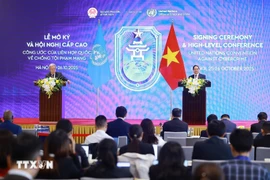
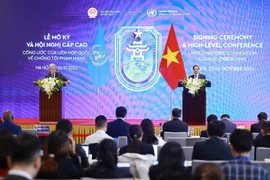
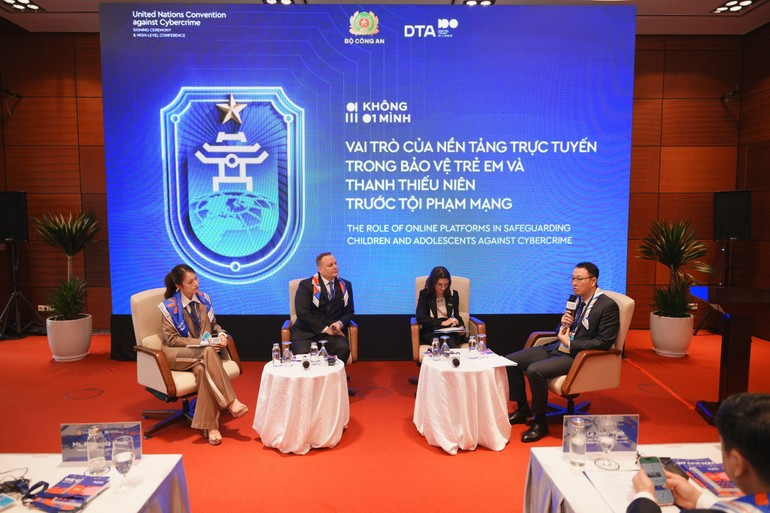
The discussion on the role of online platforms in protecting children and adolescents from cybercrime in Hanoi on October 25 (Photo: nhandan.vn)

Hanoi (VNA) – A sideline discussion on the role of online platforms in protecting children and adolescents from cybercrime took place in Hanoi on October 25, drawing representatives from government agencies, international organisations, technology platforms, and the creator community.

The event, jointly organised by the Vietnamese Digital Trust Alliance and the Ministry of Public Security’s Department of Cybersecurity and High-Tech Crime Prevention (A05), was held as part of the Signing Ceremony and High-Level Conference of the United Nations Convention against Cybercrime (Hanoi Convention), and also part of the country’s “Not Alone” campaign.

It aimed to foster a multi-dimensional dialogue to put into practice the spirit of the Hanoi Convention, focusing on safeguarding vulnerable groups – particularly children and young people – from increasingly complex forms of cybercrime.

Statistics from the A05 show that last year, Vietnam recorded 381 cases of online child abuse, most of which involved grooming, manipulation, extortion, or trafficking conducted via digital platforms. Meanwhile, an international report by the US-based National Centre for Missing and Exploited Children (NCMEC) revealed that the number of AI-generated child abuse materials shot up 1,325% year-on-year in 2024, highlighting how technology is being misused as a tool for crime.

The A05 noted that Vietnam has been actively developing its legal framework, improving management mechanisms, and enhancing international cooperation to prevent and tackle cybercrime. However, challenges remain, particularly in data sharing, content transparency, and alignment between domestic legislation and the policies of cross-border digital platforms.

At the discussion, Michaela Bauer, Deputy Representative of UNICEF Vietnam, underscored the importance of coupling protection with empowerment, helping children not only stay safe online but also gain digital literacy and self-protection skills.

She affirmed UNICEF’s continued partnership with Vietnam in promoting the Hanoi Convention’s principles and integrating online child protection into schools and digital education programmes nationwide.

Also speaking at the event, Rob Abrams, head of Law Enforcement Outreach for Asia Pacific at Meta, expressed the company’s strong support for the goals of the Hanoi Convention. He underlined Meta’s commitment to policy transparency, cooperation with authorities, and expansion of digital literacy initiatives for young people in Vietnam.

Alongside the discussion, the “Not Alone” campaign’s interactive space at the Hanoi Convention Signing Ceremony and High-Level Conference exhibition area emerged as a highlight, attracting a large number of guests and international delegates./.

VNA
See more

At the second session of the Ho Chi Minh City People’s Council (Photo: VNA)

Ho Chi Minh City greenlights central square, administrative centre in Thu Thiem

The new central city square and administrative centre will create a modern, centralised political-administrative complex for Ho Chi Minh City, designed to house around 8,000 officials, civil servants, and employees. It will also handle daily traffic of 1,500- 2,000 citizens and business representatives through a unified one-stop-shop administrative service system.

A working session at the job fair (Photo: VNA)

Vietnamese students flock to Seoul Job Fair 2026

The second annual Job Fair 2026 was held for Vietnamese students in the Republic of Korea. Organisers pitched it as a straight-up bridge between eager students and bosses hungry for young talent who can actually handle multicultural workplaces.

Defendants at the court (Photo: VNA)

Ho Chi Minh City court opens trial over Agribank lending scandal

The investigation revealed that multiple credit files were incomplete or riddled with inaccurate information, while some pledged assets lacked proper legal standing yet were accepted and grossly overvalued. As a result, the loans became high-risk and largely unrecoverable, leading to losses surpassing 1 trillion VND.

Hanoi introduces 53 electric buses from April 18 (Photo: VNA)

Hanoi to add 53 electric buses from April 18

According to the plan, all buses operating within Ring Road 1 will use green energy by July 1, 2026. The requirement will expand to Ring Road 2 by January 1, 2028, and to Ring Road 3 by 2030.

Illustrative image (Photo: VNA)

National, local traffic safety committees to be dissolved from June 1

Under the dicision, ministries and ministerial-level agencies will assume responsibility for tasks previously performed by the committee, in line with their mandates under the Law on Government Organisation, the Law on Road Traffic Order and Safety, the Law on Roads and other relevant legal frameworks, ensuring that traffic safety and order are maintained without disrupiton.

Visitors explore technology showcases at the exhibition held during the Da Nang Startup and Innovation Festival (SURF 2025). (Photo: VNA)

About 10,000 students expected at National Startup Day 2026

This year marks the rollout of the “Student Startup Support Programme for 2026 – 2035”, approved under Decision No. 336/QD-TTg, which places emphasis on practical outcomes, real products, real testing, real partnerships, and measurable impact.

Hong Quang High School pilots teaching mathematics in English starting from the 2025–2026 academic year. (Photo: VNA)

National foreign language proficiency framework issued

The circular establishes a unified benchmark for foreign language proficiency across the national education system, providing a foundation for curriculum design, teaching, testing, assessment, and certification. It is expected to help learners better map out their language development pathways while enabling educational institutions to improve training quality and strengthen articulation between different levels of education.