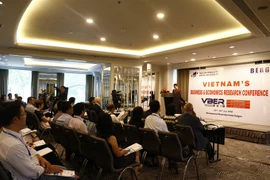
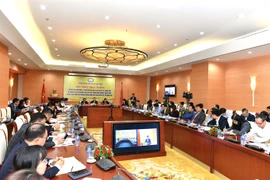
At the teleconference (Photo: SBV)
Hanoi (VNA) - The banking sector has defined its responsibility in deploying measures to enable people to get access to official credit for business and production activities in an effort to prevent them from seeking ‘black credit’.
The State Bank of Vietnam (SBV) recently organised a teleconference launching the Government’s Decree 116/2018/ND-CP on credit policy in service of agriculture and rural development, and solutions of the banking sector to curb ‘black credit’.
Loan shark is rampant
According to the central bank, the banking sector has over the past time coordinated with the Ministry of Public Security and related ministries and sectors in preventing and reducing ‘black credit’.
At the request of the public security force, the SBV’s branches in provinces and cities have joined in handling 218 cases relating to ‘black credit’ involving 117 billion VND in 16 provinces and cities, of them 14 cases faced legal proceedings and 37 cases got administrative fines.
Addressing the conference, Pham Huyen Anh, Deputy Chief Inspector of the Banking Supervision Agency said ‘black credit’ providers target people who have unstable jobs and urgently need cash for unexpected incidents, like funerals or weddings, or rural people who have inadequate knowledge about borrowing and lending.
They particularly target gamblers and football betting participants, by offering their ‘black credit” on social networks or making it available at pawn shops and investment consulting companies. People were easily lured by leaflets on electrical cabinets and poles, and in residential areas, which say borrowers can get loans with their student cards or IDs only.
A SBV representative said the collapse of a ‘black credit’ ring caused serious socio-economic consequences and social and security disorder, putting its borrowers in danger. In many cases, borrowers couldn’t pay back their loans and had to sell their houses and assets.
As the provision of ‘black credit’ is underground activity, most of the cases related are only discovered when that activity is brought to light. Though the supervision agency has tackled cases related to ‘black credit’ and given warnings to people, the situation still remains.
At the teleconference, participants talked about the methods used by loan sharks, like peer-to-peer (P2P) lending, which is designed and developed on the basis of digital technology to directly connect borrowers with lenders (investors) without going through financial intermediaries such as credit institutions or foreign bank branches, which triggered concerns in society.
Pham Chi Quang, Deputy Head of the Monetary Policy Department, said there are investors who evaded tax and laundered money via transactions on P2P lending platform, or illegal appropriated capital mobilized through pyramid channels, making borrowers fall into victim of trade frauds.
There are loan sharks who run pawn shops in combination with P2P lending activities to offer loans with interest rate exceeding the 20-percent cap regulated at Article 468 of the Code of Civil Code 2015.
The SBV warned people and firms should be cautious and careful when joining P2P lending activities, advising them to borrow credit from banks.
Pham Van Tam, Deputy Chief of the Criminal Police Department of the Ministry of Public Security said loan sharks quickly provide loans and use a lot of tricks to get them back.
He described loan sharks as “daylight robbers”, who triggered social disorders that led to various types of crimes and legal violations.
He warned that ‘black credit’ reached out not only in rural and remote areas, but also in industrial and export processing zones, and big cities.
 Illustrative photo (Source: VietnamPlus)
Increasing people’s ability to access official capital
Addressing the teleconference, SBV Deputy Governor Dao Minh Tu pointed out that the entire society is concerned about ‘black credit’.
Preventing and stamping out this evil activity is responsibility of many sectors and levels, he said.
The SBV has defined its responsibility in implementing its own solutions to enable people to access official credit in service of their production, business, and life, especially those with underprivileged backgrounds and living in difficulties-ridden rural areas.
Accordingly, the SBV consulted the Government and the Prime Minister to issue many policies to promote credit access, with the latest being Decree 116/2018/ND-CP amending Decree 55/2015/ND-CP on credit policy for agricultural and rural development.
Nguyen Quoc Hung, Head of the Economic Sectors Department of the SBV, said Decree 116 allows the maximum amount of a non-guaranteed loan to double the old amount for some households and individuals. Specifically, individuals and households not living in rural areas but involved in agricultural production and business will access the credit line of 100 million VND from the old one of 50 million VND, and those living in rural areas and involved in agricultural production and business, will get a loan of 200 million VND from 100 million VND.
“Raising credit line for customers without collateral will help timely meet their needs for capital, especially those who live in remote and rural areas, contributing to preventing customers who face the shortage of capital for production and business and have no guaranteed assets from seeking other capital sources, like ‘black credit’,” Hung said.
Nguyen Toan Vuong, Deputy Director General of Agribank pledged to supply sufficient capital for people and firms for production, business, and consumption activities.
To boost the provision of credit for agriculture and rural development, the banking sector will continue fine-tuning its legal framework in conformity with the legal system and the Government’s guideline on administrative procedure reform as well as requirements for socio-economic development and international integration.
In addition to that, the sector will complete mechanisms and policies on lending for consumption to meet the increasing needs of people in the area and prioritize the establishment of branches and transaction offices in rural areas, especially remote and extremely-difficult areas.-VNA