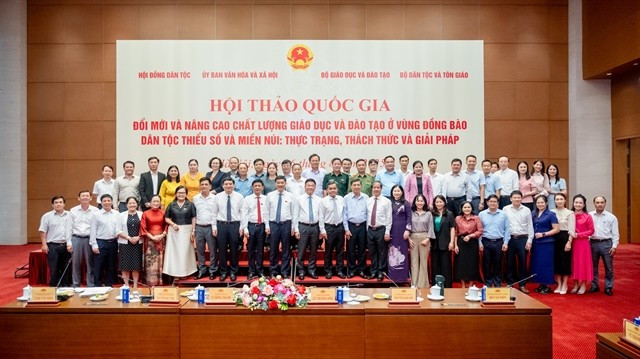
Hanoi (VNS/VNA) - Job creation support in ethnic communities and mountainous and border areas needs to go hand in hand with policies on housing settlement, tuition exemptions and reductions, and salary increases for teachers, participants heard at a conference in Hanoi on August 26.
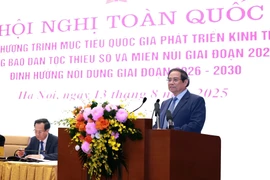
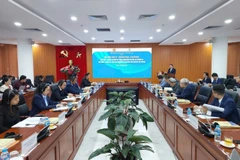
The conference on improving education and training in ethnic communities and mountainous areas was jointly hosted by the National Assembly (NA)'s Ethnic Council in coordination with the NA's Committee for Culture and Society, the Ministry of Education and Training and the Ministry of Ethnic and Religious Affairs.
Chairman of the NA Ethnic Council Lam Van Man said education and training in ethnic minority and mountainous areas have seen major recent achievements in general education, designated admissions and vocational, pre-university and university training.
These efforts have contributed to improving workforce quality, creating job opportunities for members of ethnic groups and people in mountainous areas, and fostering sustainable multidimensional poverty reduction in disadvantaged regions, he said.
However, education in ethnic communities and mountainous areas still faces many shortcomings. The school network, infrastructure and teaching equipment remain insufficient to meet the demands of educational expansion and improvement, he said.
The teaching workforce still falls short in both quantity and quality compared to other regions and localities. Vocational education, especially short-term training at local levels, has not proven highly effective, he added.
Man said that addressing these difficulties and limitations requires comprehensive, synchronised solutions, particularly in terms of policies and laws, to enhance the quality and effectiveness of education and training.
According to the delegates, in order to sustainably develop the labour force, especially skilled workers, in line with the development requirements of growth-driving and disadvantaged regions, making focused, long-term investments with a clear roadmap for education and training will be necessary.
The delegates proposed that policies ensuring fair access to education should be prioritised, including support for educational institutions in areas facing difficulties in facilities, equipment and teaching staff, in ethnic communities and mountainous areas and in regions with challenging socio-economic conditions.
They also suggested providing credit support and incentives for disadvantaged students, those entitled to social policies and students pursuing studies in key sectors and fields.
Deputy Prime Minister Le Thanh Long said student enrolment rates in ethnic communities and mountainous areas have increased. Ethnic boarding, semi-boarding and pre-university schools have proven effective, contributing to workforce training among ethnic communities.
He asked ministries, sectors and localities to reorganise the school network in a logical way, linked with the two-tier local government model.
He also called for prioritising resources for education and training in ethnic communities and mountainous areas./.
VNA