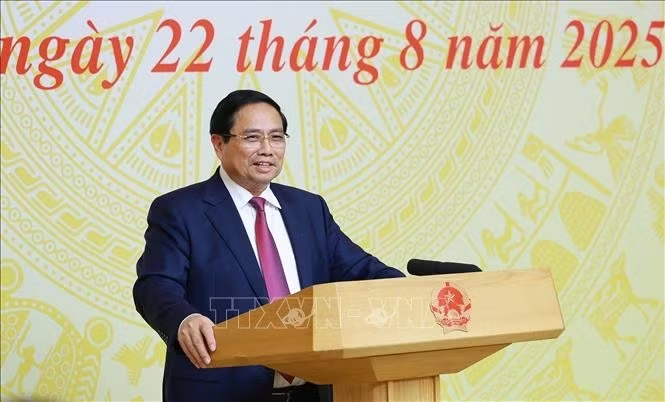
Hanoi (VNA) – Prime Minister Pham Minh Chinh on August 22 stressed the need to ensure equal access to education and training while chairing a national conference reviewing the 2024–2025 academic year and outlining tasks for 2025–2026.
The hybrid conference was held in person at the Government headquarters and connected online with the 34 provinces and cities nationwide.
In his conclusion, the PM affirmed the vital role of education and training, particularly during the era of national rise. He noted that the Politburo will soon issue resolutions to create breakthroughs in the field, alongside healthcare, cultural development, and the state-owned economic sector.
Acknowledging the educational achievements over the past academic year, the Government leader also frankly pointed out shortcomings and challenges, including outdated curricula, imbalanced disciplines, skill gaps, teacher shortages, incomplete networks, and passive funding mechanisms.
Looking ahead, he underscored the need to shift from viewing education and training as the responsibility of the sole education sector to a common task of the entire political system, the people, and society.
He asked for a transition from teaching only knowledge to developing comprehensive competency, along with a renewed mindset, methodology, and approach to ensure equal access to education and training for all citizens, particularly disadvantaged groups, ethnic minorities, and those in remote areas.
PM Chinh demanded the sector develop advanced, modern, and consistent educational programmes and curricula aligned with national development, teachers be a source of inspiration for students, and families, society, and schools be sources of support for teachers and students.
The PM requested thorough preparations for the upcoming new school year, including a nationwide online opening ceremony on September 5, marking the first academic year after the administrative unit merger and organisation of the two-tier local administration system.
The education sector will implement the policy of lunch support for primary and junior secondary students in border communes starting from the 2025–2026 school year, he noted.
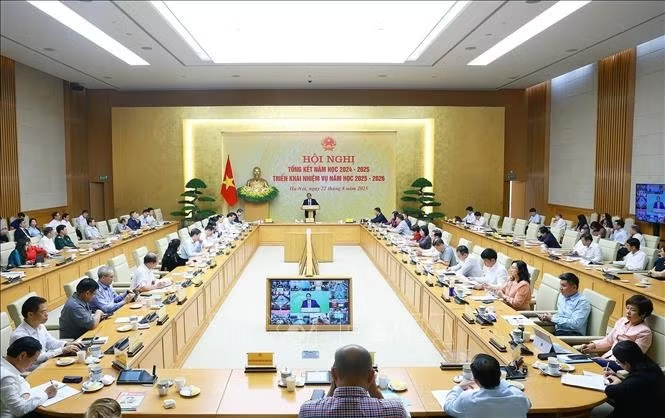
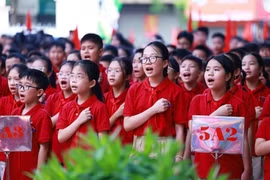
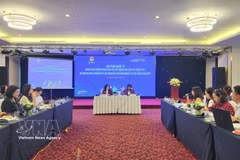
The national conference reviewing the 2024–2025 academic year and outlining tasks for 2025–2026, held on August 22. (Photo: VNA)
PM Chinh also instructed relevant agencies to build integrated boarding schools combining primary and junior secondary levels in 248 land border communes, with an initial pilot project to construct or renovate 100 schools this year.
Other directives included universalising preschool education for children aged 3–5, ensuring child safety, enhancing digital capacity and AI skills, and gradually making English a second language in schools. Besides, it is necessary to improve the training quality of human resources, especially high-quality manpower for science – technology and innovation, the field related to knowledge-based economy, digital economy, green economy, and circular economy, and emerging areas like AI, semiconductor, high-speed railway, and nuclear power.
The conference reported that the 2024–2025 school year took place amid positive socio-economic changes in the country, with education and training institutions benefiting from an improved legal and policy framework. All targets across all educational levels surpassed those of the previous year. Nationwide, 89.6% of classrooms at public preschools and schools of general education have now been made permanent.
For 2025–2026, the sector has set 28 key targets, including enrolling 94% of kindergarten-age children, achieving a 99.5% completion rate for primary education among students, and ensuring that 90% of preschool teachers, 91% of primary school teachers, and 100% of secondary school ones meet training standards./.