Top leader orders free full-day schooling from next academic year

The initiative, which involves two sessions of teaching per day, aims to enhance instruction in cultural and artistic subjects, thereby supporting students' holistic development.

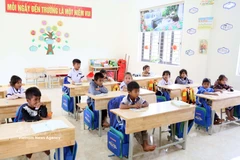
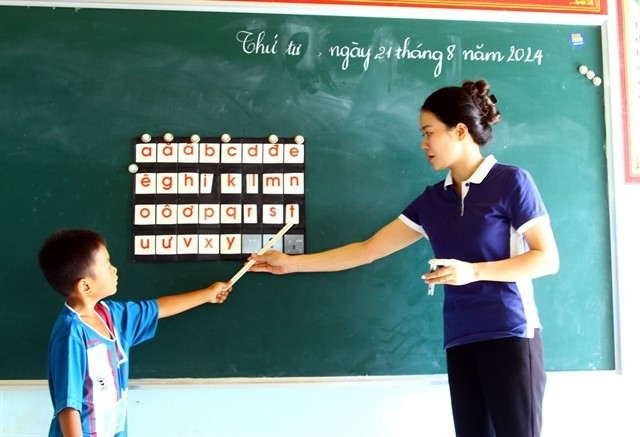
A teacher and a student in class at Thuong Hoa Primary and Secondary School in Minh Hoa district, located in the central coastal province of Quang Binh. (Photo: VNA)

Hanoi (VNS/VNA) - Party General Secretary To Lam has ordered the education sector and local authorities to prepare for the implementation of free full-day schooling at primary and secondary schools, beginning with the 2025–2026 academic year.

The initiative, which involves two sessions of teaching per day, aims to enhance instruction in cultural and artistic subjects, thereby supporting students' holistic development.

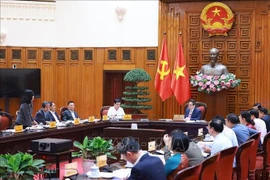
The order was made under a statement from the Office of the Party Central Committee, which outlined Lam's conclusions following a working session on April 18 with the Government and relevant ministries regarding the implementation of the Party's resolutions on education and training.

The session also addressed preparations for a new Politburo resolution on transformative education policies and support measures for teaching and learning.

After reviewing a report from the Party Committee of the Ministry of Education and Training and listening to opinions from other agencies, Lam endorsed a policy allowing primary and secondary schools to organise full-day teaching, depending on each locality’s capacity in terms of infrastructure, finance and staffing.

The plan will be rolled out gradually, with the State taking the lead on investment while encouraging support from the private sector.

The Party chief tasked the Government’s Party Committee with directing the education ministry and other authorities to ensure all necessary conditions, facilities, staff, curricula and educational activities are in place to improve the quality of teaching in the full-day programmes.

Free school lunches

Lam also agreed to a policy supporting lunch meals for students in border communes, prioritising mountainous areas. This includes both ethnic minority students and Kinh students residing in such regions.

Localities are urged to develop boarding and semi-boarding schools to facilitate learning and living conditions for students.

Infrastructure standards for schools must include adequate classrooms, science labs, clean water, kitchens, bathrooms, toilets, playgrounds and teacher accommodation.

Border communes should include instruction in neighbouring countries’ languages to enhance future cross-border people-to-people exchanges.

The policy will be introduced in phases, aligned with the national economic situation.

Strict supervision is required during implementation and any misappropriation of students' meal provisions will not be tolerated.

Initially, the programme will be piloted in land border communes starting in September, with gradual nationwide expansion based on the outcomes.

Localities able to allocate budgetary resources are encouraged to implement the scheme immediately within their jurisdictions.

The Party Committee of the education ministry has been assigned to coordinate with relevant agencies and report to the Government’s Party Committee on implementation progress.

Matters beyond their authority will be referred to the Politburo for review and decision.

Top national priorities

Lam said that education, training and science and technology remain top national priorities.

Significant policies and reforms have already yielded substantial results, contributing meaningfully to national development.

However, the education system still lacks the transformative progress needed to meet public expectations, especially in developing well-rounded citizens and a high-quality workforce, amid both domestic and global challenges.

Despite various national target programmes, students in remote, ethnic minority-inhabited and mountainous areas continue to face severe hardships, with low enrolment rates.

The situation stems largely from systemic limitations, particularly in mindset, policy frameworks, governance and resource allocation, which have hindered progress in the sector.

There is now a pressing need to train a new generation of Vietnamese citizens who are well-rounded and capable of meeting the nation’s dual centennial goals, including developing a highly skilled workforce that is key to driving breakthroughs in science, technology, innovation and digital transformation.

In tandem with economic growth, social advancement must also be prioritised, ensuring equal access to quality education, lifelong learning opportunities, and the full development of individual potential.

In response to the urgent demands, the Party leader stressed the need for bold institutional and policy reforms, targeted investment and accelerated modernisation to improve educational outcomes and develop a workforce capable of powering Vietnam’s next stage of national advancement./.

VNA
See more

The court hearing on January 14 (Photo: VNA)

Former food safety chief sentenced to 20 years for bribery

The court imposed the heaviest sentences on two former VFA directors, namely Nguyen Thanh Phong, who receive 20 years in prison, and Tran Viet Nga, who was sentenced to 15 years. Two former deputy directors, Nguyen Hung Long and Do Huu Tuan, were given 12 years and seven years, respectively.

Gift from Deputy PM Ho Quoc Dung to a flood-hit family (Photo: VNA)

Quang Trung campaign: A call from the heart, for the people

In nine provinces and cities across the central and Central Highlands regions, over 11,000 public security officers and staff were mobilised to work alongside grassroots security forces and local authorities. The ministry also sent an extra 300 mobile police officers and public security cadets to assist with housing construction, repairs, and post-disaster recovery efforts.

A Dong Thap border guard officer checks VMS device aboard a fishing a vessel (Photo: VNA)

Dong Thap closely monitors vessels to combat IUU fishing

In recent years, the Dong Thap provincial People’s Committee has directed relevant departments, agencies and localities with fishing fleets to strengthen management and strictly monitor fishing vessel operations at sea as part of efforts to prevent and combat IUU fishing.

A policeman reads an order to detain Le Minh Vu (Photo: VNA)

Thanh Hoa man faces charges for anti-State social media activity

Between 2023 and 2025, Le Minh Vu in Thanh Hoa province repeatedly used a Facebook account bearing his own name and a fan page titled “Le Minh Vu electronic portal – A place to send petitions to recipients” to post content described as unfounded, hostile and dismissive toward the Party, State and government agencies.

Deputy Prime Minister Ho Duc Phoc speaks at the conference to review and announce the preliminary results of the 2025 rural and agricultural census. (Photo: VNA)

Preliminary results of 2025 rural, agricultural census announced

The 2025 census is Vietnam’s sixth nationwide survey focusing on rural areas and agriculture. It aims to collect fundamental data for compiling socio-economic statistical indicators, serving assessments of the current situation, analyses of trends, and the formulation of plans and strategies for rural development and agricultural, forestry and fisheries production at both national and local levels.

Officials visit the photo exhibition “Under the Party’s Leadership – The nation enters a new era” at the National Convention Centre in Hanoi on January 14. (Photo: VNA)

VNA photo exhibition opens, marking 14th National Congress

The exhibition features approximately 500 archival photographs from the Vietnam News Agency, organised into eight thematic sections reflecting key stages of Vietnam’s modern history in connection with successive Party Congresses.

Quang Ngai now has 4,846 registered vessels, including nearly 3,000 over 15 metres long, while smaller vessels under 15 metres for nearshore fishing are gradually being reduced. (Illustrative photo: VNA)

IUU fishing: Quang Ngai helps fishermen transition to sustainable livelihoods

In recent years, fishermen in Quang Ngai province have actively upgraded and retrofitted large-capacity vessels, applying technical advancements in fisheries operations. As a result, the province’s fisheries sector has continued to make notable progress, with annual catches consistently meeting or exceeding planned targets.

A traffic police officer regulates the traffic flow on a street in Hanoi. (Illustrative photo: VNA)

Hanoi Police announce traffic diversions for 14th National Party Congress

To ensure security, public order and traffic safety for the 14th National Party Congress, to be held from January 19 to 25 at the National Convention Centre in Hanoi’s Tu Liem ward, Hanoi Police have announced traffic diversion and regulation plans on key roads across the capital city.

Illustrative image (Photo: VNA)

IUU combat: Vinh Long tightens fishing port control

Vinh Long will maintain close coordination among agencies and localities, intensify legal outreach on fisheries regulations, strengthen management of the fishing fleet, and enhance the effectiveness of vessel monitoring.

Hanoi sees early gains from AI-powered camera system (Photo: VNA)

Hanoi’s AI-powered camera system shows initial positive results

From December 13, 2025 to January 12, 2026, the system recorded 6,351 cases eligible for automated traffic enforcement, with red-light violations accounting for 66.36% and helmet violations 32.32%. Captured images and video clips provided clear legal evidence for enforcement.

At the inauguration of the community digital library in Quang Phu ward, Da Nang city. (Photo: VNA)

RoK locality-funded digital library makes debuts in Da Nang

After more than 10 months of construction, the project has been completed and put into use, featuring all the components of a modern digital library, including over 1,000 book titles, an e-book repository, tablet and desktop computers, dedicated study areas, and spaces for digital knowledge exploration and research.