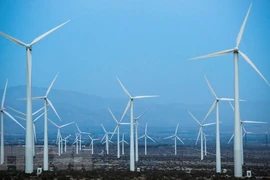
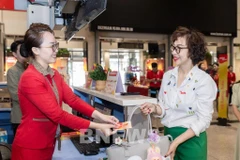
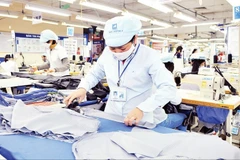
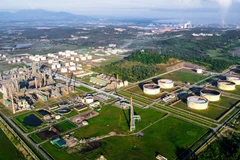
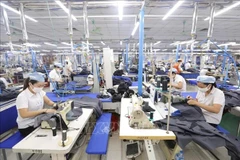
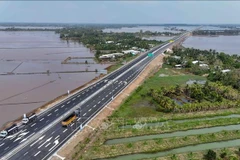
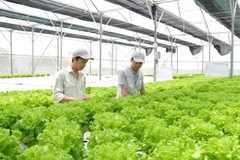
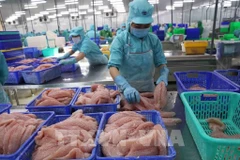
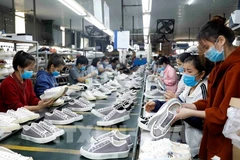
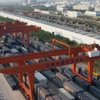
In the second quarter, the industrial sector saw improvement with growth of 1.56% (Photo: VietnamPlus)
Hanoi (VNA) – In the first half of this year, Vietnam enjoyed positive economic recovery of the industry, construction, and service sectors, giving reasons for optimism on the economic outlook for the rest of the year.
Dr. Nguyen Thi Huong, General Director of the General Statistics Office (GSO) granted VietnamPlus an interview to discuss the socio-economic situation in the first six months of the year and the prospects for the second half.
Reporter: The socio-economic report for the first six months of this year shows a mixture of good and bad. In your opinion, which positive signals will brighten the economic outlook for the rest of the year?
Dr. Nguyen Thi Huong: In the first half of this year, the domestic economy saw positive signs. Specifically, business and production gradually improved in May and June. The majority of businesses gave positive assessments on growth and stability.
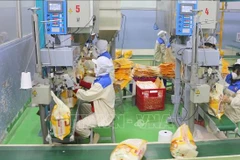
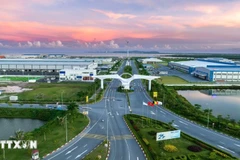
In the second quarter, the country posted economic growth of 4.14%, 0.86 percentage points higher than the increase of 3.28% in the first quarter. This can be seen from the positive signs of the industrial sector with 1.56% growth after a drop of 0.75% in the first quarter. The construction sector enjoyed 7.05% expansion, much higher than the 4.94% rise in the same period last year.
The brightest results were seen in the service sector with a growth of 6.11%. In addition, the agro-forestry-fisheries sector also recorded a stable expansion of 3.25% year on year.
In the first half of 2023, economic growth reached 3.72%, driven by the agriculture-forestry-fisheries sector which expanded 3.07%, and the service sector which increased 6.33%. They are also key factors motivating the growth of the total value added of the economy, with the respective contribution of 0.36 percentage points and 3.04 percentage points.
In reality, there are still difficulties in the industry and construction sectors, but the negative growth temporary ended after the first quarter, with an upturn of 1.13% for the first six months of this year. These are optimistic signs for the national economic outlook for the rest of the year.
On the other hand, the main growth driver in the second quarter and the first six months of the year was the service sector. This sector had the highest growth rate among all three economic sectors at 6.11% in the second quarter and 6.33% in the first six months. This contributed 2.93 percentage points and 3.04 percentage points respectively to the growth rate of total added value of the economy.
With the increase of the number of domestic and foreign visitors, the tourism sector is becoming another bright spot in the overall development picture. Tourism development has led to expansion of other activities such as accommodation, catering services, transportation, warehousing, wholesale and retail, and arts and entertainment.
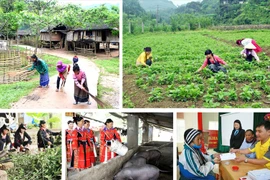
In the reviewed period, the agro-forestry-fishery sector proved its role as the "supporting platform" of the economy. Thanks to the acceleration of the restructuring process from "agricultural production" to "agricultural economy," the sector ensured food supply and security and achieved many positive results, creating stable growth in recent quarters.
Vietnam is overcoming global difficulty as a result of the close and timely direction of the Party and Government as well as the consensus and unity of all businesses, organisations, associations, and people across the country.
The macro-economy was kept stable, while inflation was controlled. At the same time, an effective monetary policy helped reduce interest rates, ensure means of payment and mobilise capital in a stable manner. As of June 20, total means of payment increased 2.53% compared to that at the end of 2022. The mobilised capital of credit organisations also increased 3.26%. In the same period last year, the rise was 3.97%.
Meanwhile, accelerated disbursement of public investment was also an important growth driver. The increase in disbursed investment capital of the State sector in six months reached 12.6%, showing the determination and efforts of the Government, ministries, sectors and localities in speeding capital disbursement right from the first months of the year.
We should note that 2023 is the key time for the medium-term public investment plan and the disbursement of capital for the infrastructure investment package under the socioeconomic recovery programme. This is a prime source of capital to encourage private investment, promote production, and stimulate the economy. Although the disbursement of public investment capital has yet to be improved significantly, it will certainly be a big growth driver in the coming quarters.
Reporter: What difficulties and challenges will face the national economy in the coming quarters?
Dr. Nguyen Thi Huong: In the outside, the world economy is complex and difficult to predict with fierce strategic competition among world powers. Currently, inflation is soaring in many major export markets of Vietnam, followed by tightened wallets of consumers, negatively affecting the export opportunities and market exploration for domestic firms.
On the other hand, tightened monetary policy has strongly impacted businesses, economic activities, investment, and global consumption. The global economy has continued to decline, and growth in many major economies has slowed.
According to predictions of international organisations in June 2023, global economic growth in 2023 is likely to be slightly higher compared to the forecast from the beginning of the year. However, the growth rate will likely be lower than that in 2022 by 0.2 to 1 percentage point.
Moreover, risks to the banking system, public debt and corporate debt globally are show signs of increasing. In addition, China's economy is recovering slowly and has many uncertainties.
Inside the country, industrial production, which is an important driving force for export and tourism, has not fully recovered, affected by difficulties from outside. Specifically, export orders have decreased due to weak demand in the US and the EURO area.
At the same time, public investment capital disbursement, a significant growth motivator, has yet to see considerable improvement. Besides, key markets such as the money market, stock market, corporate bonds as well as real estate, and labour are at risk of lower liquidity. Businesses are still having difficulty accessing capital.
Reporter: Could you suggest some solutions to ensure meeting economic targets from now to the end of the year?
Dr. Nguyen Thi Huong: Vietnam is a country with a high level of openness, modest scale and limited international competitiveness. Therefore, the domestic economy has suffered adverse impacts from the world economy, especially in the fields of import-export, manufacturing, and investment.
Difficulties still exist in production and business activities, industrial production, export, real estate market, domestic investment, and foreign direct investment (FDI) attraction and business situation, labour and employment. Currently, the economy's ability to absorb capital remains limited.
Therefore, drastic and proactive direction and management are needed, along with close coordination to build on the achievements, optimise resources, seize all opportunities for economic recovery.
Management policy should focus on maintaining macro-economic stability, reining in inflation, and laying the foundation for stimulating growth. On the basis of closely monitoring the world economic situation, prices, inflation and monetary and fiscal policies of major partners in the world, Vietnam needs to develop scenarios and give timely response to minimise effects in order to control inflation, stabilise the macro-economy and promote economic recovery at the same time.
Financial policy should focus on closely managing revenue sources and thoroughly minimising expenses. The issued policies on tax exemption, reduction and extension of tax payment deadlines need to be implemented effectively. Monetary policy should continue to aim for reducing deposit and lending interest rates and increasing capital absorption capacity for the economy. Management should be flexible with synchronised monetary policy tools and solutions, in order to control inflation, contribute to stabilising the macro-economy and the currency and foreign exchange markets, as well as controlling the credit growth according to the set direction.
Businesses should introduce attractive tourism products, while strengthening the application of information technology to develop smart tourism (Photo: VietnamPlus)
It is critical for stakeholders to speed up the disbursement of public investment capital that they have been assigned, especially for major projects. This will save time on recurrent expenses, non-business expenses, and expenses that are not really necessary.
The situation requires more effective implementation of the socioeconomic recovery and development programme with policies to stimulate demand and develop domestic trade and e-commerce. Regarding exports, besides traditional markets, it is necessary to expand and diversify markets, optimise the signed free trade agreements (FTAs) and intensify trade promotion.
Regarding tourism, businesses should come up with attractive tourism products and strengthened IT application to promote the growth of smart tourism. They also need to increase the promotion of Vietnam's tourism on major international media channels, at international tourism forums and conferences, while synchronously implementing solutions to turn tourism into a spearhead economic sector.
Support policies should focus on production, thereby upgrading the quality of agricultural products to the standards of choosy markets in order to expand the markets. In particular, the agricultural product processing industry should receive priority in calling for investment. This contributes to expanding local product consumption, lowering product costs, thus increasing profits for agricultural producers and creating jobs for rural labourers.
Reporter: Thank you very much!./.