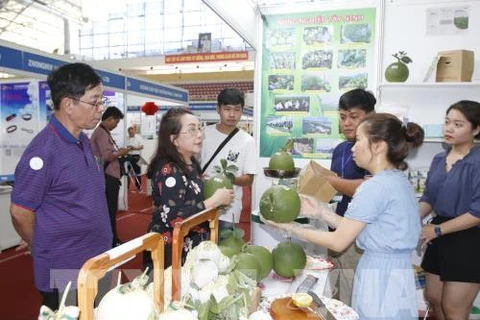
Speakers chat during a break at a meeting on imports and exports of agroforestry products between Vietnam and China held on June 20 in HCM City (Photo: VNA)
 HCM City (VNA) - Vietnamese exports of agricultural products must meet food safety, quality and traceability requirements to China which now requires that exports be sent through official channels only, heard a recent workshop in Ho Chi Minh City.
Tran Thanh Nam, Deputy Minister of Agriculture and Rural Development, said that Vietnamese producers must change their mindset about China and improve production to meet new market requirements.
He noted that businesses in the past thought China was an easy market because of lax regulations and border control. However, that is no longer the case as standards are now much higher.
Nam spoke at the June 20 workshop on food safety and management of imports and exports of agro-forestry-fishery products between the two countries.
With a market size of up to 1.4 billion people, China is the major export market for agricultural, forestry and fishery products from Vietnam.
The Ministry of Agriculture and Rural Development has been working closely with the General Department of Customs of China to remove obstacles and organise market information meetings, according to Nam.
"Enterprises must ensure the quality of goods, traceability of origin, and packaging labels similar to those of difficult markets such as the US, Europe, Japan, Australia and Canada, where Vietnamese businesses have followed the same regulations," he said.
Dao Viet Anh, Vietnam's Commercial Counsellor in China, said China will continue to be a potential export market for Vietnam due to rising demand and purchasing power.
The Chinese government is encouraging the import of goods via official channels to meet the needs of its people, he said.
However, to comply with the new requirements of the market, Vietnamese farmers and businesses must change production and business methods, he said.
Dang Phuc Nguyen, Secretary General of the Vietnam Fruit and Vegetables Association, said the Chinese market now accounts for nearly 70 percent of the total export turnover of fruits and vegetables from Vietnam.
Currently, the vegetable and fruit production industry in Vietnam is still small scale, and the percentage of farms applying VietGAP and GlobalGAP standards is still modest.
In addition, the excessive use of chemicals and substances has not been strictly controlled, Nguyen said.
China is the main export market for Vietnamese vegetables and fruits, he said, adding this is no longer an easy market.
Vo Quan Huy, Director of the Huy Long An – My Binh Ltd Company, said that changes in China’s import policy are not barriers to Vietnam's agro-forestry-fishery products as Vietnamese enterprises have been able to export the products to markets with stricter standards than China's, such as Japan, the Republic of Korea and the US.
The problem is that Vietnamese enterprises need to change their perception about the Chinese market, which now requires higher standards.
Chinese living standards have improved significantly, so their demand for high-quality products has also increased.
Vietnamese producers and businesses must aim at this high-end market segment from China, he added.
Last year, Vietnam's fruit and vegetable export turnover to China reached 3.8 billion USD. However, in the first six months of this year, exports to China fell slightly compared to the same period last year, reaching only 1.2 billion USD.
He attributed the drop to stricter requirements via official channels and the need to meet technical and quality standards, which most businesses have failed to meet, he said.
Long Yushan from the Nanning Customs Bureau under the General Administration of Customs of China, said that Chinese agencies are providing information on regulations on animal and plant management and quarantine, especially for dairy, aquatic products and fruits.
Last year Vietnam exported 8.6 billion USD worth of agro-forestry-fishery products to China. As of the end of April, Vietnam had earned 2.64 billion USD from exporting agro-forestry-fishery products to China, a year-on-year decline of 8.3 percent.
Three groups of goods - fruits and vegetables, rubber, wood and wooden products – saw export turnover surpassing the 1 billion USD benchmark.
Vietnam spent 2.47 billion USD importing farm produce from China last year.
At present, nine fresh fruits from Vietnam are shipped through official channels to China, namely dragon fruit, watermelon, lychee, longan, banana, mango, jackfruit, rambutan and mangosteen.
The ministry is proposing that China open its market for other Vietnamese fruits such as durian, passion fruit, avocado, grapefruit, coconut, custard apple, and rose apple.-VNA
Tran Thanh Nam, Deputy Minister of Agriculture and Rural Development, said that Vietnamese producers must change their mindset about China and improve production to meet new market requirements.
He noted that businesses in the past thought China was an easy market because of lax regulations and border control. However, that is no longer the case as standards are now much higher.
Nam spoke at the June 20 workshop on food safety and management of imports and exports of agro-forestry-fishery products between the two countries.
With a market size of up to 1.4 billion people, China is the major export market for agricultural, forestry and fishery products from Vietnam.
The Ministry of Agriculture and Rural Development has been working closely with the General Department of Customs of China to remove obstacles and organise market information meetings, according to Nam.
"Enterprises must ensure the quality of goods, traceability of origin, and packaging labels similar to those of difficult markets such as the US, Europe, Japan, Australia and Canada, where Vietnamese businesses have followed the same regulations," he said.
Dao Viet Anh, Vietnam's Commercial Counsellor in China, said China will continue to be a potential export market for Vietnam due to rising demand and purchasing power.
The Chinese government is encouraging the import of goods via official channels to meet the needs of its people, he said.
However, to comply with the new requirements of the market, Vietnamese farmers and businesses must change production and business methods, he said.
Dang Phuc Nguyen, Secretary General of the Vietnam Fruit and Vegetables Association, said the Chinese market now accounts for nearly 70 percent of the total export turnover of fruits and vegetables from Vietnam.
Currently, the vegetable and fruit production industry in Vietnam is still small scale, and the percentage of farms applying VietGAP and GlobalGAP standards is still modest.
In addition, the excessive use of chemicals and substances has not been strictly controlled, Nguyen said.
China is the main export market for Vietnamese vegetables and fruits, he said, adding this is no longer an easy market.
Vo Quan Huy, Director of the Huy Long An – My Binh Ltd Company, said that changes in China’s import policy are not barriers to Vietnam's agro-forestry-fishery products as Vietnamese enterprises have been able to export the products to markets with stricter standards than China's, such as Japan, the Republic of Korea and the US.
The problem is that Vietnamese enterprises need to change their perception about the Chinese market, which now requires higher standards.
Chinese living standards have improved significantly, so their demand for high-quality products has also increased.
Vietnamese producers and businesses must aim at this high-end market segment from China, he added.
Last year, Vietnam's fruit and vegetable export turnover to China reached 3.8 billion USD. However, in the first six months of this year, exports to China fell slightly compared to the same period last year, reaching only 1.2 billion USD.
He attributed the drop to stricter requirements via official channels and the need to meet technical and quality standards, which most businesses have failed to meet, he said.
Long Yushan from the Nanning Customs Bureau under the General Administration of Customs of China, said that Chinese agencies are providing information on regulations on animal and plant management and quarantine, especially for dairy, aquatic products and fruits.
Last year Vietnam exported 8.6 billion USD worth of agro-forestry-fishery products to China. As of the end of April, Vietnam had earned 2.64 billion USD from exporting agro-forestry-fishery products to China, a year-on-year decline of 8.3 percent.
Three groups of goods - fruits and vegetables, rubber, wood and wooden products – saw export turnover surpassing the 1 billion USD benchmark.
Vietnam spent 2.47 billion USD importing farm produce from China last year.
At present, nine fresh fruits from Vietnam are shipped through official channels to China, namely dragon fruit, watermelon, lychee, longan, banana, mango, jackfruit, rambutan and mangosteen.
The ministry is proposing that China open its market for other Vietnamese fruits such as durian, passion fruit, avocado, grapefruit, coconut, custard apple, and rose apple.-VNA
VNA