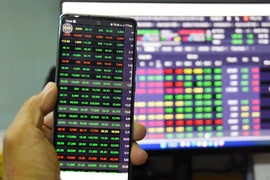
Hanoi (VNS/VNA) - After two years of record net selling, foreign capital flows in Vietnam’s stock market are expected to gradually reverse in 2026, supported by a more stable exchange rate, improving macroeconomic conditions, and growing expectations of a market upgrade.
The domestic stock market wrapped up a memorable 2025. While it failed to reach the 1,800-point threshold, a psychologically important milestone for local investors, the benchmark VN-Index still posted an impressive gain of more than 500 points, ending the year up 40.87%.
This performance surpassed the 35.73% rise recorded in 2021 and ranked second only to the remarkable 48.03% increase seen in 2017.
Liquidity also surged in 2025, with some trading sessions reaching values of around 50 trillion VND (1.9 billion USD), placing Vietnam among the most active markets in Southeast Asia. For the full year, market liquidity rose by 33% compared to 2024, setting a new record.
Despite the buoyant market, foreign investors continued their strong net selling trend.
Throughout 2025, foreign investors recorded net selling in nine months and net buying in only three.
In total, they sold 2.92 billion shares, resulting in a net outflow of nearly 134.8 trillion VND, equivalent to several billion US dollars. While the volume fell slightly by 6.4%, the value surged by 46% compared to the previous year’s record net selling of more than 92.29 trillion USD.
On the HoChiMinh Stock Exchange (HoSE), technology giant FPT Corporation, one of Vietnam’s largest listed technology firms, topped the sell-off with net selling exceeding 11.6 trillion VND. Vin-family stocks Vingroup (VIC) and Vinhomes (VHM) also saw heavy outflows, at 10.4 trillion VND and nearly 9.6 trillion VND respectively.
Other blue-chip stocks were similarly affected, with Vietcombank (VCB) recording net selling of more than 8.8 trillion VND, Sacombank (STB) close to 7.6 trillion VND, SSI Securities (SSI) nearly 6.7 trillion VND and Hoa Phat Group (HPG) over 4.1 trillion VND.
By contrast, the most notable net purchase was Vinpearl (VPL) at 1.5 trillion VND, while Novaland (NVL) led in net volume with more than 84.6 million shares bought for a total value of 1.27 trillion VND.
On the HNX, Saigon-Hanoi Securities (SHS) was the largest net buyer with 70 billion VND, while IDICO Corporation (IDC) recorded the biggest net outflow of more than 1.6 trillion VND.
Foreign capital flows in Vietnamese equities during 2024–2025 were strongly influenced by global capital costs and exchange rate movements, as a stronger US dollar and higher interest rates have drawn capital back to developed markets worldwide.
Reports from MB Securities show that the prolonged net selling trend reflects clear pressure for foreign investors to rebalance their portfolios.
Looking ahead to 2026, Trinh Duy Viet, proprietary trading manager at Kafi Securities, told tinhanhchungkhoan.vn that he expects foreign capital to become a key pillar supporting market growth.
He noted that alongside the market upgrade narrative, international capital flows may also be shaped by global portfolio reallocation following geopolitical volatility from 2020 to 2025.
According to Tran Anh Tuan, director of the analysis centre at PetroVietnam Securities, many research institutions expect foreign capital to shift from an exploratory phase to more systematic investment.
Rather than sharp short-term inflows followed by rapid withdrawals, capital is likely to enter at a slower pace but with greater sustainability.
If favourable conditions align, Vietnam could enter a stable phase of net foreign capital inflows, similar to the experience of many emerging markets after a market upgrade, referring to Vietnam’s potential reclassification from frontier to emerging market status by global index providers.
Tuan highlighted three key factors influencing foreign investment: global macroeconomic conditions, particularly US monetary policy and that of major economies; the quality and resilience of the domestic market; and prospects for an official market upgrade.
Although persistent net selling pushed foreign ownership on the HoSE down to nearly 15%, the lowest level in 13 years, selling pressure eased towards the end of the year. The return of net buying in December has sent encouraging signals, often viewed by investors as an early indicator of a potential trend reversal rather than a one-off event.
With a confirmed upgrade and solid macroeconomic fundamentals, optimism is growing that foreign capital flows into Vietnam’s stock market will soon reverse in the coming period./.
VNA