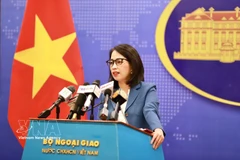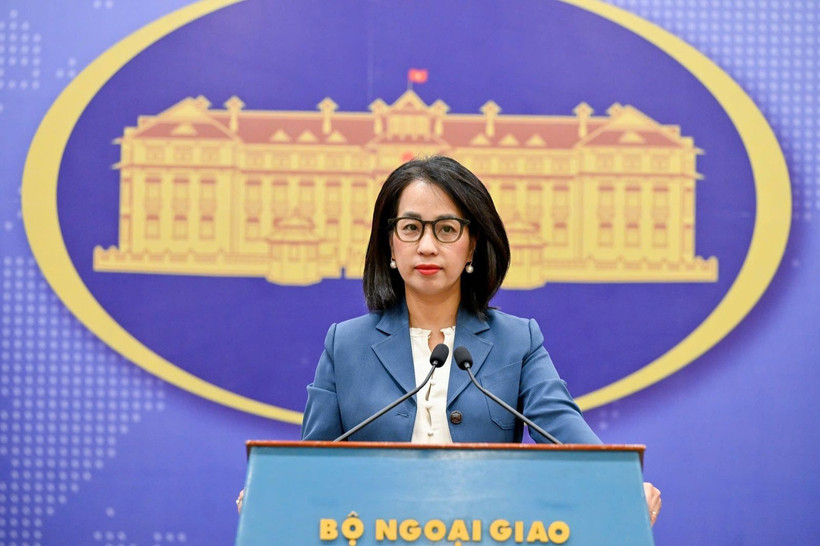
Hanoi (VNA) – Spokesperson of the Ministry of Foreign Affairs Pham Thu Hang provided updates on consular protection for Vietnamese citizens in the Middle East at the ministry’s regular press briefing on March 19.
Hang cited information from Vietnam’s overseas representative missions and relevant domestic authorities as saying that most Vietnamese citizens travelling or in transit whose flights were cancelled due to airspace closures have either returned to Vietnam or boarded alternative flights to leave the Middle East.
Regarding Vietnamese vessels and sailors who have yet to depart the Strait of Hormuz, Vietnamese missions abroad are maintaining close coordination with local authorities and relevant agencies to monitor developments and stand ready to implement measures to ensure the safety and security of both crew members and vessels.
The Foreign Ministry has instructed Vietnamese embassies in Israel, the United Arab Emirates (UAE), Saudi Arabia, Kuwait, and Qatar to open online registration systems to collect requests from citizens wishing to return home or travel to third countries. This will serve as a basis for coordinating with relevant agencies to develop appropriate support plans.
In line with the ministry’s directives, Vietnamese representative missions in Iran, Israel, and neighbouring areas are reviewing the needs of Vietnamese citizens in their jurisdictions and working closely with local authorities as well as relevant agencies at home to implement suitable support measures.
In Saudi Arabia, the Vietnamese Embassy has engaged with local authorities, who have agreed to grant free transit visas to Vietnamese citizens at border gates as well as at Saudi Arabian representative offices in the region. For vessels with Vietnamese crew members stranded at the country’s ports, port authorities, at the embassy’s request, have contacted the vessels and crew representatives to assess the situation and provide necessary assistance.
In the UAE, the Vietnamese Embassy has worked with the host’s Ministry of Foreign Affairs and airlines to facilitate the transit of more than 200 Vietnamese tourists stranded at major airports, including Dubai and Abu Dhabi, enabling them to travel onward to third countries. The embassy has also received Vietnamese citizens unable to leave Dubai and Abu Dhabi, and provided them with essential supplies.
Vietnamese citizens in Iran, Israel, and neighbouring countries are advised to closely follow updates from local authorities as well as notices issued by Vietnam’s Ministry of Foreign Affairs and overseas missions.
In case of emergency or difficulty, citizens are urged to immediately contact the 24/7 consular protection hotlines of Vietnamese representative missions in Iran, Israel, and nearby areas, or the Ministry’s Consular Protection Call Centre for prompt assistance.
Also at the briefing, responding to reports circulating on social media in recent days alleging that Vietnam had provided humanitarian aid to Iran, the spokesperson affirmed that such information is inaccurate.
Responding to questions about reports on March 13 that South African authorities had arrested Vietnamese farm owner Chu Dang Khoa for allegedly smuggling rhinoceros horns, along with requests for more details and Vietnam’s actions against transnational wildlife trafficking, Hang said that as soon as the news came in, the Vietnamese Embassy in South Africa quickly reached out to local authorities to confirm the situation and take necessary citizen protection steps.
Following the ministry’s instructions, the embassy continues to work closely with local authorities to handle the case in accordance with the law, she added.
As a party to the United Nations Convention on Biological Diversity and the Convention on International Trade in Endangered Species of Wild Fauna and Flora (CITES), Vietnam remains firmly committed to fulfilling its international obligations on wildlife protection and combating illegal wildlife trade.
To date, Vietnam has issued legal documents and taken various steps to improve management, enhance protection, and enforce strict penalties against illegal wildlife trafficking./.
Measures sought to address business challenges amid Middle East conflict
Vietnam is facing a three-stage ripple effect - first on transport and fuel-dependent industries, then on sectors relying on their outputs, and ultimately on consumers. Volatility in key commodities like fuel is disrupting the entire supply chain and increasing the risk of market instability.