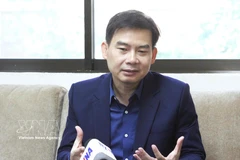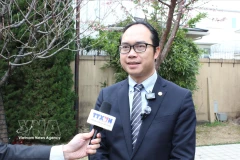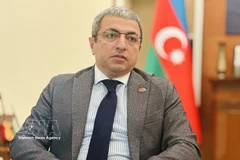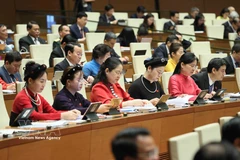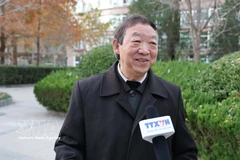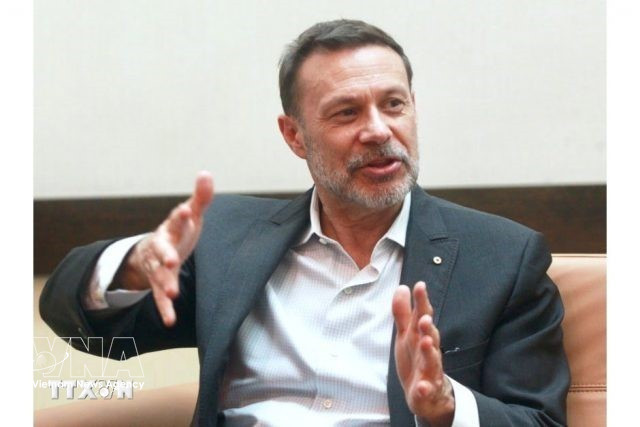
Sydney (VNA) - Former Australian Ambassador to Vietnam Andrew Goledzinowski has stated that during his 2022-2024 tenure in Vietnam, he was impressed at how Vietnam’s 15th National Assembly combined practical problem‑solving with an appetite for institutional reform.
“It worked through pandemic recovery, supply‑chain shocks and natural disasters, while advancing a heavy legislative agenda. It also provided stronger oversight mechanisms, including steps toward digital governance, and more active parliamentary diplomacy. I thought these efforts improved transparency,” he said in an interview with the Vietnam News Agency.
Notable strengths were its willingness to test new supervisory formats and to engage more directly with citizens and business on economic reform. At the same time, the legislature faces the ongoing task of translating strategic goals into consistent implementation at provincial levels, including under the formed local government system, he noted.
“I personally had a great deal of contact with the NA Committees. They were very helpful in advancing my understanding of Vietnam’s agenda and in promoting cooperation,” he added.
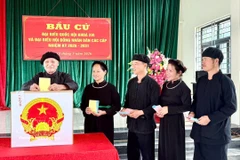
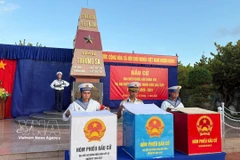
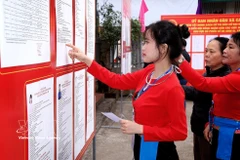
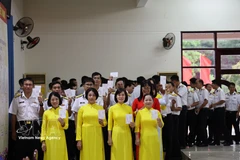
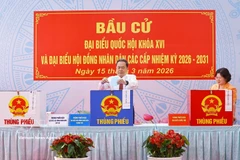
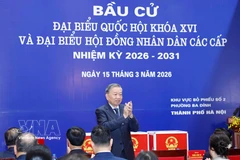
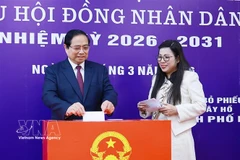
Regarding the organisation of the election of deputies to the 16th Nationl Assembly and People’s Councils at all levels for the 2026-2031 term two months earlier than usual, he said moving the election forward is a practical decision to ensure high‑level personnel changes are made as quickly as possible, so that nothing delays the implementation of the 14th Party Congress’s ambitious agenda. It might also serve to give new officials more time to bed down the two‑tier local government model and streamline their administrations before the major policy roll‑outs we expect in 2026.
Hopefully all this will reduce uncertainty for investors and help maintain momentum on reforms - particularly those tied to investment, the tech economy and climate resilience, he went on.
“The Australian business community in Vietnam has always emphasised predictable governance as a foundation for deeper economic ties. I think what we are seeing now is intended to support that predictability,” he said.
According to the former ambassador, Vietnam has set incredibly ambitious targets for itself. I think this is the right way for Vietnam to go. If it is ever going to realise it’s potential then now is the time. When China was at the same per capita GDP level, it was growing at double digit rates. Circumstances are more challenging now, but Vietnam still has a good chance of success, and there is no reason not to try.
However, he admitted that this rapid development agenda will put enormous pressure on officials. They will need to combine technical competence, integrity and practical problem‑solving. Members need to be competent in economic policy, digital governance and climate adaptation, and be able to work well with experts and communities.
“I believe these officials also need to be well paid so that the best graduates are attracted to government service; and so they are not forced to seek out other sources of income. This is one of the great lessons of Singapore’s success, and one that I hope Vietnam emulates. I believe that the Australian Embassy will continue to support capacity‑building and knowledge exchanges between our parliamentarians, senior officials and institutions. If we do this well, both sides will benefit,” he stated.
Regarding promoting regional and global cooperation amid a volatile global situation, Goledzinowski held that foreign policy has long been one of Vietnam’s great strengths, underpinned by a strong diplomatic traditions and an effective foreign service. Since the establishment of modern Vietnam, the state has carefully maintained its nonaligned status despite enormous challenges. By contrast, Australia has had it relatively easy, thanks to its benign geography and a history that has cushioned it within a supportive alliance framework.
“But the world is now changing in ways that will impact both Vietnam and Australia. We are both rule-of-law, status quo countries – in an era when the status quo is being challenged,” he stated.
He said he was attracted by the words of the Canadian prime minister, Mark Carney, who had called for middle powers such as Vietnam and Australia to play an active role in helping to shape the future world order. This will not require Australia to abandon its alignment or Vietnam to abandon it’s non-alignment. But it will require the two nations to work more closely together to navigate the challenges of the future.
Inter-regional relations will be a part of this. ASEAN will become even more important for both Australia and Vietnam. Vietnam’s recent proposal for deepening ASEAN–GCC cooperation is a great example.
As Vietnam takes a greater leadership role in international affairs, it would be appropriate for universities to expand their foreign policy training and for Vietnam to nurture the establishment of new think tanks, research institutions and foreign policy publications, he continued.
Vietnam has been well served by the Foreign Ministry and by the Diplomatic Academy of Vietnam. But it is time to expand Vietnam’s diplomatic capacity and influence in the world.
For parliamentary cooperation between Vietnam and Australia to bring even more benefits to the bilateral relationship, the former ambassador recommended three practical measures.
The first is regularising committee‑to‑committee exchanges (legal affairs, trade, education, climate) with annual work plans and staff attachments to build institutional collaboration.
The second is creating joint parliamentary working groups on critical minerals policy, digital governance and climate finance to produce policy briefs and perhaps even model legislation.
The third is expanding parliamentary diplomacy to include visits by regional delegations, exchanges of parliamentary officials, and the convening of youth parliaments to broaden the base of engagement.
“These steps would complement initiatives under the Australia–Vietnam Comprehensive Strategic Partnership and build on the successful embassy‑hosted friendship group events that already take place. Our legislative and governance systems are very different, so deepening cooperation will take time. But I think the effort is worthwhile and could yield unexpected rewards,” he concluded./.
VNA