Hanoi (VNA) – State President Luong Cuong has made impotant contributions to advancing Vietnam’s diplomacy in 2025, with his active engagement in both bilateral and multilateral activities, especially at major international events, helping showcase Vietnam’s vision, resolve, and responsible and humane approach in a rapidly evolving international order.
His notable activities include the attendance at the High-level General Debate of the 80th session of the United Nations General Assembly (UNGA 80) and the 32nd APEC Economic Leaders' Week and, notably, the presidency over the signing ceremony of the UN Convention against Cybercrime (Hanoi Convention), thereby contributing to the country’s diplomatic accomplishments in the year.
Contributing initiatives, promoting dialogue, building consensus
President Cuong led a high-ranking delegation of Vietnam to UNGA 80 in late September, where they consistently conveyed the message about the country’s role as a responsible, proactive, and substantive member of the UN.
Not merely participating, Vietnam demonstrated its determination to contribute to the UN’s and the international community’s major priorities, particularly at a time when multilateralism faces many challenges and needs constructive and responsible voices. Through his statements and activities at the world’s largest multilateral forum, President Cuong helped reinforce confidence in the central role of the UN, the UN Charter, and international law in addressing global issues, while affirming Vietnam as a partner ready to engage with both political commitment and concrete action.
At the same time, he shared Vietnam’s story of rising from the ashes of war and poverty to become a developing country with a middle-income status and vast potential, and now entering a new era of strong and prosperous development.
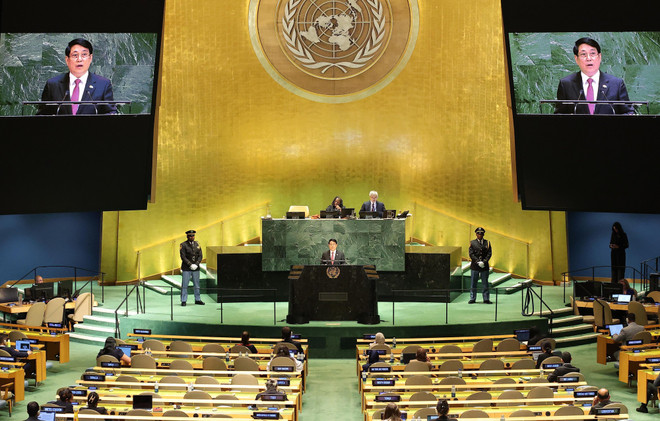
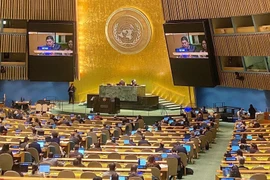
President Luong Cuong speaks at the High-level General Debate of the 80th session of the United Nations General Assembly (UNGA 80) (Photo: VNA)
In his remarks at the General Debate, the Vietnamese State leader underscored the vital importance of peace, describing it as both a goal and a prerequisite for a stable, just, democratic, and prosperous future. He highlighted that “honouring the value of peace and driving transformative changes for a sustainable future” is the heartfelt message Vietnam wishes to convey to the international community on the UN's 80th founding anniversary.
Vietnam has spearheaded many timely and targeted initiatives that have been welcomed and highly appreciated by the UN and the international community. The country has also achieved notable progress in realising the Millennium Development Goals and is actively advancing the 2030 Agenda for Sustainable Development. It has also taken the lead in UN reform, effectively implementing the UN Delivering as One (DaO) initiative and currently among the countries involved in the Just Energy Transition Partnership (JEPT) to address climate change—a major and consistent UN priority. In recent years, it has held key positions in top UN bodies related to peace, security, law, human rights, and culture.
President Cuong also stated that with a strong commitment to being a friend, a reliable partner, and a responsible member of the international community, Vietnam will always exert all-out efforts to work alongside all countries to shoulder shared responsibilities, overcome challenges, and drive transformative change to build a peaceful, stable, prosperous, and sustainable world that ensures well-being for all. This underscores Vietnam’s proactive engagement, demonstrating that the country does not stand aside from global issues but actively contributes and cooperates in line with international law, the UN Charter, and common norms.
His messages linked Vietnam’s national interests with the broader interests of humanity, emphasising that a peaceful, stable, prosperous, and sustainable world also supports the country’s development and the welfare of its people. His remarks at the UN highlighted Vietnam’s proactive role in offering initiatives, fostering dialogue, and building consensus, and advancing collective solutions.
The Washington Times wrote that President Cuong’s speech highlights Vietnam's increasingly prominent role as a “responsible and forward-looking” nation, recognising its remarkable journey from a war-torn country to one deeply integrating into the international community. It said that Vietnam’s flexible yet steadfast foreign policy was lauded for adapting pragmatically while firmly upholding the core principles of the UN Charter and international law, positioning the country as a “reliable guardian” of sovereignty, territorial integrity, and peaceful solutions to disputes.
Commenting on Vietnam’s role and contributions to the UN, UN Secretary-General Antonio Guterres said Vietnam is an active UN member and a pillar of the multipolar world at present, expressing hope that the country will have a stronger voice, representation, and role in the global governance system. Meanwhile, UN Under-Secretary-General Atul Khare perceived that Vietnam has made positively contributed to international peace and security, particularly peacekeeping operations in Africa. Furthermore, it has made certain contributions across all the 17 interconnected UN Sustainable Development Goals.
Among the highlights of the President’s activities in the UN were efforts to promote reconciliatory diplomacy—a deeply humanistic value in Vietnam’s diplomatic tradition. Particularly moving was his meeting with veterans from both sides of the Vietnam War, as well as long-time friends and progressive citizens in the US, serving as a vivid demonstration of gratitude, reconciliation, and the mending of ties between the two former adversaries.
Talking US veterans who used to fight in Vietnam, the President emphasised that the Vietnamese people, guided by compassion and tolerance, have chosen to set aside the painful past to look toward the future. They choose forgiveness without forgetting, trusting that the next generations of Vietnam and the US will jointly build an era of peace, cooperation, development, and mutual respect.
Vietnam contributes to shaping global processes
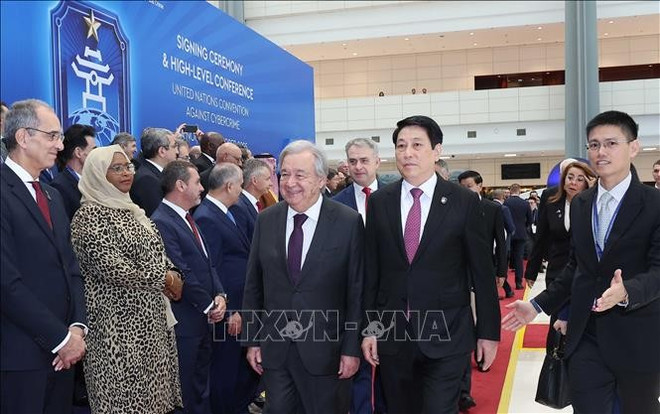
State President Luong Cuong and UN Secretary-General Antonio Guterres at the signing ceremony of the UN Convention against Cybercrime in Hanoi in October 2025 (Photo: VNA)
While New York showcased Vietnam on the global stage, Hanoi highlighted the country’s role as a host and a proactive architect in multilateral diplomacy. The signing ceremony for the UN Concention against Cybercrime was a standout event, marking not only the first inclusive UN treaty in this field but also exemplifying a new-generation foreign policy focused on tangible contributions and universal human values. For the first time in history, a global UN convention on cybercrime was adopted with Hanoi chosen as the venue for its signing ceremony, signalling a milestone in multilateral cooperation and offering an opportunity for Vietnam to illustrate credibility and pioneering role in addressing non-traditional security challenges.
Presiding over the signing ceremony, President Cuong stated that the convention conveys three clear and lasting messages to the world – reaffirming the commitment to shaping order and ensuring safety and security on cyberspace based on international law; promoting a spirit of sharing, cooperation, and mutual support; and emphasising that the ultimate goal of all efforts is the people—using technology to improve lives, foster development, create opportunities for all, and ensure no one is left behind in the global digital transformation.
These three messages reflect the core spirit of the Hanoi Convention, a commitment to the rule of law, cooperation, and the people, he said, adding that this is also the principle Vietnam steadfastly pursues in its international integration—grounded in law, driven by cooperation, and centred on the people as both the focus and ultimate goal of all efforts.
Assessing Vietnam’s role in the event, Dr. Manish Kumar Singh from Delhi University of India said Vietnam’s selection as the host of the signing ceremony marked a historic milestone in the country’s diplomatic and technological development process, reflecting the international community’s confidence in Vietnam’s growing role as a responsible partner in the global digital ecosystem.
The signing ceremony not only reinforces Vietnam’s image as a reliable partner in multilateral relations but also underscores the country’s commitment to jointly addressing one of the most pressing non-traditional security challenges today—cybercrime, he stressed.
Meanwhile, Channel NewsAsia of Singapore noted that for Vietnam, hosting the signing of a major UN multilateral treaty represented an important diplomatic achievement – a clear testament to its rising international stature and its commitment to strengthening global cyber resilience amid increasing attacks on critical infrastructure.
With the participation of over 2,500 delegates from 119 countries and territories, along with representatives from more than 100 international organisations and leading technology companies, the event set a historic milestone in establishing a global legal framework to effectively combat cybercrime.
The official signing of the convention by 72 countries at the ceremony not only reflected trust in the UN’s central role and Vietnam’s commitment and sense of responsibility, but also highlighted the international community’s shared concern over cybercrime. Vietnam’s proactive leadership in global legal processes further demonstrated its resolve and ambition as it enters a new phase of development characterised by independence, self-reliance, deep integration, and sense of responsibility towards the international community.
Promoting cooperation and forward-loking vision
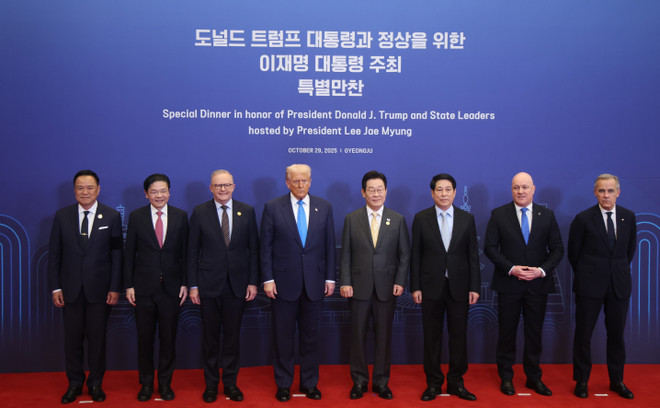
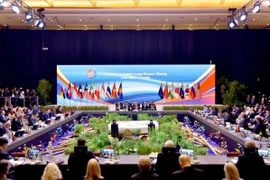
President Luong Cuong (third, right) poses for a group photo with leaders of the Asia-Pacific Economic Cooperation (APEC) economies at the 32nd APEC Economic Leaders' Week in Gyeongju, the Republic of Korea, on October 29, 2025. (Photo: VNA)
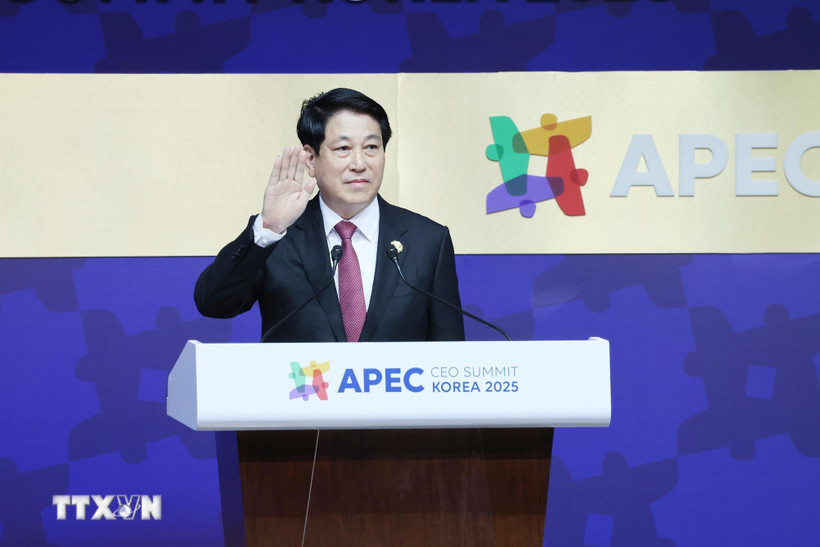
Another highlight of Vietnam’s multilateral diplomacy iss its participation in the 32nd APEC Economic Leaders' Week in Gyeongju, the Republic of Korea, attended by leaders from 21 APEC economies, nearly 2,000 heads of top regional businesses, international organisations, and other guests. President Cuong’s attendance at the event was seen as an important step to carry out the Party and State’s guidelines and foreign policy, particularly the Politburo's Resolution No. 59-NQ/TW on international integration in the new context.
During the event, President Cuong joined fellow APEC leaders to discuss major issues affecting regional cooperation and development, reaching consensus on directions to promote trade, investment, connectivity, science and technology, green and digital transitions, and other key sectors. He clearly outlined Vietnam’s perspectives and approaches to the pressing issues shaping the region’s and the world’s future. He also proposed practical solutions to make APEC cooperation more substantive, effective, and responsive to rapid changes to practically benefit both the region and each APEC member economies.
He put forward strategic and breakthrough proposals to enhance cooperation and strengthen APEC’s role in international economic integration and addressing challenges facing the global community and the Asia-Pacific region. Noting the rapid transformation driven by technological advances and profound social, cultural, and environmental shifts, he suggested five major cooperation directions, including developing a shared strategic vision for innovation ecosystems, leading in digital economy and artificial intelligence governance, and establishing standards and rules necessary for balancing businesses’ development with citizens’ rights, social progress, and equitable opportunities among economies.
The President also emphasised the need for mutual trust and confidence in cooperation to build a dynamic, modern, safe, happy, and prosperous Asia-Pacific region for all its people.
Vietnam’s proactive and responsible approach, its emphasis on multilateralism, solidarity, and international cooperation, along with practical proposals and solutions, played a crucial role in the success of the APEC meetings, thus further enhancing Vietnam’s role and standing within APEC and other multilateral frameworks.
The year 2025 closed on a positive note, with Vietnam’s international prestige rising, bilateral and multilateral relations strengthened, and its role in global forums increasingly prominent. The achievements of 2025 are not just the milestones of a year marking the start of a new era, but also foundational steps for the journey ahead, during which Vietnam continues to demonstrate the mettle, intelligence, and stature of a peace-loving nation aspiring for development and ready to shoulder responsibilities alongside the international community./.