G-bond market equal to over 25 pct of GDP after 10 years

At the end of November, the size of the Government bond (G-bond) market was equal to 25.1 percent of the gross domestic product (GDP) of 2019, rising 12-fold from 2009, data show.
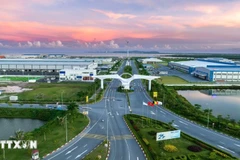
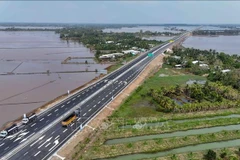
A view of Ha Long – Van Don Expressway. Capital from G-bonds plays an important role in infrastructure development (Photo: VNA)

Hanoi (VNA) – At the end of November, the size of the Government bond (G-bond) market was equal to 25.1 percent of the gross domestic product (GDP) of 2019, rising 12-fold from 2009, data show.

The figure was revealed by Phan Thi Thu Hien, Director of the Department of Banking and Financial Institutions under the Ministry of Finance, during a conference in Hanoi on December 10 that reviewed the 10-year operation and development of the G-bond market.

The market was officially opened in 2009. So far, both the size and liquidity of this market have increased, giving it a crucial role to play to develop the capital market and bond market of Vietnam.

In the first 11 months of this year, the market’s liquidity reached 9,000 trillion VND each trading session, soaring 24 times from 2009, the ministry reported.

The Vietnamese G-bond market has grown at an average rate of 27 percent per year over the past decade, the fastest pace among emerging economies in East Asia, Hien said.

She noted the G-bond market has become an effective channel for mobilising medium and long-term capital for the State budget. The focus on issuing long-term G-bonds has enabled the Government to increase domestic borrowing and reduce foreign loans.

From 2009 to 2019, thanks to G-bond issuance, 1.96 quadrillion VND was mobilised for the State budget, an average of about 175 trillion VND per year.

G-bond market equal to over 25 pct of GDP after 10 years ảnh 1The conference in Hanoi on December 10 reviews the 10-year operation and development of the G-bond market (Photo: VietnamPlus)

Also in this period, 385.15 trillion VND was raised via Government-guaranteed bonds and another 36.92 trillion VND via municipal bonds, respectively equivalent to more than 35 trillion VND and 4.61 trillion VND each year on average.

In recent years, the G-bond channel has made up 75 – 80 percent of the total capital mobilised annually, according to Hien.

Regarding the development plan for 2021 – 2025, the official said the goal for the next five years is to meet the demand to raise capital for socio-economic development as official development assistance (ODA) and preferential loans decrease.

The Government gives priority to optimising internal strength, keeping macro-economic stability and developing sustainably at the same time with accelerating economic growth.

To this end, Vietnam will press on with implementing the road map for developing the bond market in the 2017 – 2020 period, with a vision to 2030, that was approved by the Prime Minister on August 14, 2017.

In particular, for the primary market, the Government needs to connect capital mobilisation via G-bonds with budgetary governance and fund management. For the secondary market, efforts will be made to increase the trading volume of G-bonds, Government-guaranteed bonds and municipal bonds to 1 percent of the listed outstanding bond value in 2020 and to 2 percent by 2030, she noted.

At the same time, she said, market organisation and trading will be improved, shortening the process from issuance to registration, deposit, listing, trading and payment in accordance with the development of Fourth Industrial Revolution to increase liquidity in the secondary market.

Vietnam’s G-bond market will become a safe, effective and highly lucrative investment mechanism for commercial banks, insurance networks, investment funds and foreign investors, Hien stated.

At the conference, Alwaleed Alatabani, Lead Financial Sector Specialist at the World Bank in Vietnam, said that in recent years, the G-bond market has achieved remarkable results. The World Bank highly appreciates the close cooperation of Vietnamese State agencies in the development of the country’s G-bond market.

He recommended that, as the market is growing, it is necessary to expand the network of investors holding G-bonds in order to gradually reduce the dependence on investors from the banking sector.

There is a need for a broader and more diverse legal framework to encourage non-banking investors, including those from insurance, investment funds and foreign investors, to participate in the G-bond market, Alatabani added./.

VNA

See more

Hai Phong targets 4.3 billion USD in FDI in 2026 (Photo: VNA)

Hai Phong city targets 4.3 billion USD in FDI in 2026

Hai Phong’s investment appeal is underpinned by a rapidly expanding development space, including the Southern Coastal Economic Zone covering more than 20,000 hectares, a planned free trade zone, deep-water ports at Lach Huyen, and 12 industrial parks newly established in 2025.

The relocation of check-in counters aims to better meet the travel needs of residents and visitors. (Photo: VNA)

Vietjet shifts domestic check-in at Tan Son Nhat from January 13

During the recent New Year 2026 holiday peak, Vietjet added 380 flights, equivalent to nearly 78,000 additional seats, on many key domestic routes linking Hanoi and Ho Chi Minh City with destinations such as Vinh, Thanh Hoa, Hai Phong, Da Nang, Phu Quoc, Nha Trang and Da Lat.

Commercial banks are providing approximately 88% of total green credit outstanding in Vietnam. (Photo: nhandan.vn)

Capital sources expanded for sustainable growth

According to the State Bank of Vietnam (SBV), by the end of November 2025, outstanding green credit was estimated at around 750 trillion VND (28.55 billion USD), with an average growth rate exceeding that of overall credit in the economy.

Customers select goods at a supermarket. (Photo: VNA)

Retail market expands sharply, sustainability challenges persist

According to a report on recently released by the Ministry of Industry and Trade’s Agency for Domestic Market Surveillance and Development, the size of the market reached more than 7 quadrillion VND (about 266 billion USD) in 2025, up around 10% compared with 2024.

Oil rigs at the Bach Ho oil field. (Photo: VNA)

Resolution 79: State economy to lead growth

Resolution 79 is described as a “clear action declaration” by the Politburo, saying the state economy is not only responsible for maintaining macroeconomic stability, but must also become the force leading a new growth model that is green and sustainable.

Workers at Garment 10 Corporation produce apparel for export. (Photo: Nhan Dan)

Vietnam leverages export advantages within RCEP region

In 2025, seafood exports to China alone exceeded 2.2 billion USD, up about 33% compared to 2024. Shipments to Japan fetched nearly 1.7 billion USD, a year-on-year increase of 14.6%, while those to the Republic of Korea and Australia grew by 9.6% and 3.2%, respectively.

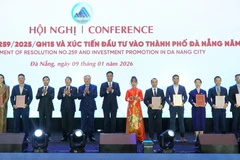
Certificates of membership in the Vietnam International Financial Centre in Da Nang are awarded at the conference on January 9. (Photo: VNA)

Da Nang continues targeted investment promotion approaches

According to Chairman of the Da Nang People’s Committee Pham Duc An, the city prioritises building sustainable economic ecosystems and focuses on key breakthrough sectors with strong spillover effects, including high technology and digital transformation, logistics, urban infrastructure, finance, processing and manufacturing industries, high-tech agriculture, and the pharmaceutical and medicinal herb industry.

In 2025, Hyundai sales reached 53,229 vehicles across the Vietnamese market. (Illustrative photo: Yonhap/VNA)

Hyundai sales in Vietnam rise almost 23% in December

In 2025, sales reached 53,229 vehicles across the market, a result considered a testament to the efforts by TC Group, Hyundai Thanh Cong, and the entire Hyundai dealership network nationwide amidst a volatile market.

Hydroponic vegetable cultivation model at the High-Tech Agricultural Park (Photo daibieunhandan.vn)

HCM City accelerates shift toward ecological urban agriculture

​The city’s agricultural sector is undergoing a strong transformation, restructuring toward higher value-added and sustainable development. In recent years, the sector has maintained steady growth, with agricultural, forestry and fisheries output rising by an estimated 2.5% annually.