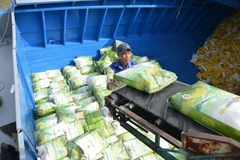
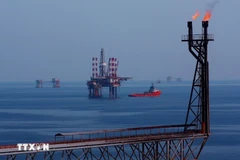
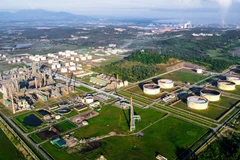
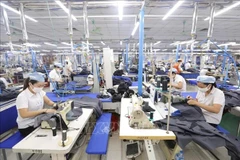
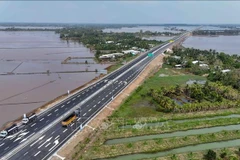
Illustrative image (Photo: VNA)
Hanoi (VNA) - In recent years, Vietnamese banking sector has adjusted its strategies and practices to meet green growth targets. However, the outcomes still fall short of expectation.
While credit policies on risky portfolios such as real estate and securities have been tightened, besides providing manufacturers with preferential loans, a lot of commercial banks have paid heed to projects on hi-tech agriculture, solar power, and environmentally friendly ones, among others.
Commercial banks take bold steps
The bank that most enthusiastically responds to the movement of green credit so far is HDBank with a credit package worth 430 million USD for enterprises operating in hi-tech agriculture and hygienic cultivation; another worth 301 million USD for home-based solar power energy system by the state electricity sector and a credit package worth 129 million USD for renewable energy projects in An Giang, Binh Dinh and Binh Thuan provinces, etc.
The interest rates of the preferential loans are 1% lower than the usual rates. Collaterals are assets formed from the loan with loan rate of 80% and maximum loan term of 10 years.
According to HDBank leaders, the bank also conducts cooperation programmes with supermarket and convenient store chains nationwide, as well as develops export promotion programmes and specialised financial solutions for agricultural enterprises. The movements are expected to help enterprises bring their high-quality products closer to both domestic and foreign consumers.
Nam A Bank is also among pioneers in implementing green credit for sustainable development. The bank has signed a Memorandum of Understanding with the Global Climate Partnership Fund (GCPF) in implementing green credit in Vietnam. Accordingly, the bank will provide medium- and long-term green credit packages for projects on greenhouse emission reduction and cutting down 20% of demand for energy.
Tran Ngoc Tam, General Director of Nam A Bank said environmental protection is a global issue. The bank looks to join hands in developing a green environment and sustainable society through its project ‘I choose living green’. The project aims to raise public awareness on using clean and renewable energy; environmentally friendly and energy-saving technologies. The preferential interest rate for businesses participating in the programme is some 5 – 6% a year.
Besides, many other banks have also turned to clean and renewable energy projects. They include Vietcombank, Agribank and Vietinbank.
According to the State Bank of Vietnam (SBV), 24% of green projects are being verified, 26% banks have developed and deployed an environmental and social risk management procedure on credit package granting, including 100% foreign owned banks such as HSBC and Standard Chartered, among others. Domestic banks also devised and published documents detailing environmental risk management.
According to a representative from Credit Management under the State Bank of Vietnam, green credit debt has been rising significantly. Specifically, green credit debt has increased from only 7.7 billion USD in Quarter IV/2017 to 8.1 billion USD in Quarter I/2018 and 10.1 billion USD in Quarter III/2018.
However, insiders also pointed out difficulties in investing in green sectors, such as long payback period, large investment and high risk.
 Many banks have also turned to clean and renewable energy projects (Photo: VNA)
Obstacles remain
In recent years, Vietnamese banking sector has adjusted its strategies and practices to meet green growth targets. However, the outcomes still fall short of expectation.
Explaining the situation, leader of a commercial bank said investing in green sectors requires long payback period and large investment and high risk, entailing risks of bad debts. Besides, green project evaluation is also a major challenge.
He also said in order to facilitate the development of green credit, the State Bank of Vietnam should not provide credit packages for green projects by using short-term capital to fund medium- and long-term loans and should not offer incentives on re-granting loans and rediscount. Besides, the State Bank of Vietnam is also advised to consider lowering compulsory reserve rate for banks’ capital mobilised for implementing green credit.
Meanwhile, Le Kien Nghi, deputy head of Department for big enterprise segment under the Bank for Investment and Development of Vietnam (BIDV) said that BIDV had been paying heed to providing loans for clean energy projects, such as power and waste treatment projects, etc. As deciding to lend such a clean project, BIDV cares much about environment criteria and assess carefully impacts by the project on the environment. BIDV so far has approved 9 loan applications from wind power and solar power projects.
However according to Nghi, the banks still encounter numerous difficulties in granting green loans, including confusing incentive mechanism, large investment and long payback period. Other banks also share the same problem as their mobilised sources of capital are mostly short- and medium-term, while investment on green project requires long-term capital.
From the side of management authorities, leaders of Credit Department under the SBV said, the central bank will improve legal framework on guiding credit institutions on green credit implementation. At the same time, the Bank also vowed to continue studying and completing a guideline for environmental and social risk assessment for 11 economic sectors, develop centralised solutions to facilitate green credit with environmentally friendly projects. Especially, all resources will be mobilised for effectively implementing green credit.
Finance-banking expert Bui Quang Tin said, development of green credit has been practiced in many countries. The source of capital for developing this form of credit is mostly from policy fund for projects on environment and effective agriculture, etc. Therefore, in order to give green credit a real boost, Vietnamese banks also need assistance from the central bank.
Pham Xuan Hoe. Deputy Director of Banking Strategy Institute under the SBV stressed that Vietnam has been challenged by a lot of environmental problems such as climate change, natural disaster, and pollution. Thus, the country’s growth target in the next two decades is determined to be green and sustainable, aiming at green economy development, instead of fast development.
Hoe also said that one of functions of banking sector, which accounts for 30% of national GDP is to provide capital for the economy. Therefore, it plays an important role in promoting green growth and sustainable development in Vietnam. In order to do that, the central bank has promulgated concrete policies and guidelines. Specifically, SBV Governor has issued a direction and action programmes to promote green growth of the banking sector.-VNA