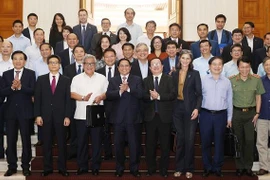
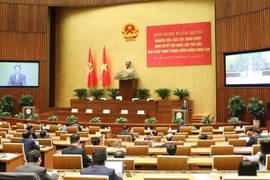
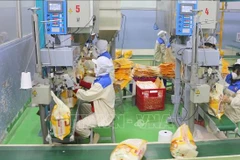
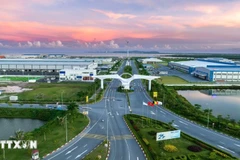
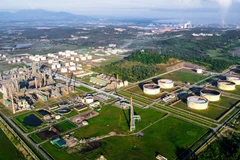
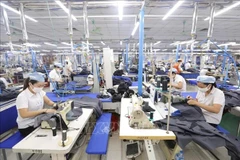
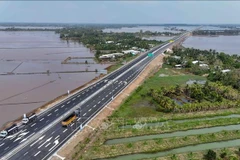
A corner of Hanoi (Photo: VNA)
Hanoi (VNA) - Hanoi capital city is aiming to lead the nation during the industrialisation and modernisation process.
Chairman of the municipal People’s Committee Tran Sy Thanh signed on May 9 a plan to carry out the municipal Party Committee’s February 2 Programme of Action on the implementation of the Party Central Committee’s Resolution No.29, dated November 17, 2022, on continuing to step up Vietnam’s industrialisation and modernisation to 2030, with a vision to 2045.
Building, developing creativity and innovation centres
The plan specifies criteria assessing the implementation of industrialisation and modernisation in the capital city, and defines works associated with specific tasks and responsibilities of each agency, official and Party member in carrying out the action programme.
Specifically, there are a total of 26 criteria, including eight related to economic development, nine on culture development, five on urban development, and four on environmental protection and management.
In terms of building and perfecting relevant mechanisms and policies, the municipal People's Committee assigned the Department of Justice to coordinate with other agencies to accelerate the making of the Law on the Capital City (revised) with the principle of only including specific issues that are typical or not covered by other laws. The city will also study and apply pilot models of public investment - private governance, and private investment - public use. It will improve standards, regulations and technical norms of industries and fields close to the reality and characteristics of the capital city as well as international standards.
The Department of Science and Technology is required to work with relevant agencies to build incentive mechanisms for science - technology development and innovation to encourage enterprises to invest in research and development. The department was also to consult the municipal People's Committee to continue proposing to the upper level on assigning Hanoi to manage Hoa Lac Hi-Tech Park, and build and develop creativity and innovation centres.
Preparing to start work on Belt Road No.5 before 2030
The Hanoi People's Committee also assigned the Department of Industry and Trade to build industries and industrial products that use modern, environmentally friendly technologies with high added value; and give priority to develop concentrated industrial production.
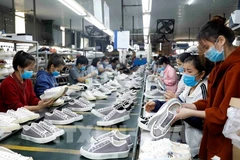
In addition, the city will develop supporting industries in three key areas of manufacturing components and spare parts. These include the textile, leather and footwear sectors, high-tech industries, and several low-carbon industries that use land and resources economically.
By 2025, Hanoi aims to boost the proportion of trained and skilled labour force to 75-80% and keep the urban unemployment rate below 3%. The city also intends to fully digitise its government agencies and establish itself as a smart city while promoting the development of the digital economy and society.
To support national digital transformation, Hanoi plans to nurture technology-based businesses and aid enterprises in researching, developing, and mastering core technologies, digital products, and services. The city will also focus on building modern, integrated infrastructure to support rapid and sustainable urbanisation, which will serve as a strong foundation for industrialisation and modernisation. This involves completing the Belt Road No.4 project before 2027 and preparing for the investment and construction of Belt Road No.5 before 2030.
Hanoi’s plan also aims to achieve a modern, advanced, and eco-friendly public transportation system that caters to 30-35% of the travel demand by 2025 and 45-50% by 2030. The city also intends to shift intake from underground to surface water from the Red River, Da River, and Duong River for a clean water supply to all households.
Another objective is to have three to five urban districts by 2030. The plan emphasises the importance of sustainable development, environmental protection, and cultural preservation in industrialisation.
It is crucial to enhance the efficient utilisation of natural resources, protect the environment, and address climate change during the development process, with the cultural and human values of the Vietnamese people playing a central role in the industrialisation process, stated the plan./.