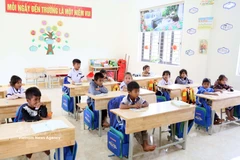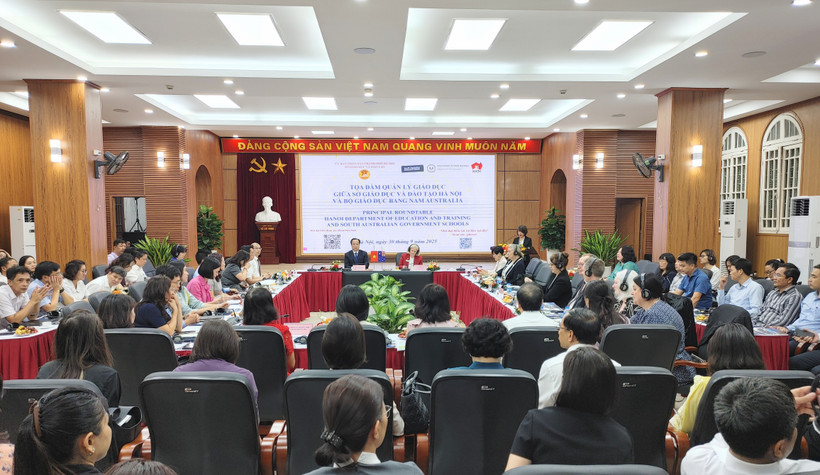
Hanoi (VNA) – As Hanoi is stepping up educational cooperation with international partners, education officials and school representatives from the capital city and South Australia have convened to exchange experiences and explore new directions in adapting to the evolving educational landscape.
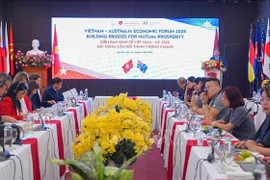
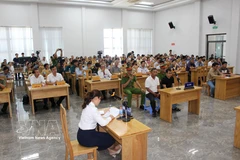
At an education management seminar held on September 30, participants engaged in substantive discussions on educational policies, strategic orientations in the new context and, particularly, the integration of artificial intelligence (AI) in schools, the effective management of smart learning devices, and the cultivation of both digital and soft skills for students.
The seminar also provided a platform for both sides to share pedagogical expertise and compare teaching approaches in Vietnam and South Australia, thereby identifying valuable lessons that could inform efforts to further improve the quality of teaching and learning.
On this occasion, the Hanoi Department of Education and Training and the South Australian Department for Education discussed new opportunities for cooperation, laying the groundwork for closer linkages between schools in Hanoi and South Australia in the years to come.
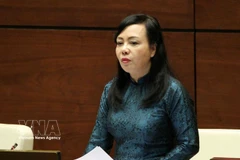
In his remarks, Tran The Cuong, Director of the Hanoi department, underscored the nearly-two-decade-long educational collaboration between Hanoi and South Australia. He characterised the partnership as a successful and exemplary model of international cooperation, which has been continuously cultivated and yielded notable achievements. These positive results, he added, provide a strong foundation for expanding and deepening bilateral ties in education.
With a history of more than 70 years, the city's educational sector currently has nearly 3,000 schools with over 2.3 million students. Alongside general education, Hanoi has also prioritised vocational training, with 29 centres for vocational and continuing education and 352 vocational institutions. According to Cuong, this diversity reflects the capital’s comprehensive approach to human resources development, ensuring that graduates are prepared to meet the demand of various industries and sectors.
The quality of Hanoi’s education has also seen continuous progress in recent years. Local students have consistently demonstrated excellence in both domestic and international academic arenas, securing hundreds of awards at national competitions as well as medals and prizes at prestigious global contests. For the 2024–2025 academic year alone, Hanoi students claimed 200 national awards and 14 international honours, reaffirming the city’s leading position in intellectual achievements.
Notably, Hanoi has the honour to be the host of the 19th International Olympiad on Astronomy and Astrophysics (IOAA) in 2026. This major event highlights Hanoi’s credibility and capability in organising international educational activities.
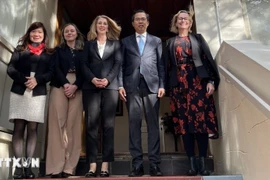
Narelle Slivak, Director of International Education at the South Australian Department for Education, said the event demonstrated the strong determination of both sides to strengthen educational ties, promote academic exchanges, and nurture high-quality human resources. She emphasised that such collaboration forms a bridge of friendship and marks a promising new chapter in the Vietnam – Australia Comprehensive Strategic Partnership.
Slivak further expressed her belief that South Australia’s experience in competency-based learning, creative thinking, and life skills education will offer valuable insights for Hanoi’s education officials, who can adapt and apply these lessons in their own context.
Since the establishment of ties in 2007, the Hanoi Department of Education and Training and the South Australian Department for Education have carried out numerous practical and effective cooperation initiatives, including the signing of memoranda of understanding, joint teacher training programmes, exchanges in pedagogical methods, and collaboration in student assessment and evaluation./.