HCM City, Mekong Delta face serious land subsidence
Land subsidence in Ho Chi Minh City and the Mekong Delta has ranged from 0.1 to 81 centimetres in the last 10 years, according to the Water Resources Management Department at the Ministry of Natural Resources and Environment.
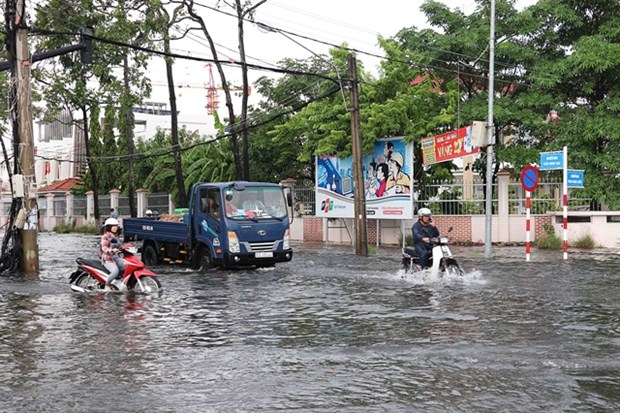 Land subsidence in HCM City and the Mekong Delta has ranged from 0.1 to 81 centimetres in the last 10 years. (Photo: VNA)
Can Tho (VNS/VNA) - Land subsidence in Ho Chi Minh City and the Mekong Delta has ranged from 0.1 to 81 centimetres in the last 10 years, according to the Water Resources Management Department at the Ministry of Natural Resources and Environment.
The figure was reported at a conference on land subsidence in the Mekong Delta, co-organised by the Ministry of Construction and the German Corporation for International Cooperation (GIZ) in Can Tho city last week.
Nguyen Minh Khuyen, Deputy Director of the Water Resources Management Department, said the department had set up 339 monitoring points for recording land subsidence in HCM City and the Mekong Delta in the last 10 years. Of these, 306 points saw land subsidence.
An Lac ward of Binh Tan district in HCM City saw land subsidence of up to 81cm, Bac Lieu province 62.6cm, Soc Trang 53.1cm, and Can Tho 52.4cm.
Experts at the conference said that overexploitation of underground water, rising sea levels, and substandard drainage systems were the main causes of land subsidence.
Data from the department showed that about 1 million cubic metres of underground water are exploited every day in the region.
Dr Philip Minderhoud of Utrecht University in the Netherlands said that land subsidence would improve if local authorities dealt with the overexploitation of underground water. He said that underground water in the Netherlands was used only for emergency situations like serious drought caused by climate change, not for daily use.
Sepehr Eslami Arab of Utrecht University said that land subsidence also caused serious flooding and tides in the rainy season, as well as salinity in the dry season.
In an attempt to curb water overexploitation, the Ministry of Natural Resources and Environment has submitted to the Prime Minister a draft decree to tighten control over construction activities.
The ministry will restrict new construction that would exploit underground water, and review and make adjustments for current works.
The ministry will also build new water systems to provide clean water to rural areas.
The Mekong Delta is home to nearly 18 million people, and is the most important rice and fishing region in the country. HCM City is the largest city in Vietnam, with a population of more than 8 million./.





You should also see
World economy’s recovery drives Vietnam’s exports
With the recovery of the world market and increasing orders, Vietnam's import and export activities in the first quarter of 2024 prospered and achieved positive results.


See more
 Environment
Consultation workshop on Cambodia’s Funan-Techo canal held in Can Tho
The Vietnam National Mekong Committee (VNMC) on April 23 held a consultation workshop on Cambodia’s proposed Funan-Techo canal project which has raised concerns about potential impacts on the Mekong river.
 Environment
Up to 1,000 ban flowers planted at Dien Bien Phu battlefield relic sites
About 1,000 ban (Bauhinia variegate) flower trees were planted at relic sites such as A1 Hill, Him Lam resistance centre and De Castries Bunker at Dien Bien Phu battlefield relic complex in the northern province of Dien Bien on April 21.
 Environment
Vietnam acts to combat white pollution
The Vietnamese Government has issued a lot of policies, participated in various forums, and promoted international cooperation, demonstrating its activeness and affirming its determination to reduce plastic waste and join global efforts toward a planet without white pollution.
 Environment
Can Tho explores climate change cooperation with foreign countries
Leaders of the Mekong Delta city of Can Tho on April 17 met with a visiting delegation from the Embassies of Canada, New Zealand, Norway, and Switzerland to discuss issues related to erosion, climate change, migration, and the city's current needs for support and cooperation.
 Environment
Nghe An: Man captured for illegal wildlife transport
Police in Vinh city, the central province of Nghe An, have captured a suspect involved in the illegal transport of 420 rare wildlife animals, including parrots, kangaroos, turtles, and monkeys.
