Indonesia determined to revamp deteriorating school infrastructure

The initiative is backed by a 16.9 trillion IDR (approximately 1.02 billion USD) budget and seeks to address widespread infrastructure deterioration in the national education system.

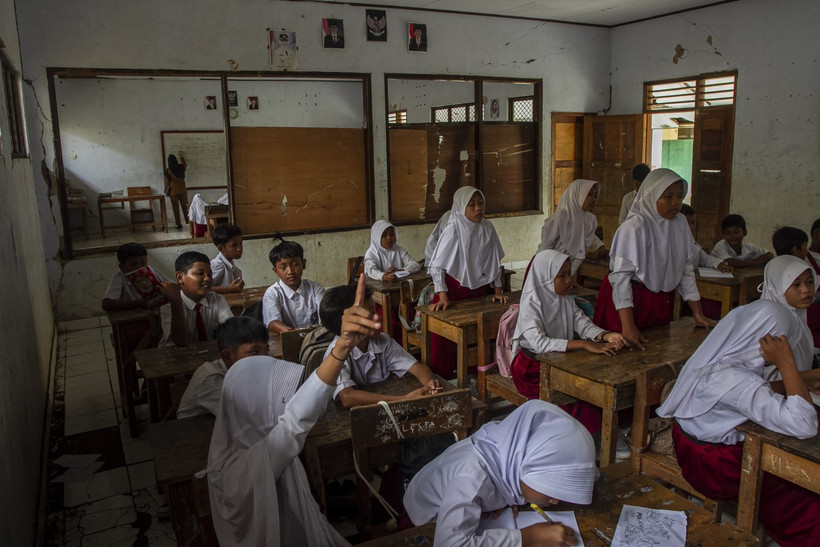
Students participate in classroom activities at the SD Negeri Karangbolong 2 elementary school in Cigeulis, Pandeglang regency, Banten, Indonesia. (Photo: Antara)

Jakarta (VNA) – The Indonesian government has officially begun implementing President Prabowo Subianto’s nationwide school renovation programme, aiming to upgrade more than 10,000 schools across the country in 2025.

The initiative is backed by a 16.9 trillion IDR (approximately 1.02 billion USD) budget and seeks to address widespread infrastructure deterioration in the national education system.

According to the Statistics Indonesia (BPS), many school buildings, particularly primary schools, are in varying states of disrepair. Only 40% of primary school classrooms are in good condition, with nearly 49% moderately damaged and over 10% severely damaged.

This situation is similarly concerning in junior secondary schools, where nearly half of all classrooms are damaged, including 42.1% moderately and 6.63% severely. Vocational and senior high schools report degradation rates of 35% and 38%, respectively.

Speaking on National Education Day (May 2), President Prabowo stated that the 2025 target of renovating 10,440 schools is just a fraction of the actual need. He acknowledged that it could take up to 30 years to repair all schools nationwide, urging for rapid and widespread implementation.

On the same day, Minister of Indonesian Primary and Secondary Education Abdul Mu'ti launched the first renovation project at SD 3 Leuwibatu Elementary School in Bogor.

Observers note that the government’s decisive approach marks a significant shift after years of ineffective renovation efforts and offers hope for long-term improvements in Indonesia’s educational infrastructure./.
VNA

See more

A voter casts her ballot in the general election at a polling station in Yangon, Myanmar. (Photo: Xinhua/VNA)

Myanmar begins second round of general election

This is the first election in Myanmar since the military government assumed power five years ago. A total of 57 political parties are participating in the election, including six parties running nationwide, with around 5,000 candidates vying for seats in the parliament.

A healthcare worker performs a swab test on a patient during influenza symptom screening at a community health centre in Banten, on January 7, 2026. (Photo: antaranews.com)

Indonesia reports first death related to so-called super flu

Yovita Hartantri, head of the New and Re-emerging Infectious Diseases Team at Hasan Sadikin Regional Hospital in Bandung, said the hospital treated 10 patients with influenza A subclade K between September and November last year. The patients exhibited a range of symptoms, with at least three developing severe complications.

Thailand enters technical deflation: Expert

Thailand enters technical deflation: Expert

Associate Professor Thanavath Phonvichai, President of the University of the Thai Chamber of Commerce and Chairman of the Centre for Economic and Business Forecasting, attributed the current bout mainly to lower production costs, particularly cheaper fuel and persistently low agricultural prices.

Indonesia spots four Sumatran tigers at national park

Indonesia spots four Sumatran tigers at national park

Camera traps installed in Bukit Tigapuluh National Park of Indonesia have recorded four individual Sumatran tigers (Panthera tigris sumatrae), providing strong evidence that the conservation area's ecosystem remains well preserved.

Deputy Prime Minister and Agriculture Minister of Thailand Thammanat Prompao (Photo: The Nation)

Agricultural envoys ordered to boost Thai crop exports

Deputy Prime Minister and Agriculture Minister of Thailand Thammanat Prompao said that the ministry is prioritising a “market-led, innovation-supported, higher income” strategy, built on three key pillars: strengthening confidence in core, established markets to protect Thailand’s market share; targeting high-potential products to open new opportunities, including dried seahorses, dried geckos, live crocodiles for consumption, and breeding crocodile parent stock for farming; and expanding networks by deepening cooperation with key trading partners, including China, and widening sales channels, such as digital platforms, so Thai products can reach consumers more directly.