Israel-based expert highly values Vietnam’s foreign policy

Vietnam can contribute to Middle East peace not as a dominant power, but as a nation whose credibility stems from experience rather than coercion. Its post-war reconstruction, transforming a war-torn country into a developing nation integrated into the global economy, offers valuable lessons in rebuilding infrastructure, restoring social cohesion, and prioritising human development.

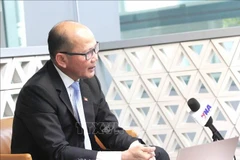
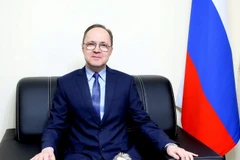
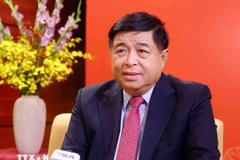
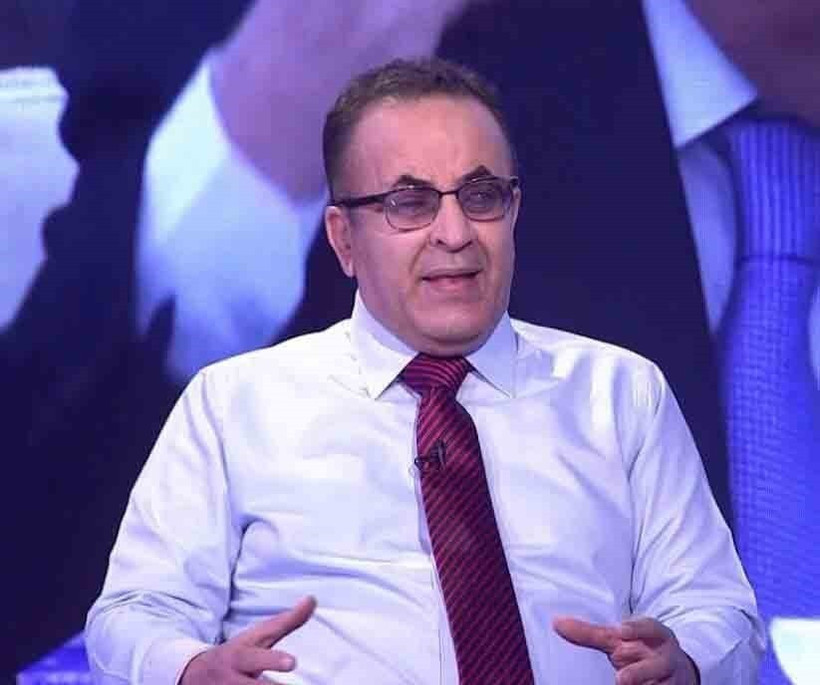
Dr. Khaled Khalifa, President of the Arab Council for Foreign Relations in Israel (Photo: VNA)

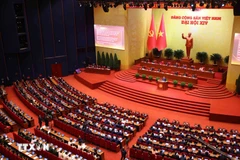
Tel Aviv (VNA) – On the occasion of the 14th National Congress of the Communist Party of Vietnam (CPV), Dr. Khaled Khalifa, President of the Arab Council for Foreign Relations in Israel, has shared his views on Vietnam’s global role and standing, as well as its prospects for cooperation and contributions in regions affected by conflict.

According to him, Vietnam’s foreign policy of independence, self-reliance, and proactive multilateral diplomacy represents one of the most principled and respected models in contemporary international relations. Rooted in its own long struggle against colonialism and foreign occupation, Vietnam has consistently demonstrated that sovereignty, dignity, and peace can coexist with openness, dialogue, and global engagement. This approach, reaffirmed by the CPV’s 14th National Congress, enables the country to act as a “credible, balanced, and trusted international actor, particularly in regions affected by prolonged conflict,” he affirmed.

The expert assessed that Vietnam’s insistence on strategic autonomy allows it to engage constructively with all parties without becoming subordinate to any power bloc, which is especially valuable in today’s fragmented global environment, where polarisation often undermines peace efforts. The country’s multilateral diplomacy, through ASEAN, the United Nations, and South–South cooperation, emphasises dialogue over confrontation and political solutions over military dominance. These principles are deeply relevant to conflict zones where decades of violence have eroded trust and stability.

According to the President of the Arab Council for Foreign Relations in Israel, Vietnam can contribute to Middle East peace not as a dominant power, but as a nation whose credibility stems from experience rather than coercion. Its post-war reconstruction, transforming a war-torn country into a developing nation integrated into the global economy, offers valuable lessons in rebuilding infrastructure, restoring social cohesion, and prioritising human development.

In addition, Khaled Khalifa proposed Vietnam step up dialogue and confidence-building among Arab, Israeli and international communities through political, economic and humanitarian initiatives. He suggested expanding cooperation, including the appointment of an Honorary Consul of Vietnam in Israel, to strengthen ties with Arab communities and reaffirm the country’s longstanding solidarity with just causes around the world./.

VNA
See more

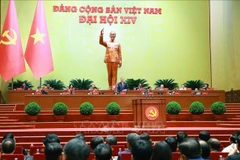
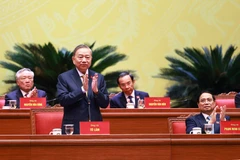
General Secretary of the 13th Central Committee of the Communist Party of Vietnam To Lam addresses the 14th National Party Congress. (Photo: VNA)

List of members of 14th Party Central Committee announced

The 14th National Congress of the Communist Party of Vietnam on January 22 afternoon announced the results and approved the list of 200 newly-elected members of the 14th Party Central Committee, including 180 official members and 20 alternate members.

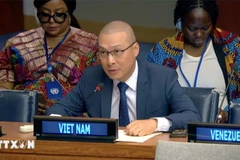
Minister-Counsellor Nguyen Hoang Nguyen, Chargé d’Affaires ad interim of the Permanent Mission of Vietnam to the UN, addresses the session. (Photo: VNA)

Vietnam supports UN Security Council’s substantive reform

Minister-Counsellor Nguyen Hoang Nguyen, Chargé d’Affaires ad interim of the Permanent Mission of Vietnam to the UN, reaffirmed Vietnam’s strong commitment to multilateralism and to the UN’s central role in maintaining international peace and security.

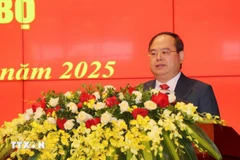
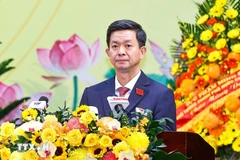
Quan Minh Cuong, Secretary of the Quang Ninh Party Committee and head of the province's delegation to the ongoing 14th National Congress of the Communist Party of Vietnam. (Photo: VNA)

Quang Ninh confident of key economic locomotive role: provincial Party leader

Since the very first days of 2026, the province has focused on leading and directing the synchronous implementation of key tasks aligned with its annual theme of "making breakthroughs in economic growth and improving urban quality towards early attainment of the criteria for centrally governed city status".

Milan Krajca, Chairman of the Czech Peace Movement and a member of the Communist Party of Bohemia and Moravia (KSČM) speaks to a Vietnam News Agency (VNA) correspondent in Prague. (Photo: VNA)

14th National Party Congress – milestone shaping brighter future for Vietnam

Vietnam is not only an integral part of but also a frontrunner in the dynamic development process of East and Southeast Asia, having recorded highly impressive progress over recent decades, said Milan Krajca, Chairman of the Czech Peace Movement and a member of the Communist Party of Bohemia and Moravia (KSČM).

Deputy Prime Minister Nguyen Chi Dung (Photo: VNA)

Deputy PM affirms resolve to build clean, strong Government’s Party Organisation

The Government Party Committee urged all subordinate Party committees, organisations, officials, and members throughout its structure to unite closely, act with shared resolve, bolster self-reliance and confidence, embrace proactive renewal and innovation, and pursue decisive breakthroughs, with unwavering commitment to forging a thoroughly clean and strong Party Organisation within the Government

Pallab Sengupta, President of the World Peace Council. (Photo: VNA)

14th National Party Congress: Vietnam - positive factor for peace, sustainable development

Pallab Sengupta, President of the World Peace Council, described the four decades of renewal as a historic success that vividly reflects Vietnam’s independent, people-centred development path. From a war-ravaged and impoverished nation, Vietnam has risen to become a country with political stability and rapid growth, recording remarkable achievements in poverty reduction, social welfare, education and healthcare, while firmly safeguarding political independence and social cohesion.